Kirjojen hintavertailu – 12 903 725 kirjaa ja 27 kauppaa

Kirjailija

Frank J. Swetz

Kirjat ja teokset yhdessä paikassa: 7 kirjaa, julkaisuja vuosilta 1977–2020, suosituimpiin kuuluu Capitalism and Arithmetic. Vertaile teosten hintoja ja tarkista saatavuus suomalaisista kirjakaupoista.

Nimi esiintyy myös muodoissa: Frank J Swetz

7 kirjaa

Kirjojen julkaisuvuodet: 1977–2020.

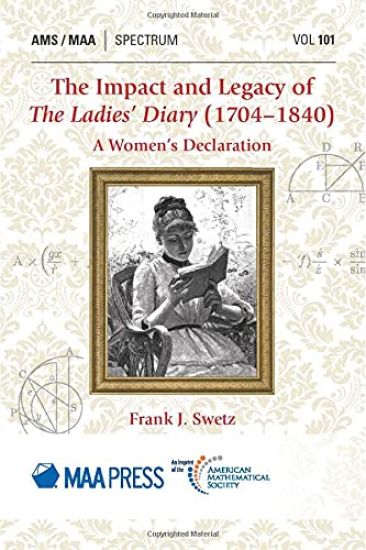
Impact and Legacy of The Ladies' Diary (1704-1840)

Impact and Legacy of The Ladies' Diary (1704-1840)

Frank J. Swetz

AMERICAN MATHEMATICAL SOCIETY
2020
pokkari
The Ladies' Diary was an almanac published in England from 1704 to 1840. Its subtitle reveals its purpose, Containing New Improvements in Arts and Sciences, and Many Entertaining Particulars: Designed for the Use and Diversion of the Fair Sex. This book unearths the story of the Diary's creation and of the community of people surrounding it.
Mathematical Expeditions

Mathematical Expeditions

Frank J. Swetz

Johns Hopkins University Press
2012
sidottu
A little bucket, one-third full, is 8 inches deep, and its upper and lower diameters are 7 inches and 6 inches, respectively. How large is the frog which, jumping into the bucket, causes the water to rise 3 inches? Word problems not unlike this example are a staple on math tests and of abiding interest to students, teachers, and professional mathematicians alike. Frank Swetz, a highly regarded mathematics educator, gathers hundreds of these problems in this fun and fascinating introduction to mathematics from around the world. "Mathematical Expeditions" is a collection of over 500 culturally and historically diverse mathematical problems carefully chosen to enrich mathematics teaching from middle school through the college level. What better way to teach students the multicultural aspects of math than by assigning them problems first composed on clay tablets by Babylonian scribes, included in the Rhind papyrus, or Vedic problems scratched on tree bark? From Egypt to Greece to China to India, Swetz's problems - both practical and abstract - span centuries and cultures. Swetz has organized the problems by culture and historical period, showing, through the various constructs and contexts of the problems, the history and development of mathematics throughout the world. Along the way, he tells us what various cultures knew about math and how they came to learn it, providing instructors with a wonderful way to incorporate multicultural mathematics into the middle school, high school, and college classroom.
Mathematical Expeditions

Mathematical Expeditions

Frank J. Swetz

Johns Hopkins University Press
2012
pokkari
A little bucket, one-third full, is 8 inches deep, and its upper and lower diameters are 7 inches and 6 inches, respectively. How large is the frog which, jumping into the bucket, causes the water to rise 3 inches? Word problems not unlike this example are a staple on math tests and of abiding interest to students, teachers, and professional mathematicians alike. Frank Swetz, a highly regarded mathematics educator, gathers hundreds of these problems in this fun and fascinating introduction to mathematics from around the world. "Mathematical Expeditions" is a collection of over 500 culturally and historically diverse mathematical problems carefully chosen to enrich mathematics teaching from middle school through the college level. What better way to teach students the multicultural aspects of math than by assigning them problems first composed on clay tablets by Babylonian scribes, included in the Rhind papyrus, or Vedic problems scratched on tree bark? From Egypt to Greece to China to India, Swetz's problems - both practical and abstract - span centuries and cultures. Swetz has organized the problems by culture and historical period, showing, through the various constructs and contexts of the problems, the history and development of mathematics throughout the world. Along the way, he tells us what various cultures knew about math and how they came to learn it, providing instructors with a wonderful way to incorporate multicultural mathematics into the middle school, high school, and college classroom.
The Seasons of America Past

The Seasons of America Past

Eric Sloane; Frank J Swetz

Dover Publications Inc.
2005
nidottu
From kites and marbles, "sugaring time," and strawberry picking in the spring, to the weeding season in summer, the fall harvest, and cider-making, this charming book takes readers through a full year's activities. The author's drawings depict cider mills and presses, sleds, pumps, stump-pulling equipment, plows, and other elements of America's rural heritage. A section of old recipes and household hints adds additional color and practical value to this delightful book. 75 black-and-white illustrations; four in color on the covers.
Capitalism and Arithmetic

Capitalism and Arithmetic

Frank J. Swetz

Open Court Publishing Co ,U.S.
1999
pokkari
"In Mr. Swetz's learned and engrossing commentary on the text, you can find facts that will impress your boss and amaze your friends, such as the mathematical origins of the words 'counter, ' 'banks, ' and 'digits.' The rich historical details support a compelling account of how mercantile capitalism in the Venetian republic of the early Renaissance crucially influenced the evolution of mathematics and how mathematics helped the rise of capitalism." --Wall Street Journal
The Sea Island Mathematical Manual

The Sea Island Mathematical Manual

Frank J. Swetz

Pennsylvania State University Press
1992
pokkari
The Haidao Suanjing or Sea Island Mathematical Manual, is one of the "Ten Classics" of traditional Chinese mathematics, and its contents demonstrate the high standards of theoretical and mathematical sophistication present in early Chinese surveying theory. The Haidao composed in A. D. 263 by Liu Hui, established the mathematical procedures for much of East Asian surveying activity for the next one thousand years. The contents of the Haidao also testify to the ability of the Chinese to systematize mathematics and hint at the use of proof in Chinese mathematics, a concept usually associated with Greek mathematical thought. Frank Swetz provides an annotated translation of the Haidao and an analysis of its surveying problems. In particular, he details surveying techniques and undertakes a mathematical exposition of the Chinese chong cha solution procedures. The Haidao is a testimony to the ingenuity and skill of China's early surveyors and its author, Liu Hui. This study complements and extends the findings of Swetz's previous book, Was Pythagoras Chinese? An Examination of Right Triangle Theory in Ancient China.
Was Pythagoras Chinese?

Was Pythagoras Chinese?

Frank J. Swetz; T. I. Kao

Pennsylvania State University Press
1977
pokkari
The title of this monograph, while intended to intrigue and attract the otherwise unresponsive reader, is not whimsically conceived. Of course, the historical figure of mathematical fame known as Pythagoras, born on the island of Samos in the 6th century B. C., was Greek, not Chinese. But there is another "Pythagoras" equally deserving fame. He is the man who first proved the proposition that "the sum of the squares of the legs of a right triangle is equal to the square of the hypotenuse." For hundreds of years this theorem has borne the name of Pythagoras of Samos, but was he really the first person to demonstrate the universal validity of this theorem? The issue is controversial. Seldom are mathematical discoveries the product of a single individual's genius. Often centuries and thousands of miles separate the appearance and the isolated reappearance of the same mathematical or scientific theory. It is now acknowledged that the "Pascal Triangle" method of determining the coefficients of a binomial expansion was known in Sung China 300 years before Pascal was born, and that the root extraction algorithm credited to the 19th-century British mathematician W. G. Homer was employed by Han mathematicians of the 3rd century A. D. If, then, these mathematical processes are to bear the names of the persons who devised them, surely "Pascal" and "Homer" were Chinese. So too might such an argument be posed for the Pythagorean Theorem on the basis of evidence contained in ancient Chinese mathematics texts. It is the purpose of this monograph to present and examine this evidence. This is a joint publication of the Penn State Press and the National Council of Teachers of Mathematics. Penn State Study No. 40