Kirjojen hintavertailu – 12 903 724 kirjaa ja 27 kauppaa

Kirjailija

Frank L. Lewis

Kirjat ja teokset yhdessä paikassa: 24 kirjaa, julkaisuja vuosilta 1998–2025, suosituimpiin kuuluu Robot Manipulator Control. Vertaile teosten hintoja ja tarkista saatavuus suomalaisista kirjakaupoista.

Nimi esiintyy myös muodoissa: Frank L Lewis

24 kirjaa

Kirjojen julkaisuvuodet: 1998–2025.

Nonlinear H2/H-Infinity Constrained Feedback Control

Nonlinear H2/H-Infinity Constrained Feedback Control

Murad Abu-Khalaf; Jie Huang; Frank L. Lewis

Springer London Ltd
2006
sidottu
The series Advances in Industrial Control aims to report and encourage technology transfer in control engineering. The rapid development of control technology has an impact on all areas of the control discipline. New theory, new controllers, actuators, sensors, new industrial processes, computer methods, new applications, new philosophies , new challenges. Much of this development work resides in industrial reports, feasibility study papers and the reports of advanced collaborative projects. The series offers an opportunity for researchers to present an extended exposition of such new work in all aspects of industrial control for wider and rapid dissemination. Almost all physical systems are nonlinear and the success of linear control techniques depends on the extent of the nonlinear system behaviour and the careful attention given to switching linear controllers through the range of nonlinear system operations. In many industrial and process-control applications, good engineering practice, linear control systems and classical PID control can give satisfactory performance because the process nonlinearity is mild and the control system performance specification is not particularly demanding; however, there are other industrial system applications where the requirement for high-performance control can only be achieved if nonlinear control design techniques are used. Thus, in some industrial and technological domains there is a strong justification for more applications of nonlinear methods. One prevailing difficulty with nonlinear control methods is that they are not so easily understood nor are they easy to reduce to formulaic algorithms for routine application.
Manufacturing Systems Control Design

Manufacturing Systems Control Design

Stjepan Bogdan; Frank L. Lewis; Zdenko Kovacic; Jose Mireles

Springer London Ltd
2006
sidottu
The series Advances in Industrial Control aims to report and encourage technology transfer in control engineering. The rapid development of control technology has an impact on all areas of the control discipline. New theory, new controllers, actuators, sensors, new industrial processes, computer methods, new applications, new philosophies , new challenges. Much of this development work resides in industrial reports, feasibility study papers and the reports of advanced collaborative projects. The series offers an opportunity for researchers to present an extended exposition of such new work in all aspects of industrial control for wider and rapid dissemination. In some areas of manufacturing, the elements of a flexible manufacturing system form the key components of the process line. These key components are four-fold: a set of programmable robots and machines, an automated materia- handling system that allows parts to be freely routed and re-routed, a buffer storage system where parts and partly-assembled components can wait until required for further processing and assembly and finally, a supervisory control system. The technology employed to coordinate and control all these components as a working system is usually based on programmable logic controllers. The use of this automation hardware and software in manufacturing is designed to yield significant cost reductions and to enhance quality.
Neuro-Fuzzy Control of Industrial Systems With Actuator Nonlinearities

Neuro-Fuzzy Control of Industrial Systems With Actuator Nonlinearities

Frank L. Lewis; Javier Campos; Rastko Selmic

Society for Industrial Applied Mathematics,U.S.
2001
sidottu
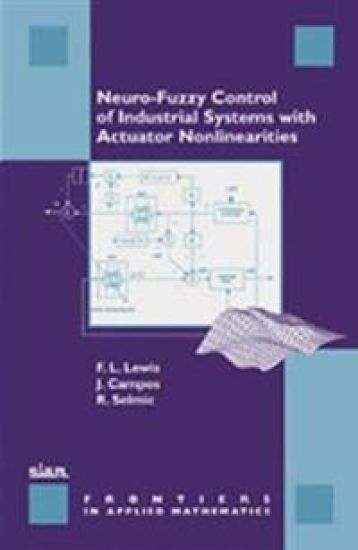
Neural networks and fuzzy systems are model free control design approaches that represent an advantage over classical control when dealing with complicated nonlinear actuator dynamics. This book brings neural networks and fuzzy logic together with dynamical control systems. Each chapter presents powerful control approaches for the design of intelligent controllers to compensate for actuator nonlinearities such as time delay, friction, deadzone, and backlash that can be found in all industrial motion systems, plus a thorough development, rigorous stability proofs, and simulation examples for each design. In the final chapter, the authors develop a framework to implement intelligent control schemes on actual systems. Rigorous stability proofs are further verified by computer simulations, and appendices contain the computer code needed to build intelligent controllers for real-time applications. Neural networks capture the parallel processing and learning capabilities of biological nervous systems, and fuzzy logic captures the decision-making capabilities of human linguistics and cognitive systems.
High-level Feedback Control With Neural Networks

High-level Feedback Control With Neural Networks

Young Ho Kim; Frank L Lewis

World Scientific Publishing Co Pte Ltd
1998
sidottu
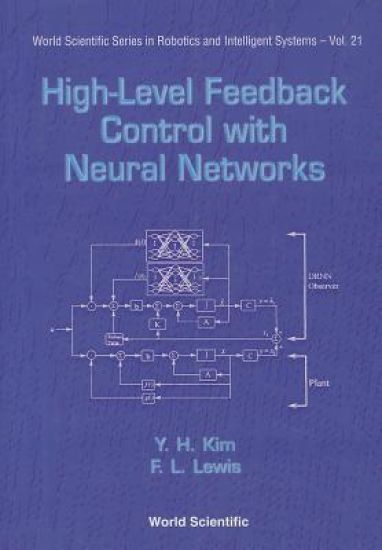
Complex industrial or robotic systems with uncertainty and disturbances are difficult to control. As system uncertainty or performance requirements increase, it becomes necessary to augment traditional feedback controllers with additional feedback loops that effectively “add intelligence” to the system. Some theories of artificial intelligence (AI) are now showing how complex machine systems should mimic human cognitive and biological processes to improve their capabilities for dealing with uncertainty. This book bridges the gap between feedback control and AI. It provides design techniques for “high-level” neural-network feedback-control topologies that contain servo-level feedback-control loops as well as AI decision and training at the higher levels. Several advanced feedback topologies containing neural networks are presented, including “dynamic output feedback”, “reinforcement learning” and “optimal design”, as well as a “fuzzy-logic reinforcement” controller. The control topologies are intuitive, yet are derived using sound mathematical principles where proofs of stability are given so that closed-loop performance can be relied upon in using these control systems. Computer-simulation examples are given to illustrate the performance.