Kirjojen hintavertailu – 12 903 724 kirjaa ja 27 kauppaa
Kirjailija
Frank M. Dattilio
Kirjat ja teokset yhdessä paikassa: 8 kirjaa, julkaisuja vuosilta 2009–2019, suosituimpiin kuuluu The Therapeutic Relationship in Cognitive-Behavioral Therapy. Vertaile teosten hintoja ja tarkista saatavuus suomalaisista kirjakaupoista.
Dit boek laat zien hoe de therapeutische relatie in de cognitieve gedragstherapie (CGT) kan worden ingezet om verandering te weeg te brengen. Het beschrijft onder andere hoe casusconceptualisatie gebruikt kan worden om te beslissen wanneer relatieproblemen moeten worden aangepakt, welke specifieke strategie n moeten worden gebruikt (bijvoorbeeld het uiten van empathie of het vragen van feedback aan cli nten) en hoe therapeuten kunnen omgaan met hun eigen emotionele reacties tijdens een therapiesessie. De therapeutische relatie bij cognitieve gedragstherapie legt daarnaast uit hoe samenwerking, empirisme en de socratische dialoog kunnen worden versterkt en de resultaten kunnen worden verbeterd. Speciale onderwerpen die aan bod komen zijn onder andere het verbeteren van de therapeutische relatie bij paren, gezinnen, groepen, kinderen en adolescenten. De therapeutische relatie bij cognitieve gedragstherapie is toegankelijk geschreven, biedt praktische klinische aanbevelingen, veel casu stiek, werkbladen en een groot aantal oefeningen.
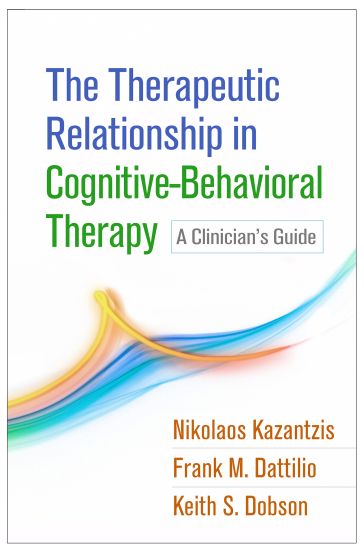
From leading cognitive-behavioral therapy (CBT) experts, this book describes ways to tailor empirically supported relationship factors that can strengthen collaboration, empiricism, and Socratic dialogue and improve outcomes. In an accessible style, it provides practical clinical recommendations accompanied by rich case examples and self-reflection exercises. The book shows how to use a strong case conceptualization to decide when to target relationship issues, what specific strategies to use (for example, expressing empathy or requesting client feedback), and how to navigate the therapist's own emotional responses in session. Special topics include enhancing the therapeutic relationship with couples, families, groups, and children and adolescents. Reproducible worksheets can be downloaded and printed in a convenient 8 1/2" x 11" size. See also Doing CBT, Second Edition, by David F. Tolin, which lucidly explains the full range of CBT techniques, and Experiencing CBT from the Inside Out, by James Bennett-Levy, Richard Thwaites, Beverly Haarhoff, and Helen Perry, a unique self-practice/self-reflection workbook.
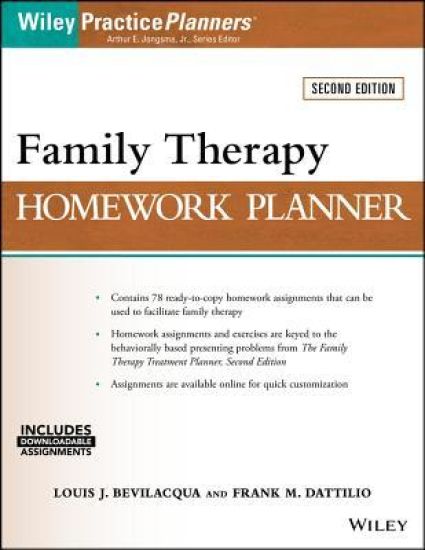
Contains 78 ready-to-copy homework assignments that can be used to facilitate family therapyHomework assignments and exercises are keyed to the behaviorally based presenting problems from The Family Therapy Treatment Planner, Second EditionAssignments are available online for quick customization Features new and updated assignments and exercises to meet the changing needs of mental health professionals The Family Therapy Homework Planner, Second Edition provides you with an array of ready-to-use, between- session assignments designed to fit virtually every therapeutic mode. This easy-to-use sourcebook features: New and updated homework assignments consistent with evidence-based therapies and grouped by presenting problems including adoption, communication issues, interracial family problems, sexual abuse, and school concerns78 ready-to-copy exercises covering the most common issues encountered by families in therapy, such as family-of-origin interference, depression in family members, divorce, financial conflict, adolescent and parent conflicts, traumatic life events, and dependency issuesExpert guidance on how and when to make the most efficient use of the exercisesAssignments that are cross-referenced to The Family Therapy Treatment Planner, Second Edition—so you can quickly identify the right exercise for a given situation or problemAll exercises are available online for you to download and customize to suit you and your clients' unique styles and needs For more information on our Practice Planners products, including our full line of Treatment Planners, visit us on the Web at www.wiley.com/practiceplanners
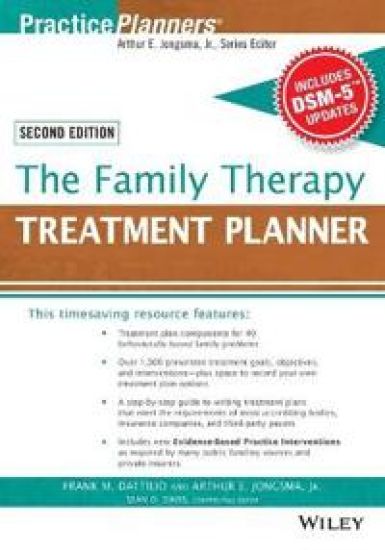
This timesaving resource features: Treatment plan components for 40 behaviorally based presenting problemsOver 1,000 prewritten treatment goals, objectives, and interventions?plus space to record your own treatment plan optionsA step-by-step guide to writing treatment plans that meet the requirements of most accrediting bodies, insurance companies, and third-party payorsIncludes new Evidence-Based Practice Interventions as required by many public funding sources and private insurers PracticePlanners® THE BESTSELLING TREATMENT PLANNING SYSTEM FOR MENTAL HEALTH PROFESSIONALS The Family Therapy Treatment Planner, Second Edition provides all the elements necessary to quickly and easily develop formal treatment plans that satisfy the demands of HMOs, managed care companies, third-party payors, and state and federal agencies. New edition features empirically supported, evidence-based treatment interventionsOrganized around 40 main presenting problems including child/parent conflicts, depression, abuse, death and loss issues, blended family problems, and loss of family cohesionOver 1,000 prewritten treatment goals, objectives, and interventions?plus space to record your own treatment plan optionsEasy-to-use reference format helps locate treatment plan components by behavioral problemDesigned to correspond with The Family Therapy Progress Notes Planner, Second Edition and the Brief Family Therapy Homework Planner, Second EditionIncludes a sample treatment plan that conforms to the requirements of most third-party payors and accrediting agencies including CARF, The Joint Commission (TJC), COA, and the NCQA Additional resources in the PracticePlanners® series: Progress Notes Planners contain complete, prewritten progress notes for each presenting problem in the companion Treatment Planners. Homework Planners feature behaviorally based, ready-to-use assignments to speed treatment and keep clients engaged between sessions. For more information on our PracticePlanners®, including our full line of Treatment Planners, visit us on the Web at: www.wiley.com/practiceplanners
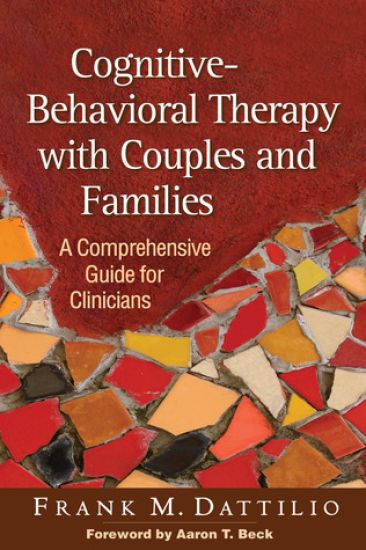
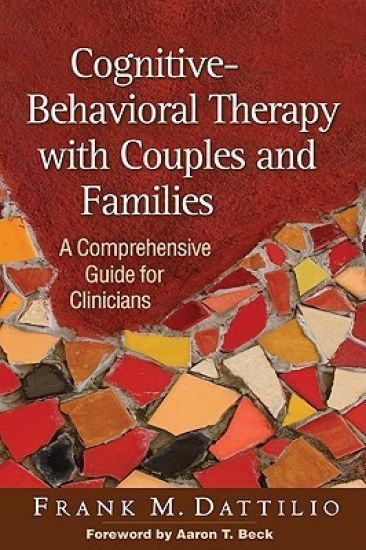
From a leading expert in cognitive-behavioral therapy and couple and family therapy, this comprehensive guide combines research and clinical wisdom. The author shows how therapeutic techniques originally designed for individuals have been successfully adapted for couples and families struggling with a wide range of relationship problems and stressful life transitions. Vivid clinical examples illustrate the process of conducting thorough assessments, implementing carefully planned cognitive and behavioral interventions, and overcoming roadblocks. Used as a practitioner resource and text worldwide, the book highlights ways to enhance treatment by drawing on current knowledge about relationship dynamics, attachment, and neurobiology. Cultural diversity issues are woven throughout. See also Dattilio's edited volume, Case Studies in Couple and Family Therapy, which features case presentations from distinguished practitioners plus commentary from Dattilio on how to integrate systemic and cognitive perspectives.
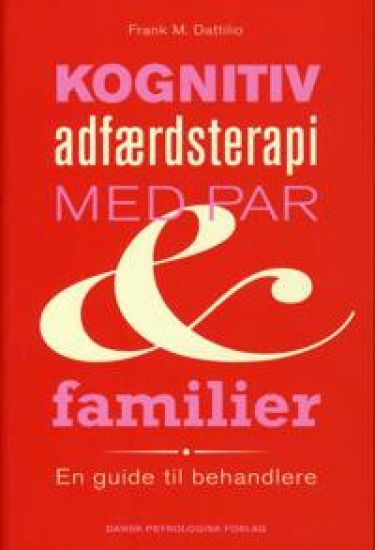
En omfattende, up-to-date og praktisk guide til kognitiv adfærdsterapi med dysfunktionelle familier og par. Bogen fokuserer på kognitiv adfærdsterapi, men inddrager også andre behandlingsformer, teorier og emneområder som fx neurobiologi, tilknytningsteori, ACT, mindfulness, emotionalitet og skematerapi samt metoder til assessment og intervention. Indeholder et stort antal kliniske caseeksempler. Henvender sig til psykologer, psykoterapeuter og andre professionelle, som beskæftiger sig med par og familier.
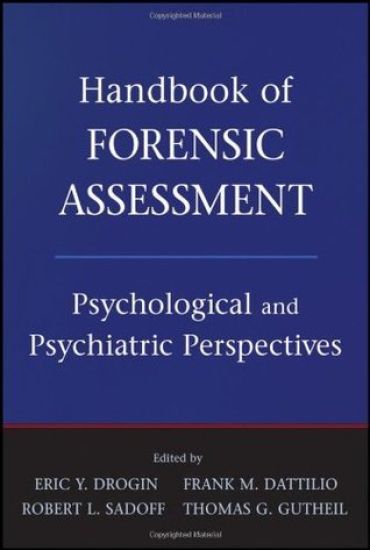
The first handbook to explore forensic assessment from psychiatric and psychological perspectives "The editors have assembled a magnificent collaboration between psychiatrists and psychologists to bring forth critical knowledge and insight to the core competency of forensic assessment. This handbook is essential reading and a comprehensive resource for both newly minted and seasoned forensic practitioners." —Robert I. Simon, MD, Director, Program in Psychiatry and Law, Georgetown University School of Medicine "This long-awaited resource blows the dust off traditional standards, shakes the cobwebs out of our old ways of thinking, and shows the practical steps in producing work that will make sense to juries and withstand the most skillful cross-examination. . . . [T]here is no better resource." —Kenneth S. Pope, PhD, ABPP, Diplomate in Clinical Psychology; coauthor, Ethics in Psychotherapy and Counseling, Fourth Edition "From preparation to collection to interpretation to communication of the results, this excellent, comprehensive treasure shows how to conduct forensic assessments. Each splendid evidence-based chapter is presented from the collaboration between psychologists and psychiatrists. It is a must-have resource for forensic experts as well as general practitioners or anyone wishing to understand standard of care in forensic assessment." —Melba Vasquez, PhD, ABPP, 2011 American Psychological Association President The practitioner-oriented coverage in the Handbook of Forensic Assessment examines: The current state of psychology and psychiatry—including requisite clinical competencies, ethical guidelines, and considerations of multidisciplinary collaboration Various approaches to assessments in criminal and civil matters The principles of effective preparation, data collection, and interpretation, as well as communication for each special situation Topics including competence to stand trial, sexual offender evaluations, addictions, child abuse, and education Overarching practice issues, such as practice development, retention, compensation, consultation, and forensic treatment Includes sample reports that demonstrate the integrative potential of both psychology and psychiatry Incorporating a wealth of current and multidisciplinary research, the Handbook of Forensic Assessment is destined to become every mental health professional's most valuable one-stop reference for their forensic work.
From a leading expert in cognitive-behavioral therapy and couple and family therapy, this comprehensive guide combines research and clinical wisdom. The author shows how therapeutic techniques originally designed for individuals have been successfully adapted for couples and families struggling with a wide range of relationship problems and stressful life transitions. Vivid clinical examples illustrate the process of conducting thorough assessments, implementing carefully planned cognitive and behavioral interventions, and overcoming roadblocks. Read and used by clinicians worldwide, the book highlights ways to enhance treatment by drawing on current knowledge about relationship dynamics, attachment, and neurobiology. Cultural diversity issues are woven throughout. See also Dattilio's edited volume, Case Studies in Couple and Family Therapy, which features case presentations from distinguished practitioners plus commentary from Dattilio on how to integrate systemic and cognitive perspectives.