Kirjojen hintavertailu – 12 903 732 kirjaa ja 27 kauppaa

Kirjailija

Frank R. Baumgartner

Kirjat ja teokset yhdessä paikassa: 15 kirjaa, julkaisuja vuosilta 1998–2021, suosituimpiin kuuluu Suspect Citizens. Vertaile teosten hintoja ja tarkista saatavuus suomalaisista kirjakaupoista.

15 kirjaa

Kirjojen julkaisuvuodet: 1998–2021.

The Dynamics of Public Opinion

The Dynamics of Public Opinion

Mary Layton Atkinson; K. Elizabeth Coggins; James A. Stimson; Frank R. Baumgartner

Cambridge University Press
2021
sidottu
A central question in political representation is whether government responds to the people. To understand that, we need to know what the government is doing, and what the people think of it. We seek to understand a key question necessary to answer those bigger questions: How does American public opinion move over time? We posit three patterns of change over time in public opinion, depending on the type of issue. Issues on which the two parties regularly disagree provide clear partisan cues to the public. For these party-cue issues we present a slight variation on the thermostatic theory from (Soroka and Wlezien (2010); Wlezien (1995)); our “implied thermostatic model.” A smaller number of issues divide the public along lines unrelated to partisanship, and so partisan control of government provides no relevant clue. Finally, we note a small but important class of issues which capture response to cultural shifts.
The Dynamics of Public Opinion

The Dynamics of Public Opinion

Mary Layton Atkinson; K. Elizabeth Coggins; James A. Stimson; Frank R. Baumgartner

Cambridge University Press
2021
pokkari
A central question in political representation is whether government responds to the people. To understand that, we need to know what the government is doing, and what the people think of it. We seek to understand a key question necessary to answer those bigger questions: How does American public opinion move over time? We posit three patterns of change over time in public opinion, depending on the type of issue. Issues on which the two parties regularly disagree provide clear partisan cues to the public. For these party-cue issues we present a slight variation on the thermostatic theory from (Soroka and Wlezien (2010); Wlezien (1995)); our “implied thermostatic model.” A smaller number of issues divide the public along lines unrelated to partisanship, and so partisan control of government provides no relevant clue. Finally, we note a small but important class of issues which capture response to cultural shifts.

Suspect Citizens

Suspect Citizens

Frank R. Baumgartner; Derek A. Epp; Kelsey Shoub

Cambridge University Press
2018
pokkari
Suspect Citizens offers the most comprehensive look to date at the most common form of police-citizen interactions, the routine traffic stop. Throughout the war on crime, police agencies have used traffic stops to search drivers suspected of carrying contraband. From the beginning, police agencies made it clear that very large numbers of police stops would have to occur before an officer might interdict a significant drug shipment. Unstated in that calculation was that many Americans would be subjected to police investigations so that a small number of high-level offenders might be found. The key element in this strategy, which kept it hidden from widespread public scrutiny, was that middle-class white Americans were largely exempt from its consequences. Tracking these police practices down to the officer level, Suspect Citizens documents the extreme rarity of drug busts and reveals sustained and troubling disparities in how racial groups are treated.
Suspect Citizens

Suspect Citizens

Frank R. Baumgartner; Derek A. Epp; Kelsey Shoub

Cambridge University Press
2018
sidottu
Suspect Citizens offers the most comprehensive look to date at the most common form of police-citizen interactions, the routine traffic stop. Throughout the war on crime, police agencies have used traffic stops to search drivers suspected of carrying contraband. From the beginning, police agencies made it clear that very large numbers of police stops would have to occur before an officer might interdict a significant drug shipment. Unstated in that calculation was that many Americans would be subjected to police investigations so that a small number of high-level offenders might be found. The key element in this strategy, which kept it hidden from widespread public scrutiny, was that middle-class white Americans were largely exempt from its consequences. Tracking these police practices down to the officer level, Suspect Citizens documents the extreme rarity of drug busts and reveals sustained and troubling disparities in how racial groups are treated.
Agenda Dynamics in Spain

Agenda Dynamics in Spain

Laura Chaqués Bonafont; Frank R. Baumgartner; Anna Palau

Palgrave Macmillan
2017
nidottu
Spanish politics has been transformed. Using new techniques, this book looks at 30 years of Spanish political history to understand party competition, the impact of the EU, media-government relations, aspirations for independence in Catalonia and the Basque region, and the declining role of religion.
Agenda Dynamics in Spain

Agenda Dynamics in Spain

Laura Chaqués Bonafont; Frank R. Baumgartner; Anna Palau

Palgrave Macmillan
2015
sidottu
Spanish politics has been transformed. Using new techniques, this book looks at 30 years of Spanish political history to understand party competition, the impact of the EU, media-government relations, aspirations for independence in Catalonia and the Basque region, and the declining role of religion.
The Politics of Information

The Politics of Information

Frank R. Baumgartner; Bryan D. Jones

University of Chicago Press
2015
sidottu
How does the government decide what's a problem and what isn't? Like individuals, Congress is subject to the "paradox of search." If policy makers don't look for problems, they won't find those that need to be addressed. But if they carry out a thorough search, they will almost certainly find new problems-and with the definition of each new problem comes the possibility of creating a program to address it. With The Politics of Attention, leading policy scholars Frank R. Baumgartner and Bryan D. Jones demonstrated the central role attention plays in how governments prioritize problems. Now, with The Politics of Information, they turn the focus to the problem-detection process itself, showing how the growth or contraction of government is closely related to how it searches for information and how, as an organization, it analyzes its findings. Better search processes that incorporate more diverse viewpoints lead to more intensive policy-making activity. Similarly, limiting search processes leads to declines in policy-making. At the same time, the authors find little evidence that the factors usually thought to be responsible for government expansion - partisan control, changes in presidential leadership, and shifts in public opinion - can be systematically related to the patterns they observe.
The Politics of Information

The Politics of Information

Frank R. Baumgartner; Bryan D. Jones

University of Chicago Press
2015
nidottu
How does the government decide what's a problem and what isn't? Like individuals, Congress is subject to the "paradox of search." If policy makers don't look for problems, they won't find those that need to be addressed. But if they carry out a thorough search, they will almost certainly find new problems-and with the definition of each new problem comes the possibility of creating a program to address it. With The Politics of Attention, leading policy scholars Frank R. Baumgartner and Bryan D. Jones demonstrated the central role attention plays in how governments prioritize problems. Now, with The Politics of Information, they turn the focus to the problem-detection process itself, showing how the growth or contraction of government is closely related to how it searches for information and how, as an organization, it analyzes its findings. Better search processes that incorporate more diverse viewpoints lead to more intensive policy-making activity. Similarly, limiting search processes leads to declines in policy-making. At the same time, the authors find little evidence that the factors usually thought to be responsible for government expansion - partisan control, changes in presidential leadership, and shifts in public opinion - can be systematically related to the patterns they observe.
Lobbying and Policy Change

Lobbying and Policy Change

Frank R. Baumgartner; Jeffrey M. Berry; Marie Hojnacki; David C. Kimball; Beth L. Leech

University of Chicago Press
2009
nidottu
During the 2008 election season, politicians from both sides of the aisle promised to rid government of lobbyists' undue influence. For the authors of Lobbying and Policy Change, the most extensive study ever done on the topic, these promises ring hollow - not because politicians fail to keep them but because lobbies are far less influential than political rhetoric suggests. Based on a comprehensive examination of ninety-eight issues, this volume demonstrates that sixty percent of recent lobbying campaigns failed to change policy despite millions of dollars spent trying. Why? The authors find that resources explain less than five percent of the difference between successful and unsuccessful efforts. Moreover, they show, these attempts must overcome an entrenched Washington system with a tremendous bias in favor of the status quo. Though elected officials and existing policies carry more weight, lobbies have an impact too, and when advocates for a given issue finally succeed, policy tends to change significantly. The authors argue, however, that the lobbying community so strongly reflects elite interests that it will not fundamentally alter the balance of power unless its makeup shifts dramatically in favor of average Americans' concerns.
Agendas and Instability in American Politics, Second Edition

Agendas and Instability in American Politics, Second Edition

Frank R. Baumgartner; Bryan D. Jones

University of Chicago Press
2009
nidottu
When "Agendas and Instability in American Politics" appeared fifteen years ago, offering a profoundly original account of how policy issues rise and fall on the national agenda, the "Journal of Politics" predicted that it would 'become a landmark study of public policy making and American politics'. That prediction proved true, and in this long-awaited second edition, Frank R. Baumgartner and Bryan D. Jones refine their influential argument and expand it to illuminate the workings of democracies beyond the United States. The authors retain all the substance of their contention that short-term, single-issue analysis cast public policy too narrowly as the result of cozy and dependable arrangements among politicians, interest groups, and the media. Baumgartner and Jones provide a different interpretation by taking the long view of several issues - including nuclear energy, urban affairs, smoking, and auto safety - to demonstrate that bursts of rapid, unpredictable policy change punctuate the patterns of stability more frequently associated with government. Featuring a new introduction and two additional chapters, this updated edition ensures that their findings will remain a touchstone of policy studies for many years to come.
Agendas and Instability in American Politics, Second Edition

Agendas and Instability in American Politics, Second Edition

Frank R. Baumgartner; Bryan D. Jones

University of Chicago Press
2009
sidottu
When "Agendas and Instability in American Politics" appeared fifteen years ago, offering a profoundly original account of how policy issues rise and fall on the national agenda, the "Journal of Politics" predicted that it would 'become a landmark study of public policy making and American politics'. That prediction proved true, and in this long-awaited second edition, Frank R. Baumgartner and Bryan D. Jones refine their influential argument and expand it to illuminate the workings of democracies beyond the United States. The authors retain all the substance of their contention that short-term, single-issue analysis cast public policy too narrowly as the result of cozy and dependable arrangements among politicians, interest groups, and the media. Baumgartner and Jones provide a different interpretation by taking the long view of several issues - including nuclear energy, urban affairs, smoking, and auto safety - to demonstrate that bursts of rapid, unpredictable policy change punctuate the patterns of stability more frequently associated with government. Featuring a new introduction and two additional chapters, this updated edition ensures that their findings will remain a touchstone of policy studies for many years to come.
The Decline of the Death Penalty and the Discovery of Innocence

The Decline of the Death Penalty and the Discovery of Innocence

Frank R. Baumgartner; Suzanna L. De Boef; Amber E. Boydstun

Cambridge University Press
2008
sidottu
Since 1996, death sentences in America have declined by more than 60 percent, reversing a generation-long trend toward greater acceptance of capital punishment. In theory, most Americans continue to support the death penalty. But it is no longer seen as a theoretical matter. Prosecutors, judges, and juries across the country have moved in large numbers to give much greater credence to the possibility of mistakes - mistakes that in this arena are potentially fatal. The discovery of innocence, documented in this book through painstaking analyses of media coverage and with newly developed methods, has led to historic shifts in public opinion and to a sharp decline in use of the death penalty by juries across the country. A social cascade, starting with legal clinics and innocence projects, has snowballed into a national phenomenon that may spell the end of the death penalty in America.
The Decline of the Death Penalty and the Discovery of Innocence

The Decline of the Death Penalty and the Discovery of Innocence

Frank R. Baumgartner; Suzanna L. De Boef; Amber E. Boydstun

Cambridge University Press
2008
pokkari
Since 1996, death sentences in America have declined by more than 60 percent, reversing a generation-long trend toward greater acceptance of capital punishment. In theory, most Americans continue to support the death penalty. But it is no longer seen as a theoretical matter. Prosecutors, judges, and juries across the country have moved in large numbers to give much greater credence to the possibility of mistakes - mistakes that in this arena are potentially fatal. The discovery of innocence, documented in this book through painstaking analyses of media coverage and with newly developed methods, has led to historic shifts in public opinion and to a sharp decline in use of the death penalty by juries across the country. A social cascade, starting with legal clinics and innocence projects, has snowballed into a national phenomenon that may spell the end of the death penalty in America.
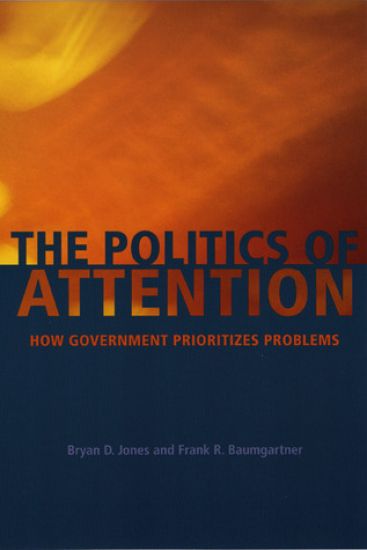
The Politics of Attention

The Politics of Attention

Bryan D. Jones; Frank R. Baumgartner

University of Chicago Press
2005
nidottu

Halvin toimitettuna 41,70 €

On any given day, policymakers are required to address a multitude of problems and make decisions about a variety of issues, from the economy and education to health care and defense. This has been true for years, but until now no studies have been conducted on how politicians manage the flood of information from a wide range of sources. How do they interpret and respond to such inundation? Which issues do they pay attention to and why? Bryan D. Jones and Frank R. Baumgartner answer these questions on decision-making processes and prioritization in "The Politics of Attention". Analyzing fifty years of data, Jones and Baumgartner's book is the first study of American politics based on a new information-processing perspective. The authors bring together the allocation of attention and the operation of governing institutions into a single model that traces public policies, public and media attention to them, and governmental decisions across multiple institutions. "The Politics of Attention offers a groundbreaking approach to American politics based on the responses of policymakers to the flow of information. It asks how the system solves, or fails to solve, problems rather than looking to how individual preferences are realized through political action.
Basic Interests

Basic Interests

Frank R. Baumgartner; Beth L. Leech

Princeton University Press
1998
pokkari
A generation ago, scholars saw interest groups as the single most important element in the American political system. Today, political scientists are more likely to see groups as a marginal influence compared to institutions such as Congress, the presidency, and the judiciary. Frank Baumgartner and Beth Leech show that scholars have veered from one extreme to another not because of changes in the political system, but because of changes in political science. They review hundreds of books and articles about interest groups from the 1940s to today; examine the methodological and conceptual problems that have beset the field; and suggest research strategies to return interest-group studies to a position of greater relevance. The authors begin by explaining how the group approach to politics became dominant forty years ago in reaction to the constitutional-legal approach that preceded it. They show how it fell into decline in the 1970s as scholars ignored the impact of groups on government to focus on more quantifiable but narrower subjects, such as collective-action dilemmas and the dynamics of recruitment. As a result, despite intense research activity, we still know very little about how groups influence day-to-day governing. Baumgartner and Leech argue that scholars need to develop a more coherent set of research questions, focus on large-scale studies, and pay more attention to the context of group behavior. Their book will give new impetus and direction to a field that has been in the academic wilderness too long.