Kirjojen hintavertailu – 12 859 819 kirjaa ja 27 kauppaa

Kirjailija

Frank Ruda

Kirjat ja teokset yhdessä paikassa: 13 kirjaa, julkaisuja vuosilta 2011–2023, suosituimpiin kuuluu Hegel's Rabble. Vertaile teosten hintoja ja tarkista saatavuus suomalaisista kirjakaupoista.

13 kirjaa

Kirjojen julkaisuvuodet: 2011–2023.

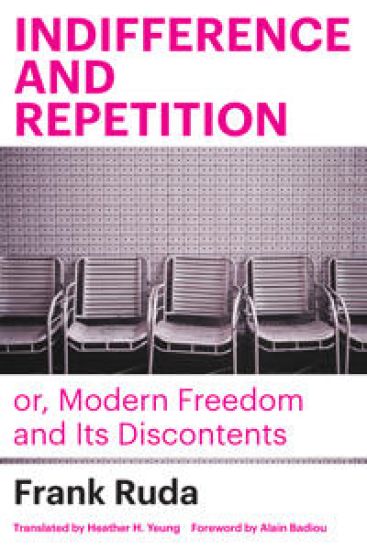
Indifference and Repetition; or, Modern Freedom and Its Discontents

Indifference and Repetition; or, Modern Freedom and Its Discontents

Frank Ruda; Alain Badiou

FORDHAM UNIVERSITY PRESS
2023
pokkari
In capitalism human beings act as if they are mere animals. So we hear repeatedly in the history of modern philosophy. Indifference and Repetition examines how modern philosophy, largely coextensive with a particular boost in capitalism's development, registers the reductive and regressive tendencies produced by capitalism's effect on individuals and society. Ruda examines a problem that has invisibly been shaping the history of modern, especially rationalist philosophical thought, a problem of misunderstanding freedom. Thinkers like Descartes, Kant, Hegel, and Marx claim that there are conceptions and interpretations of freedom that lead the subjects of these interpretations to no longer act and think freely. They are often unwillingly led into unfreedom. It is thus possible that even "freedom" enslaves. Modern philosophical rationalism, whose conceptual genealogy the books traces and unfolds, assigns a name to this peculiar form of domination by means of freedom: indifference. Indifference is a name for the assumption that freedom is something that human beings have: a given, a natural possession. When we think freedom is natural or a possession we lose freedom. Modern philosophy, Ruda shows, takes its shape through repeated attacks on freedom as indifference; it is the owl that begins its flight, so that the days of unfreedom will turn to dusk.
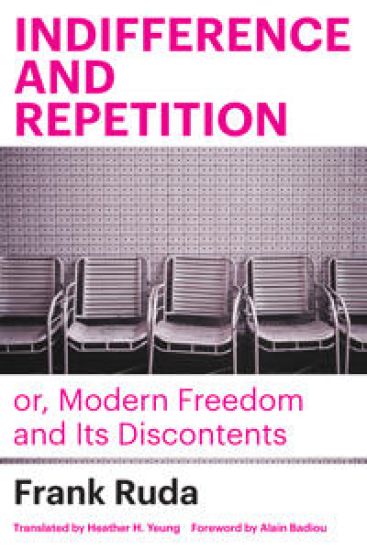
Indifference and Repetition; or, Modern Freedom and Its Discontents

Indifference and Repetition; or, Modern Freedom and Its Discontents

Frank Ruda; Alain Badiou

FORDHAM UNIVERSITY PRESS
2023
sidottu
In capitalism human beings act as if they are mere animals. So we hear repeatedly in the history of modern philosophy. Indifference and Repetition examines how modern philosophy, largely coextensive with a particular boost in capitalism's development, registers the reductive and regressive tendencies produced by capitalism's effect on individuals and society. Ruda examines a problem that has invisibly been shaping the history of modern, especially rationalist philosophical thought, a problem of misunderstanding freedom. Thinkers like Descartes, Kant, Hegel, and Marx claim that there are conceptions and interpretations of freedom that lead the subjects of these interpretations to no longer act and think freely. They are often unwillingly led into unfreedom. It is thus possible that even "freedom" enslaves. Modern philosophical rationalism, whose conceptual genealogy the books traces and unfolds, assigns a name to this peculiar form of domination by means of freedom: indifference. Indifference is a name for the assumption that freedom is something that human beings have: a given, a natural possession. When we think freedom is natural or a possession we lose freedom. Modern philosophy, Ruda shows, takes its shape through repeated attacks on freedom as indifference; it is the owl that begins its flight, so that the days of unfreedom will turn to dusk.
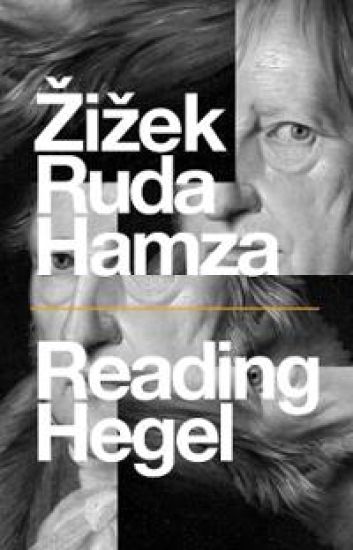
Reading Hegel

Reading Hegel

Slavoj Zizek; Frank Ruda; Agon Hamza

Polity Press
2021
sidottu
A spirit is haunting contemporary thought – the spirit of Hegel. All the powers of academia have entered into a holy alliance to exorcize this spirit: Vitalists and Eschatologists, Transcendental Pragmatists and Speculative Realists, Historical Materialists and even ‘liberal Hegelians’. Which of these groups has not been denounced as metaphysically Hegelian by its opponents? And which has not hurled back the branding reproach of Hegelian metaphysics in its turn? Progressives, liberals and reactionaries alike receive this condemnation. In light of this situation, it is high time that true Hegelians should openly admit their allegiance and, without obfuscation, express the importance and validity of Hegelianism to the contemporary intellectual scene. To this end, a small group of Hegelians of different nationalities have assembled to sketch the following book – a book which addresses a number of pressing issues that a contemporary reading of Hegel allows a new perspective on: our relation to the future, our relation to nature and our relation to the absolute.
Reading Hegel

Reading Hegel

Slavoj Zizek; Frank Ruda; Agon Hamza

Polity Press
2021
nidottu
A spirit is haunting contemporary thought – the spirit of Hegel. All the powers of academia have entered into a holy alliance to exorcize this spirit: Vitalists and Eschatologists, Transcendental Pragmatists and Speculative Realists, Historical Materialists and even ‘liberal Hegelians’. Which of these groups has not been denounced as metaphysically Hegelian by its opponents? And which has not hurled back the branding reproach of Hegelian metaphysics in its turn? Progressives, liberals and reactionaries alike receive this condemnation. In light of this situation, it is high time that true Hegelians should openly admit their allegiance and, without obfuscation, express the importance and validity of Hegelianism to the contemporary intellectual scene. To this end, a small group of Hegelians of different nationalities have assembled to sketch the following book – a book which addresses a number of pressing issues that a contemporary reading of Hegel allows a new perspective on: our relation to the future, our relation to nature and our relation to the absolute.
The Dash—The Other Side of Absolute Knowing

The Dash—The Other Side of Absolute Knowing

Rebecca Comay; Frank Ruda

MIT Press
2018
pokkari
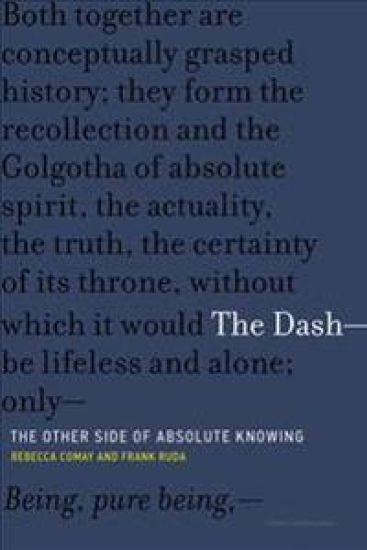
An argument that what is usually dismissed as the "mystical shell" of Hegel's thought-the concept of absolute knowledge-is actually its most "rational kernel." This book sets out from a counterintuitive premise: the "mystical shell" of Hegel's system proves to be its most "rational kernel." Hegel's radicalism is located precisely at the point where his thought seems to regress most. Most current readings try to update Hegel's thought by pruning back his grandiose claims to "absolute knowing." Comay and Ruda invert this deflationary gesture by inflating what seems to be most trivial: the absolute is grasped only in the minutiae of its most mundane appearances. Reading Hegel without presupposition, without eliminating anything in advance or making any decision about what is essential and what is inessential, what is living and what is dead, they explore his presentation of the absolute to the letter. The Dash is organized around a pair of seemingly innocuous details. Hegel punctuates strangely. He ends the Phenomenology of Spirit with a dash, and he begins the Science of Logic with a dash. This distinctive punctuation reveals an ambiguity at the heart of absolute knowing. The dash combines hesitation and acceleration. Its orientation is simultaneously retrospective and prospective. It both holds back and propels. It severs and connects. It demurs and insists. It interrupts and prolongs. It generates nonsequiturs and produces explanations. It leads in all directions: continuation, deviation, meaningless termination. This challenges every cliche about the Hegelian dialectic as a machine of uninterrupted teleological progress. The dialectical movement is, rather, structured by intermittency, interruption, hesitation, blockage, abruption, and random, unpredictable change-a rhythm that displays all the vicissitudes of the Freudian drive.
Reading Marx

Reading Marx

Slavoj Zizek; Frank Ruda; Agon Hamza

Polity Press
2018
nidottu
Marx's critique of political economy is vital for understanding the crisis of contemporary capitalism. Yet the nature of its relevance and some of its key tenets remain poorly understood. This bold intervention brings together the work of leading Marx scholars Slavoj ?i?ek, Frank Ruda and Agon Hamza, to offer a fresh, radical reinterpretation of Marxism that explains the failures of neoliberalism and lays the foundations for a new emancipatory politics. Avoiding trite comparisons between Marx's worldview and our current political scene, the authors show that the current relevance and value of Marx's thought can better be explained by placing his key ideas in dialogue with those that have attempted to replace them. Reading Marx through Hegel and Lacan, particle physics, and modern political trends, the authors provide new ways to explain the crisis in contemporary capitalism and resist fundamentalism in all its forms. Reading Marx will find a wide audience amongst activists and scholars.
Reading Marx

Reading Marx

Slavoj Zizek; Frank Ruda; Agon Hamza

Polity Press
2018
sidottu
Marx's critique of political economy is vital for understanding the crisis of contemporary capitalism. Yet the nature of its relevance and some of its key tenets remain poorly understood. This bold intervention brings together the work of leading Marx scholars Slavoj ?i?ek, Frank Ruda and Agon Hamza, to offer a fresh, radical reinterpretation of Marxism that explains the failures of neoliberalism and lays the foundations for a new emancipatory politics. Avoiding trite comparisons between Marx's worldview and our current political scene, the authors show that the current relevance and value of Marx's thought can better be explained by placing his key ideas in dialogue with those that have attempted to replace them. Reading Marx through Hegel and Lacan, particle physics, and modern political trends, the authors provide new ways to explain the crisis in contemporary capitalism and resist fundamentalism in all its forms. Reading Marx will find a wide audience amongst activists and scholars.
Abolishing Freedom

Abolishing Freedom

Frank Ruda

University of Nebraska Press
2016
pokkari

Halvin toimitettuna 32,50 €

Pushing back against the contemporary myth that freedom from oppression is freedom of choice, Frank Ruda resuscitates a fundamental lesson from the history of philosophical rationalism: a proper concept of freedom can arise only from a defense of absolute necessity, utter determinism, and predestination. Abolishing Freedom demonstrates how the greatest philosophers of the rationalist tradition and even their theological predecessors-Luther, Descartes, Kant, Hegel, Freud-defended not only freedom but also predestination and divine providence. By systematically investigating this mostly overlooked and seemingly paradoxical fact, Ruda demonstrates how real freedom conceptually presupposes the assumption that the worst has always already happened; in short, fatalism. In this brisk and witty interrogation of freedom, Ruda argues that only rationalist fatalism can cure the contemporary sickness whose paradoxical name today is freedom.
For Badiou

For Badiou

Frank Ruda

Northwestern University Press
2015
nidottu
For Badiou serves both as an introduction to the influential French philosopher Alain Badiou’s thought and as an in-depth examination of his work. Ruda begins with a thorough and clear outline of the sometimes difficult main tenets of Badiou’s philosophy. He then traces the philosophers throughout Western thought who have influenced Badiou’s project—especially Plato, Descartes, Hegel, and Marx—and on whose work Badiou has developed his provocative philosophy. Ruda draws from Badiou’s oeuvre a series of directives with regard to renewing philosophy for the twenty-first century. For Badiou continues the interrogations of its subject and raises new materialistic and dialectical questions for the next generation of engaged philosophers.
Art and Contemporaneity

Art and Contemporaneity

Frank Ruda; Jan Voelker

Diaphanes AG
2015
nidottu
Art is often said to be timeless, but specific works of art always take place within time and maintain a dynamic balance between their conditions of production and reception. Art and Contemporaneity features contributions from leading scholars, including Alain Badiou and Alexander Garcia Duttmann, who bring theories of aesthetic philosophy to bear on one of the most crucial questions about contemporary art: how do works of art come to exist within and in relation to time? A specific temporality of an artwork emerges from the material and political conditions of its production. But works of art also forge new relationships to time in their reception, which are continually superimposed upon layers of history. With a broad range of perspectives, Art and Contemporaneity offers a sustained reflection on the relationship between art and time, and it will appeal to those interested in both the theory and practice of contemporary art.
Hegel's Rabble

Hegel's Rabble

Frank Ruda

Bloomsbury Academic
2013
nidottu
In Hegel's Rabble, Frank Ruda identifies and explores a crucial problem in the Hegelian philosophy of right that strikes at the heart of Hegel's conception of the state. This singular problem, which Ruda argues is the problem of Hegelian political thought, appears in Hegel's text only in a seemingly marginal form under the name of the "rabble": a particular side-effect of the dialectical deduction of the necessity of the existence of state from the contradictory constitution of civil society. Working out from a thorough analysis of this problem and drawing on contemporary discussions in the work of such thinkers as Alain Badiou, Jean-Luc Nancy and Slavoj Zizek, the book proceeds to re-examine and reconstruct Hegel's entire political project. Ruda goes on to argue that only by re-thinking this problem of 'the rabble' in Hegel's thought - the only problem Hegel is able neither to resolve nor to sublate - can the early Marxian conception of 'the proletariat' be properly understood. The book closes with an Afterword from Slavoj Zizek.
Hegel's Rabble

Hegel's Rabble

Frank Ruda

CONTINUUM PUBLISHING CORPORATION
2011
sidottu
In Hegel's Rabble, Frank Ruda identifies and explores a crucial problem in the Hegelian philosophy of right that strikes at the heart of Hegel's conception of the state. This singular problem, which Ruda argues is the problem of Hegelian political thought, appears in Hegel's text only in a seemingly marginal form under the name of the "rabble": a particular side-effect of the dialectical deduction of the necessity of the existence of state from the contradictory constitution of civil society. Working out from a thorough analysis of this problem and drawing on contemporary discussions in the work of such thinkers as Alain Badiou, Jean-Luc Nancy and Slavoj Zizek, the book proceeds to re-examine and reconstruct Hegel's entire political project. Ruda goes on to argue that only by re-thinking this problem of the rabble' in Hegel's thought the only problem Hegel is able neither to resolve nor to sublate can the early Marxian conception of the proletariat' be properly understood. The book closes with an Afterword from Slavoj Zizek.