Kirjojen hintavertailu – 12 903 724 kirjaa ja 27 kauppaa

Kirjailija

Frank Schalow

Kirjat ja teokset yhdessä paikassa: 10 kirjaa, julkaisuja vuosilta 1986–2023, suosituimpiin kuuluu Imagination and Existence. Vertaile teosten hintoja ja tarkista saatavuus suomalaisista kirjakaupoista.

10 kirjaa

Kirjojen julkaisuvuodet: 1986–2023.

Heidegger’s Ecological Turn

Heidegger’s Ecological Turn

Frank Schalow

TAYLOR FRANCIS LTD
2023
nidottu

Halvin toimitettuna 74,10 €

This book makes explicit the ecological implications of Martin Heidegger. It examines how the trajectory of Heidegger’s thinking harbors an "ecological turn," which comes to the forefront in his attempt to anticipate the impending crisis precipitated by modern technology. Schalow’s emphasis on such key motifs as stewardship, dwelling, and "letting be" (Gelassenheit) serves to coalesce the problem of freedom in a new and innovative way, in order to expand the interpretive or hermeneutic horizon for re-examining Heidegger’s philosophy. By prioritizing a response to today’s environmental crisis and the possible impact upon future generations, the author traverses a divide within Heidegger scholarship by developing a deeper, critical outlook on his philosophy—without either reiterating standard interpretations or rejecting them wholesale. He develops a trans-human approach to ethics, which, by prioritizing the welfare of the earth, nature, and animals, counters the anthropocentric bias and destructive premise of modern technology. Heidegger’s Ecological Turn will be of interest to Heidegger scholars and researchers working in phenomenology, hermeneutics, continental philosophy, and environmental philosophy.
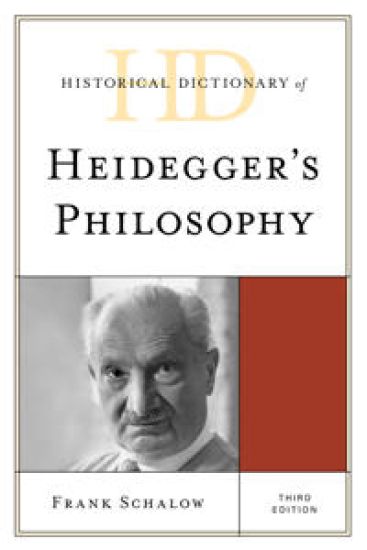
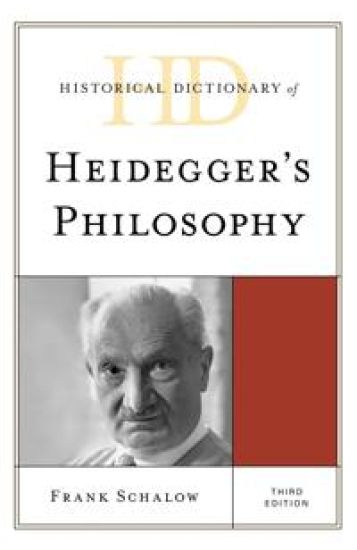
Historical Dictionary of Heidegger's Philosophy

Historical Dictionary of Heidegger's Philosophy

Frank Schalow

BLOOMSBURY PUBLISHING PLC
2022
nidottu
Martin Heidegger’s thinking is a complex, and his terminology is as nuanced, as any thinker in the history of philosophy. As the historian of philosophy par excellence, he also exhibits both a greater appreciation and mastery of previous thinkers than any almost any other philosopher before or since. The Historical Dictionary of Heidegger's Philosophy, Third Edition addresses this dual challenge of reading, understanding, and interpreting Heidegger’s vast writings. The book provides a comprehensive and detailed account of the key terms shaping Heidegger’s philosophy, as well as outlining the development of his thought spanning the entirety of his career spanning almost sixty years. The Dictionary also includes a discussion of Heidegger’s seminal writings, the spanning his entire Gesamtausgabe (Complete Edition) up through volume 99 (of the projected 102 volumes).
Heidegger’s Ecological Turn

Heidegger’s Ecological Turn

Frank Schalow

Taylor Francis Ltd
2021
sidottu
This book makes explicit the ecological implications of Martin Heidegger. It examines how the trajectory of Heidegger’s thinking harbors an "ecological turn," which comes to the forefront in his attempt to anticipate the impending crisis precipitated by modern technology. Schalow’s emphasis on such key motifs as stewardship, dwelling, and "letting be" (Gelassenheit) serves to coalesce the problem of freedom in a new and innovative way, in order to expand the interpretive or hermeneutic horizon for re-examining Heidegger’s philosophy. By prioritizing a response to today’s environmental crisis and the possible impact upon future generations, the author traverses a divide within Heidegger scholarship by developing a deeper, critical outlook on his philosophy—without either reiterating standard interpretations or rejecting them wholesale. He develops a trans-human approach to ethics, which, by prioritizing the welfare of the earth, nature, and animals, counters the anthropocentric bias and destructive premise of modern technology. Heidegger’s Ecological Turn will be of interest to Heidegger scholars and researchers working in phenomenology, hermeneutics, continental philosophy, and environmental philosophy.

Historical Dictionary of Heidegger's Philosophy

Historical Dictionary of Heidegger's Philosophy

Frank Schalow

Rowman Littlefield
2019
sidottu
Martin Heidegger’s thinking is a complex, and his terminology is as nuanced, as any thinker in the history of philosophy. As the historian of philosophy par excellence, he also exhibits both a greater appreciation and mastery of previous thinkers than any almost any other philosopher before or since. The Historical Dictionary of Heidegger's Philosophy, Third Edition addresses this dual challenge of reading, understanding, and interpreting Heidegger’s vast writings. The book provides a comprehensive and detailed account of the key terms shaping Heidegger’s philosophy, as well as outlining the development of his thought spanning the entirety of his career spanning almost sixty years. The Dictionary also includes a discussion of Heidegger’s seminal writings, the spanning his entire Gesamtausgabe (Complete Edition) up through volume 99 (of the projected 102 volumes). This third edition of Historical Dictionary of Heidegger's Philosophy, Third Edition contains a chronology, an introduction, appendixes and an extensive bibliography. The dictionary section has over 800 cross-referenced entries that provides a clear and comprehensive exposition of the key developments in his life and his thought. This book is an excellent resource for students, researchers, and anyone wanting to know more about Martin Heidegger.
Toward a Phenomenology of Addiction: Embodiment, Technology, Transcendence

Toward a Phenomenology of Addiction: Embodiment, Technology, Transcendence

Frank Schalow

Springer International Publishing AG
2018
nidottu
This book addresses an epidemic that has developed on a global scale, and, which under the heading of “addiction,” presents a new narrative about the travails of the human predicament. The book introduces phenomenological motifs, such as desire, embodiment, and temporality, to uncover the existential roots of addiction, and develops Martin Heidegger’s insights into technology to uncover the challenge of becoming a self within the impulsiveness and depersonalization of our digital age. By charting a new path of philosophical inquiry, the book allows a pervasive, cultural phenomenon, ordinarily reserved to psychology, to speak as a referendum about the danger which technology poses to us on a daily basis. In this regard, addiction ceases to be merely a clinical malady, and instead becomes a “signpost” to exposing a hidden danger posed by the assimilation of our culture within a technological framework.
Toward a Phenomenology of Addiction: Embodiment, Technology, Transcendence

Toward a Phenomenology of Addiction: Embodiment, Technology, Transcendence

Frank Schalow

Springer International Publishing AG
2017
sidottu
This book addresses an epidemic that has developed on a global scale, and, which under the heading of “addiction,” presents a new narrative about the travails of the human predicament. The book introduces phenomenological motifs, such as desire, embodiment, and temporality, to uncover the existential roots of addiction, and develops Martin Heidegger’s insights into technology to uncover the challenge of becoming a self within the impulsiveness and depersonalization of our digital age. By charting a new path of philosophical inquiry, the book allows a pervasive, cultural phenomenon, ordinarily reserved to psychology, to speak as a referendum about the danger which technology poses to us on a daily basis. In this regard, addiction ceases to be merely a clinical malady, and instead becomes a “signpost” to exposing a hidden danger posed by the assimilation of our culture within a technological framework.
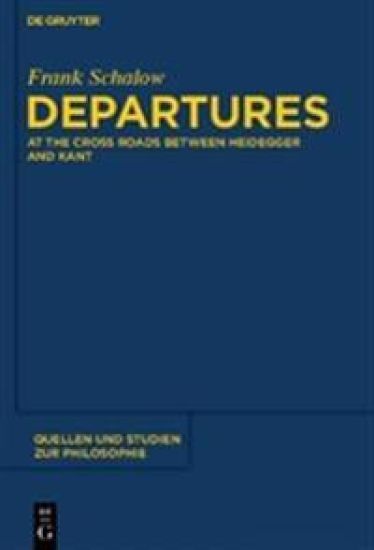
Departures

Departures

Frank Schalow

De Gruyter
2016
nidottu
In this study, the author shows new entry points to the dialogue between Kant and Heidegger. Schalow takes up the question: “Why should a philosopher like Kant, for whom language seemed to be almost inconsequential, become the crucial counter point for a thinker like Heidegger to develop a novel way to understand and express the most perennial of all philosophical concepts, namely, ‘being’ as such?”
Departures

Departures

Frank Schalow

De Gruyter
2013
sidottu
In this study, the author shows new entry points to the dialogue between Kant and Heidegger. Schalow takes up the question: “Why should a philosopher like Kant, for whom language seemed to be almost inconsequential, become the crucial counter point for a thinker like Heidegger to develop a novel way to understand and express the most perennial of all philosophical concepts, namely, ‘being’ as such?” This approach allows for addressing issues which are normally relegated to the periphery of the exchange between Heidegger and Kant, including spatiality and embodiment, nature and art, religion and politics.
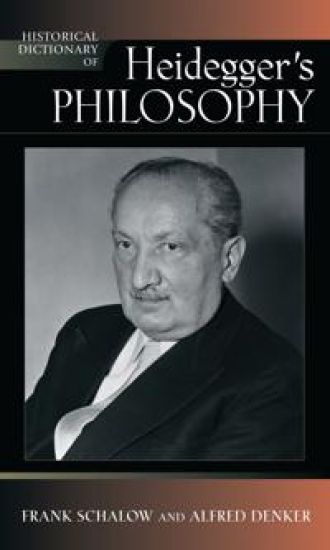
Historical Dictionary of Heidegger's Philosophy

Historical Dictionary of Heidegger's Philosophy

Frank Schalow; Alfred Denker

Scarecrow Press
2010
sidottu
By the time Martin Heidegger passed away on May 26th, 1976, he had become the most important and controversial philosopher of his age. While many of his former students had become important philosophers and thinkers in their own right, Heidegger also inspired countless others, like Jacques Derrida, Michel Foucault, and Jean-Paul Sartre. The second edition of the Historical Dictionary of Heidegger's Philosophy is an historical perspective on the development of Heidegger's thought in all its nuances and facets. Schalow and Denker cast light on the historical influences that shaped the thinker and his time through a chronology; an introductory essay; a bibliography; appendixes that include German and Greek to English glossaries of terms and a complete listing of Heidegger's writings, lectures, courses, and seminars; and a cross-referenced dictionary section offering over 600 entries on concepts, people, works, and technical terms. This volume is an invaluable resource for student and scholar alike.
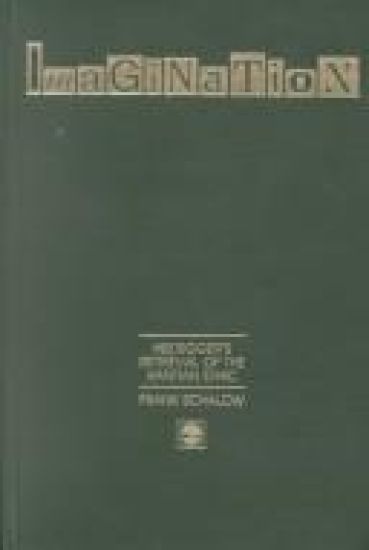
Imagination and Existence

Imagination and Existence

Frank Schalow

University Press of America
1986
sidottu
Unfolds the internal connection between Heidegger's ontology of human existence and Kant's attempt to establish an ethic of obligation. Shows that the faculty Kant identified for applying a rule in a specific case, namely, the transcendental imagination, is the basis for moral judgments. This conclusion substantiates Heidegger's central thesis in Kant and the Problem of Metaphysics that the imagination is the ultimate root of human reason.