

Kirjojen hintavertailu – 12 903 725 kirjaa ja 27 kauppaa

Kirjailija

Frank Tough

Kirjat ja teokset yhdessä paikassa: 2 kirjaa, julkaisuja vuosilta 1997–2002, suosituimpiin kuuluu As Their Natural Resources Fail. Vertaile teosten hintoja ja tarkista saatavuus suomalaisista kirjakaupoista.

2 kirjaa

Kirjojen julkaisuvuodet: 1997–2002.

Bounty and Benevolence

Bounty and Benevolence

Arthur J. Ray; Jim Miller; Frank Tough

McGill-Queen's University Press
2002
nidottu
Arthur Ray, Jim Miller, and Frank Tough draw on a wide range of documentary sources to provide a rich and complex interpretation of the process that led to these historic agreements. The authors explain how Saskatchewan treaties were shaped by long-standing First Nations' Hudson's Bay Company diplomatic and economic understandings, treaty practices developed in eastern Canada before the 1870s, and the changing economic and political realities of western Canada during the nineteenth and early twentieth centuries. Ray, Miller, and Tough also show why these same forces were responsible for creating some of the misunderstandings and disputes that subsequently arose between the First Nations and government officials regarding the interpretation and implementation of the accords. Bounty and Benevolence offers new insights into this crucial dimension of Canadian history, making it of interest to the general reader as well as specialists in the field of First Nations history.
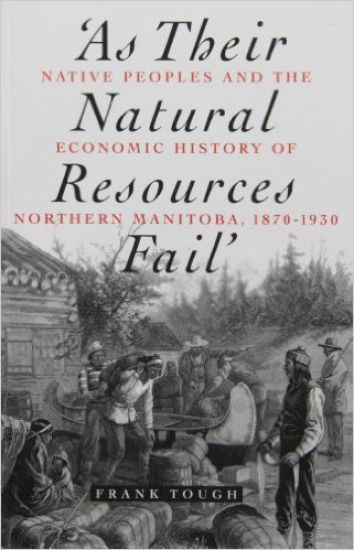
As Their Natural Resources Fail

As Their Natural Resources Fail

Frank Tough

University of British Columbia Press
1997
pokkari
In conventional histories of the Canadian prairies, Native people disappear from view after the Riel Rebellions. In this groundbreaking study, Frank Tough examines the role of Native peoples, both Indian and Metis, in the economy of northern Manitoba from Treaty 1 to the Depression. He argues that they did not become economically obsolete but rather played an important role in the transitional era between the mercantile fur trade and the emerging industrial economy of the mid-twentieth century. Tough reconstructs the traditional economy of the dynamic fur trade era and examines its evolution through reserve selection and settlement, scrip distribution and the participation of Natives in the new resource industries of commercial fishing, transportation, lumbering, and mining. His analysis clearly shows that Native people in northern Manitoba responded to the challenge of an expanding market economy in rational and enterprising ways, but that they were repeatedly obstructed by government policy. Numerous interpretive maps, figures, and illustrations provide indispensible aids to Tough's argument. His book will be essential reading for anyone interested in the history of western Canada and the role of Native people in the post-fur trade era.