Kirjojen hintavertailu – 12 903 724 kirjaa ja 27 kauppaa

Kirjailija

Frank Uhlig

Kirjat ja teokset yhdessä paikassa: 7 kirjaa, julkaisuja vuosilta 2006–2024, suosituimpiin kuuluu Biological Insulating Liquids. Vertaile teosten hintoja ja tarkista saatavuus suomalaisista kirjakaupoista.

7 kirjaa

Kirjojen julkaisuvuodet: 2006–2024.

Biological Insulating Liquids

Biological Insulating Liquids

Ernst Peter Pagger; Norasage Pattanadech; Frank Uhlig; Michael Muhr

Springer International Publishing AG
2024
nidottu
This book describes the state-of-the-art use of biological insulating liquids in detail. In recent years, more and more transformers filled with esters have been put into operation. This is because people recognize the benefits of ester liquids in terms of their fire safety (high flash and fire points) and environmental characteristics, judging from their biodegradability, their low CO2 footprint (only valid for natural ester) and their beneficial interactions with solid insulation, etc. One of the main reasons is that the water adsorption and absorption characteristics of these liquids are excellent and very different compared to mineral oil. The today’s discussion about climate change and global warming is an additional driver for using natural ester. Another advantage is that transformers filled with biological insulating liquids can operate with an overload of up to 150%. This is advantageous in the case of volatile energy generation from wind and solar power and in the supply of electrical energy for electromobility. Liquid inside electrical equipment is the lifeblood that serves both as a dielectric and a cooling medium. Some properties of these liquids differ from mineral oil, which had to be considered in the transformer design. The dielectric liquid is always in direct contact with transformer materials; therefore, the interaction should be very well understood, especially when retrofilling an existing mineral oil filled device. There are several natural ester fluids derived from various seeds and fruits on the market, and their properties may differ more or less. In the book, the most important properties of the different biological insulating fluids and mineral oil are compared. Ester fluids have already found their way into various standards. The condition of the device can be verified very well from the contents of the insulating liquids. For analysis and testing, the same equipment and devices that are commonly used for mineral oilare used for ester liquid. The chemical and physical behaviors of ester fluids compared to mineral oil are different. This must always be considered when interpreting test results stemming from ester fluids. The book is a guideline for students, original equipment manufacturers, users, laboratories and authorities in the use of biological insulating liquids.

Biological Insulating Liquids

Biological Insulating Liquids

Ernst Peter Pagger; Norasage Pattanadech; Frank Uhlig; Michael Muhr

Springer International Publishing AG
2023
sidottu
This book describes the state-of-the-art use of biological insulating liquids in detail. In recent years, more and more transformers filled with esters have been put into operation. This is because people recognize the benefits of ester liquids in terms of their fire safety (high flash and fire points) and environmental characteristics, judging from their biodegradability, their low CO2 footprint (only valid for natural ester) and their beneficial interactions with solid insulation, etc. One of the main reasons is that the water adsorption and absorption characteristics of these liquids are excellent and very different compared to mineral oil. The today’s discussion about climate change and global warming is an additional driver for using natural ester. Another advantage is that transformers filled with biological insulating liquids can operate with an overload of up to 150%. This is advantageous in the case of volatile energy generation from wind and solar power and in the supply of electrical energy for electromobility. Liquid inside electrical equipment is the lifeblood that serves both as a dielectric and a cooling medium. Some properties of these liquids differ from mineral oil, which had to be considered in the transformer design. The dielectric liquid is always in direct contact with transformer materials; therefore, the interaction should be very well understood, especially when retrofilling an existing mineral oil filled device. There are several natural ester fluids derived from various seeds and fruits on the market, and their properties may differ more or less. In the book, the most important properties of the different biological insulating fluids and mineral oil are compared. Ester fluids have already found their way into various standards. The condition of the device can be verified very well from the contents of the insulating liquids. For analysis and testing, the same equipment and devices that are commonly used for mineral oilare used for ester liquid. The chemical and physical behaviors of ester fluids compared to mineral oil are different. This must always be considered when interpreting test results stemming from ester fluids. The book is a guideline for students, original equipment manufacturers, users, laboratories and authorities in the use of biological insulating liquids.
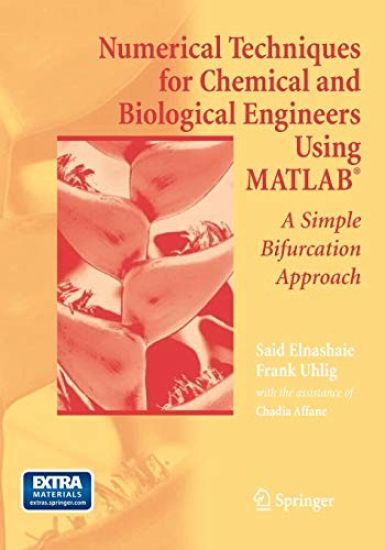
Numerical Techniques for Chemical and Biological Engineers Using MATLAB®

Numerical Techniques for Chemical and Biological Engineers Using MATLAB®

Said S.E.H. Elnashaie; Frank Uhlig

Springer-Verlag New York Inc.
2017
nidottu
This interdisciplinary book presents numerical techniques needed for chemical and biological engineers using Matlab. The book begins by exploring general cases, and moves on to specific ones. The text includes a large number of detailed illustrations, exercises and industrial examples. The book provides detailed mathematics and engineering background in the appendixes, including an introduction to Matlab. The text will be useful to undergraduate students in chemical/biological engineering, and in applied mathematics and numerical analysis.
Numerical Algorithms with C

Numerical Algorithms with C

Giesela Engeln-Müllges; Frank Uhlig

Springer-Verlag Berlin and Heidelberg GmbH Co. K
2014
nidottu
More scientists now use C than any other programming language. This book contains practical, computer-ready algorithms for many standard methods of numerical mathematics. It describes the principles of the various methods and provides support in choosing the appropriate method for a given task. Topics given special emphasis include converging methods for solving nonlinear equations, methods for solving systems of linear equations for many special matrix structures, and the Shepard method for multidimensional interpolation. The CD contains C-programs for almost all the algorithms given in the book and a compiler, together with software for graphical printing.
Numerical Algorithms with Fortran

Numerical Algorithms with Fortran

Gisela Engeln-Müllges; Frank Uhlig

Springer-Verlag Berlin and Heidelberg GmbH Co. K
2014
nidottu
This is a completely up-to-date compendium of Fortran algorithms for numerical mathematics, including many sophisticated algorithms which are not available elsewhere. All have been extensively field-tested and cover methods for solving nonlinear equations, the method of Laguerre for solving algebraic equations, conjugating gradients for solving linear systems of equations, and the McKee algorithm for solving special systems of symmetric equations. The real, practical algorithms provided make the book indispensable for applied scientists working in all areas of research. The CD contains Fortran programs for the algorithms given in the text.
Numerical Techniques for Chemical and Biological Engineers Using MATLAB®

Numerical Techniques for Chemical and Biological Engineers Using MATLAB®

Said S.E.H. Elnashaie; Frank Uhlig

Springer-Verlag New York Inc.
2006
sidottu
This interdisciplinary book presents numerical techniques needed for chemical and biological engineers using Matlab. The book begins by exploring general cases, and moves on to specific ones. The text includes a large number of detailed illustrations, exercises and industrial examples. The book provides detailed mathematics and engineering background in the appendixes, including an introduction to Matlab. The text will be useful to undergraduate students in chemical/biological engineering, and in applied mathematics and numerical analysis.