Kirjojen hintavertailu – 12 859 829 kirjaa ja 27 kauppaa
Kirjailija
Franz Brentano
Kirjat ja teokset yhdessä paikassa: 70 kirjaa, julkaisuja vuosilta 1896–2026, suosituimpiin kuuluu The Origin of the Knowledge of Right and Wrong (Cram Edition). Vertaile teosten hintoja ja tarkista saatavuus suomalaisista kirjakaupoista.
In dem hier edierten dritten Teil des W rzburger Vorlesungszyklus und den erg nzenden Texten des Anhangs zeichnet Brentano die Grundlinien der philosophischen Systeme der Neuzeit nach. Die berwiegend negative Bewertung der neuzeitlichen Systeme orientiert sich in der Wahl der Kriterien der Kritik an dem Denker, den Brentano den "Mann aller Zeiten" nennt, an Aristoteles.
'Is there such a thing as a moral truth taught by nature itself and independent of ecclesiastical, political, and every other kind of social authority? Is there a moral law that is natural in the sense of being universally and incontestably valid—valid for men at all places and all times, indeed valid for any being that thinks and feels—and are we capable of knowing that there is such a law? ... My own answer is emphatically affirmative.' - Franz Brentano, The Origin of Our Knowledge of Right and WrongFranz Brentano is one of the founding figures of twentieth century philosophy, celebrated for introducing the concept of intentionality as well as making significant contributions to ethics, philosophy of psychology and logic. He counted Sigmund Freud, Rudolf Steiner and Edmund Husserl amongst his students and Freud wrote to his teacher to express his great admiration for him. The Origin of Our Knowledge of Right and Wrong is Brentano's most important book on ethics and moral philosophy. Hailed by the Cambridge philosopher G. E. Moore as 'a far better discussion of the most fundamental principles of Ethics than any others with which I am acquainted', it is based on an important lecture Brentano delivered in Vienna in 1889 and the product of many years of reflection on its subject matter. Breaking with earlier arguments that ideas of right and wrong are innate, Brentano seeks to overcome a major challenge: if there is no such thing as objective moral goodness, can our moral judgments themselves still be objective, independent of context or human conventions? Brentano's answer is that they can, but only if we understand correctly the function of moral thought and discourse. His bold and highly original insight is that emotions are a precondition for moral knowledge and our experience of them can be right or wrong: if it is correct or fitting to love something we can say it is good, and if it is fitting to hate it, it is bad. Moving deftly through key figures in the history of philosophy, including Descartes and John Stuart Mill, The Origin of Our Knowledge of Right and Wrong is a pioneering work of ethics that continues to influence both analytical and phenomenological traditions in philosophy. This Routledge Classics edition includes a helpful account of Brentano's life and major works and a Foreword, both by Uriah Kriegel, explaining some of Brentano’s core ideas and arguments. Also included are a significant excerpt from Brentano's The Foundation and Construction of Ethics, and a historically important review by G. E. Moore of The Origin of Our Knowledge of Right and Wrong on the book's first publication.
'Is there such a thing as a moral truth taught by nature itself and independent of ecclesiastical, political, and every other kind of social authority? Is there a moral law that is natural in the sense of being universally and incontestably valid—valid for men at all places and all times, indeed valid for any being that thinks and feels—and are we capable of knowing that there is such a law? ... My own answer is emphatically affirmative.' - Franz Brentano, The Origin of Our Knowledge of Right and WrongFranz Brentano is one of the founding figures of twentieth century philosophy, celebrated for introducing the concept of intentionality as well as making significant contributions to ethics, philosophy of psychology and logic. He counted Sigmund Freud, Rudolf Steiner and Edmund Husserl amongst his students and Freud wrote to his teacher to express his great admiration for him. The Origin of Our Knowledge of Right and Wrong is Brentano's most important book on ethics and moral philosophy. Hailed by the Cambridge philosopher G. E. Moore as 'a far better discussion of the most fundamental principles of Ethics than any others with which I am acquainted', it is based on an important lecture Brentano delivered in Vienna in 1889 and the product of many years of reflection on its subject matter. Breaking with earlier arguments that ideas of right and wrong are innate, Brentano seeks to overcome a major challenge: if there is no such thing as objective moral goodness, can our moral judgments themselves still be objective, independent of context or human conventions? Brentano's answer is that they can, but only if we understand correctly the function of moral thought and discourse. His bold and highly original insight is that emotions are a precondition for moral knowledge and our experience of them can be right or wrong: if it is correct or fitting to love something we can say it is good, and if it is fitting to hate it, it is bad. Moving deftly through key figures in the history of philosophy, including Descartes and John Stuart Mill, The Origin of Our Knowledge of Right and Wrong is a pioneering work of ethics that continues to influence both analytical and phenomenological traditions in philosophy. This Routledge Classics edition includes a helpful account of Brentano's life and major works and a Foreword, both by Uriah Kriegel, explaining some of Brentano’s core ideas and arguments. Also included are a significant excerpt from Brentano's The Foundation and Construction of Ethics, and a historically important review by G. E. Moore of The Origin of Our Knowledge of Right and Wrong on the book's first publication.
Unver nderter Nachdruck der Originalausgabe von 1873. Der Verlag Antigonos spezialisiert sich auf die Herausgabe von Nachdrucken historischer B cher. Wir achten darauf, dass diese Werke der ffentlichkeit in einem guten Zustand zug nglich gemacht werden, um ihr kulturelles Erbe zu bewahren.
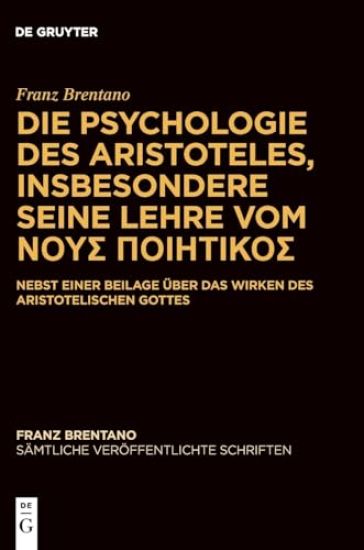
Brentanos Habilitationsschrift ber die Psychologie des Aristoteles von 1867 ist in zweierlei Hinsicht von grundlegender Bedeutung: Zum einen hat sie einen beachtlichen Einfluss auf die Aristoteles-Forschung ausge bt, insbesondere durch ihre Stellungnahme gegen den historisch-systematischen Ansatz der Geschichtsschreibung Hegelscher Pr gung, exemplarisch vertreten durch Eduard Zeller. Brentano zielt in diesem Werk darauf ab, die thomistische Interpretation des Aristoteles auf eine neue Basis zu stellen, um zu zeigen, dass der aktive Intellekt, der zusammen mit dem aufnehmenden Verstand die intellektive Seele des Menschen ausmacht, von Gott bei der Zeugung des Menschen geschaffen wird. Die Unsterblichkeit der intellektiven Seele sichert das pers nliche Weiterleben des Menschen nach dem Tod. Diese Interpretation der Psychologie des Aristoteles, die eine heftige Debatte ausgel st hat, ist allerdings fast einstimmig von der sp teren Forschung abgelehnt worden. In j ngerer Zeit ist jedoch Brentanos Deutung der Aristotelischen Psychologie wieder in den Fokus der Debatte ber das Leib-Seele-Problem bei Aristoteles ger ckt. F r die Brentano-Forschung ist dieses Werk hinsichtlich der Frage grundlegend, welche Aspekte der aristotelischen Psychologie Brentano weiterentwickelt und berarbeitet hat, die dann zu wesentlichen Bestandteilen seiner empirischen und deskriptiven Psychologie geworden sind, wie etwa die Intentionalit t der psychischen Ph nomene, die Natur des Bewusstseins und Struktur und Aufbau des menschlichen Geistes.
Das vorliegende Werk ist ein weiteres Zeugnis von Brentanos lebenslanger Auseinandersetzung mit Aristoteles, seinem philosophischen Lehrer par excellence. Auch die literarische Fehde mit dem bedeutenden Berliner Philosophiehistoriker Eduard Zeller (1814–1908) währte Jahrzehnte, ja über den Tod Zellers hinaus. In dieser Kontroverse ging es zunächst um Brentanos These vom Kreatianismus des Aristoteles, in der er Zellers Ansicht, der menschliche nous sei Teil des absoluten Denkens der aristotelischen Gottheit und somit ewig, zurückweist und darzulegen versucht, das der nous poietikos von dieser unmittelbar erschaffen wird und somit nicht präexistieren kann. In dieser Auseinandersetzung kommen aber auch ganz unterschiedliche Ansichten über das Wesen der Philosophie und ihrer Geschichte zum Ausdruck. In den Augen Brentanos war Zellers Vorgehensweise ein verkehrter Historismus, während für ihn selbst die Geschichte der Philosophie nur dann eine Berechtigung hat, wenn sie in den Dienst der sachlichen Forschung tritt.
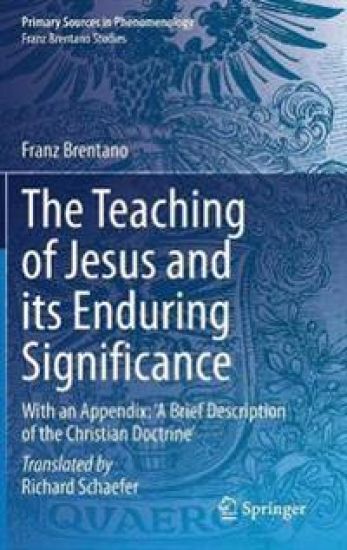
Here, for the first time in English, is Franz Brentano’s The Teaching of Jesus, a compendium of texts Brentano assembled for publication shortly before his death that constitute a frank, public settling of accounts with the Christian religion. Originally conceived by Brentano as a volume that might help others similarly led to doubt the doctrines of Christianity, the book is remarkably free of bitterness or spitefulness. On the contrary, what makes the book of singular importance, especially now, is its careful attempt at taking stock of the positive and negative influence Christianity has had in history. This text appeals to those researchers and scholars interested in the work of Franz Brentano and his work on the philosophy of religion, in this case, Christianity.
Here, for the first time in English, is Franz Brentano’s The Teaching of Jesus, a compendium of texts Brentano assembled for publication shortly before his death that constitute a frank, public settling of accounts with the Christian religion. Originally conceived by Brentano as a volume that might help others similarly led to doubt the doctrines of Christianity, the book is remarkably free of bitterness or spitefulness. On the contrary, what makes the book of singular importance, especially now, is its careful attempt at taking stock of the positive and negative influence Christianity has had in history. This text appeals to those researchers and scholars interested in the work of Franz Brentano and his work on the philosophy of religion, in this case, Christianity.
"Aristoteles und seine Weltanschauung" ist Franz Brentanos letztes Wort in seiner lebensl nglichen Auseinandersetzung mit seinem ersten und gr ten philosophischen Lehrer. Indem er sich auf die aristotelische Metaphysik und hier vor allem auf die Gotteslehre konzentriert, versucht er einerseits zu zeigen, dass die oft als dunkel und widerspr chlich hingestellten Lehren des Aristoteles sich konsistent rekonstruieren lassen, und dass Aristoteles andererseits als ein Vertreter des metaphysischen Optimismus, als ein "antiker Leibniz" also, betrachtet werden kann.
Ce premier tome des Essais et conferences de Franz Brentano comporte seize etudes qui, pour la plupart, paraissent pour la premiere fois en traduction francaise. Ces textes sont regroupes dans quatre sections qui portent respectivement sur l'etat de la philosophie et ses principes, sa philosophie de l'histoire et sa theorie des quatre phases, ses reflexions sur les philosophes Auguste Comte, Plotin, Schelling et Thomas d'Aquin, et finalement son debat avec Edouard Zeller, l'auteur de La philosophie des Grecs, autour de l'interpretation de la philosophie d'Aristote. Ce volume comprend en outre une introduction substantielle visant a contextualiser chacune des contributions du philosophe viennois. Le deuxieme tome comprendra les essais et conferences de Brentano qui contiennent les autres elements essentiels de son programme philosophique, a commencer par la metaphysique et la psychologie, qui en constituent les deux axes principaux, ainsi que des trois disciplines philosophiques par excellence pour Brentano, a savoir l'esthetique, la logique et l'ethique.