Kirjojen hintavertailu – 12 903 725 kirjaa ja 27 kauppaa

Kirjailija

Fred Brauer

Kirjat ja teokset yhdessä paikassa: 8 kirjaa, julkaisuja vuosilta 2003–2024, suosituimpiin kuuluu Dynamical Systems for Biological Modeling. Vertaile teosten hintoja ja tarkista saatavuus suomalaisista kirjakaupoista.

8 kirjaa

Kirjojen julkaisuvuodet: 2003–2024.

Dynamical Systems for Biological Modeling

Dynamical Systems for Biological Modeling

Fred Brauer; Christopher Kribs

TAYLOR FRANCIS LTD
2024
nidottu
Dynamical Systems for Biological Modeling: An Introduction prepares both biology and mathematics students with the understanding and techniques necessary to undertake basic modeling of biological systems. It achieves this through the development and analysis of dynamical systems. The approach emphasizes qualitative ideas rather than explicit computations. Some technical details are necessary, but a qualitative approach emphasizing ideas is essential for understanding. The modeling approach helps students focus on essentials rather than extensive mathematical details, which is helpful for students whose primary interests are in sciences other than mathematics need or want. The book discusses a variety of biological modeling topics, including population biology, epidemiology, immunology, intraspecies competition, harvesting, predator-prey systems, structured populations, and more. The authors also include examples of problems with solutions and some exercises which follow the examples quite closely. In addition, problems are included which go beyond the examples, both in mathematical analysis and in the development of mathematical models for biological problems, in order to encourage deeper understanding and an eagerness to use mathematics in learning about biology.

Mathematical Models in Epidemiology

Mathematical Models in Epidemiology

Fred Brauer; Carlos Castillo-Chavez; Zhilan Feng

Springer-Verlag New York Inc.
2019
sidottu
The book is a comprehensive, self-contained introduction to the mathematical modeling and analysis of disease transmission models. It includes (i) an introduction to the main concepts of compartmental models including models with heterogeneous mixing of individuals and models for vector-transmitted diseases, (ii) a detailed analysis of models for important specific diseases, including tuberculosis, HIV/AIDS, influenza, Ebola virus disease, malaria, dengue fever and the Zika virus, (iii) an introduction to more advanced mathematical topics, including age structure, spatial structure, and mobility, and (iv) some challenges and opportunities for the future. There are exercises of varying degrees of difficulty, and projects leading to new research directions. For the benefit of public health professionals whose contact with mathematics may not be recent, there is an appendix covering the necessary mathematical background. There are indications which sections require a strong mathematical background so that the book can be useful for both mathematical modelers and public health professionals.
Dynamical Systems for Biological Modeling

Dynamical Systems for Biological Modeling

Fred Brauer; Christopher Kribs

Chapman Hall/CRC
2015
sidottu
Dynamical Systems for Biological Modeling: An Introduction prepares both biology and mathematics students with the understanding and techniques necessary to undertake basic modeling of biological systems. It achieves this through the development and analysis of dynamical systems. The approach emphasizes qualitative ideas rather than explicit computations. Some technical details are necessary, but a qualitative approach emphasizing ideas is essential for understanding. The modeling approach helps students focus on essentials rather than extensive mathematical details, which is helpful for students whose primary interests are in sciences other than mathematics need or want. The book discusses a variety of biological modeling topics, including population biology, epidemiology, immunology, intraspecies competition, harvesting, predator-prey systems, structured populations, and more. The authors also include examples of problems with solutions and some exercises which follow the examples quite closely. In addition, problems are included which go beyond the examples, both in mathematical analysis and in the development of mathematical models for biological problems, in order to encourage deeper understanding and an eagerness to use mathematics in learning about biology.

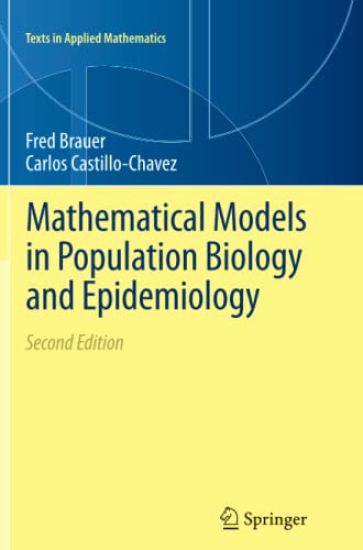
Mathematical Models in Population Biology and Epidemiology

Mathematical Models in Population Biology and Epidemiology

Fred Brauer; Carlos Castillo-Chavez

Springer-Verlag New York Inc.
2014
nidottu
This textbook provides an introduction to the field of mathematical biology through the integration of classical applications in ecology with more recent applications to epidemiology, particularly in the context of spread of infectious diseases. It integrates modeling, mathematics, and applications in a semi-rigorous way, stating theoretical results and giving references but not necessarily giving detailed proofs, providing a solid introduction to the field to undergraduates (junior and senior level), graduate students in applied mathematics, ecology, epidemiology or evolutionary biology, sustainability scientists, and to researchers who must routinely read the practical and theoretical results that come from modeling in ecology and epidemiology. This new edition has been updated throughout. In particular the chapters on epidemiology have been updated and extended considerably, and there is a new chapter on spatially structured populations that incorporates dispersal. The number of problems has been increased and the number of projects has more than doubled, in particular those stressing connections to data. In addition some examples, exercises, and projects include use of Maple and Matlab. Review of first edition: "A strength of the book is the large number of biologically-motivated problem sets. These and the references to the original biological papers would be valuable resources for an instructor." (UK Nonlinear News, 2001)
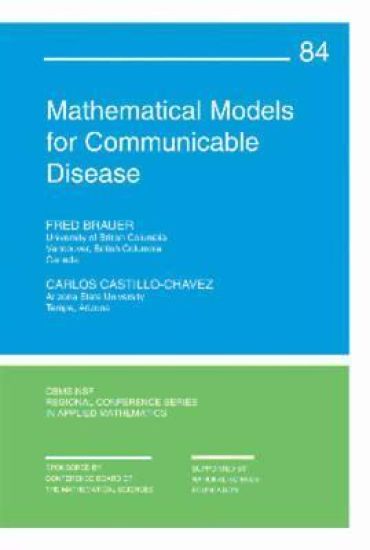
Mathematical Models for Communicable Diseases

Mathematical Models for Communicable Diseases

Fred Brauer; Carlos Castillo-Chavez

Society for Industrial Applied Mathematics,U.S.
2012
pokkari
This graduate-level textbook appeals to readers interested in the mathematical theory of disease transmission models. It is self-contained and accessible to readers who are comfortable with calculus, elementary differential equations, and linear algebra. The book provides insight into modeling:* Cross-immunity between different disease strains (such as influenza) and the synergistic interactions between multiple diseases (e.g., HIV and tuberculosis).* Diseases transmitted by viral agents, bacteria, and vectors (e.g., mosquitos transmitting malaria to humans).* Both epidemic and endemic disease occurrences.
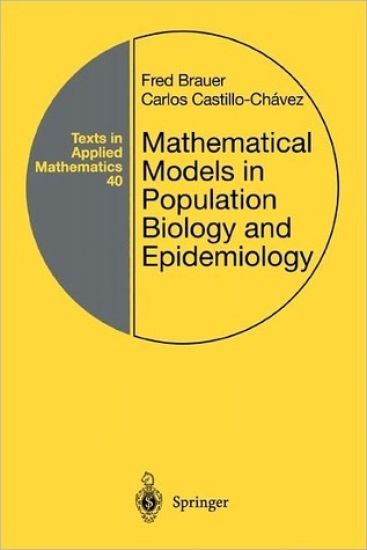
Mathematical Models in Population Biology and Epidemiology

Mathematical Models in Population Biology and Epidemiology

Fred Brauer; Carlos Castillo-Chavez

Springer-Verlag New York Inc.
2011
sidottu
This textbook provides an introduction to the field of mathematical biology through the integration of classical applications in ecology with more recent applications to epidemiology, particularly in the context of spread of infectious diseases. It integrates modeling, mathematics, and applications in a semi-rigorous way, stating theoretical results and giving references but not necessarily giving detailed proofs, providing a solid introduction to the field to undergraduates (junior and senior level), graduate students in applied mathematics, ecology, epidemiology or evolutionary biology, sustainability scientists, and to researchers who must routinely read the practical and theoretical results that come from modeling in ecology and epidemiology. This new edition has been updated throughout. In particular the chapters on epidemiology have been updated and extended considerably, and there is a new chapter on spatially structured populations that incorporates dispersal. The number of problems has been increased and the number of projects has more than doubled, in particular those stressing connections to data. In addition some examples, exercises, and projects include use of Maple and Matlab. Review of first edition: "A strength of the book is the large number of biologically-motivated problem sets. These and the references to the original biological papers would be valuable resources for an instructor." (UK Nonlinear News, 2001)
Mathematical Models in Population Biology and Epidemiology

Mathematical Models in Population Biology and Epidemiology

Fred Brauer; Carlos Castillo-Chavez

Springer-Verlag New York Inc.
2010
nidottu
As the world population exceeds the six billion mark, questions of population explosion, of how many people the earth can support and under which conditions, become pressing. Some of the questions and challenges raised can be addressed through the use of mathemathical models, but not all. The goal of this book is to search for a balance between simple and analyzable models and unsolvable models which are capable of addressing important questions such as these. Part I focusses on single-species simple models including those which have been used to predict the growth of human and animal population in the past. Single population models are, in some sense, the building blocks of more realistic models - the subject of Part II. Their role is fundamental to the study of ecological and demographic processes including the role of population structure and spatial heterogeneity - the subject of Part III. This book, which includes both examples and exercises, will be useful to practitioners, graduate students, and scientists working in the field.