Kirjojen hintavertailu – 12 903 725 kirjaa ja 27 kauppaa

Kirjailija

Fred Espenak

Kirjat ja teokset yhdessä paikassa: 27 kirjaa, julkaisuja vuosilta 2008–2023, suosituimpiin kuuluu Eclipse Almanac 2051 to 2060 - Color Edition. Vertaile teosten hintoja ja tarkista saatavuus suomalaisista kirjakaupoista.

27 kirjaa

Kirjojen julkaisuvuodet: 2008–2023.

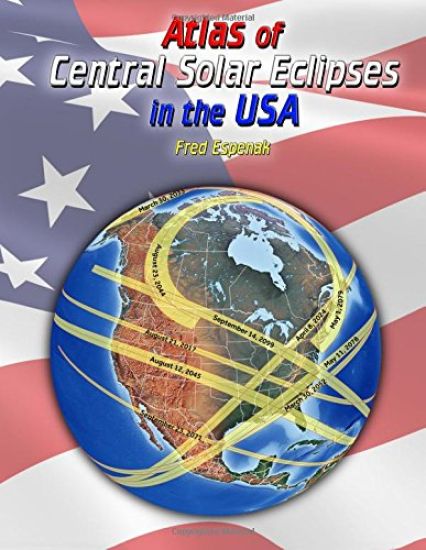
Atlas of Central Solar Eclipses in the USA

Atlas of Central Solar Eclipses in the USA

Fred Espenak

Astropixels Publishing
2016
nidottu
With the upcoming total solar eclipse of 2017 August 21, certain questions naturally arise as to the frequency of these events. When was the last total eclipse through the USA and when is the next? How often do they happen? What total eclipse tracks passed across the USA during the 17th, 18th, and 19th centuries, etc., and what states did they include? And how often is a total solar eclipse visible from each of the 50 states? In 2012 the track of an annular solar eclipse passed through the western USA. The same questions can be asked about this type of eclipse as well. The "Atlas of Central Solar Eclipses in the USA" answers all of these questions. It contains of a comprehensive series of 499 global maps showing the geographic track of every single total and annular solar eclipse across the USA (including Alaska and Hawaii) during the two-thousand-year period 1001 through 3000. It is accompanied by a catalog that lists the major characteristics of each eclipse including its duration and whether it is visible from the lower 48 states, Alaska and/or Hawaii. Finally, a set of 20 detailed maps, each covering a 50-year period and centered on the lower 48 states, shows the path of every central eclipse (total or annular). The maps include state boundaries and the location of major cities. This allows quick determination as to whether a particular eclipse was visible from any state or city in question. These maps also cover southern Canada and northern Mexico. There is something compelling about the pattern of eclipse tracks crossing familiar places many hundreds of years in the past and future. It was this fascination that inspired the creation of the Atlas.
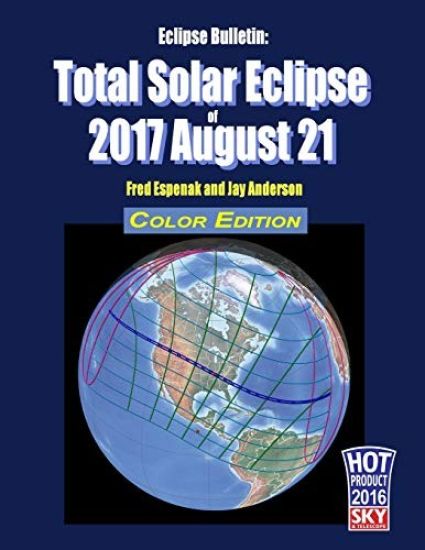
Eclipse Bulletin: Total Solar Eclipse of 2017 August 21 - Color Edition

Eclipse Bulletin: Total Solar Eclipse of 2017 August 21 - Color Edition

Jay Anderson; Fred Espenak

Astropixels Publishing
2015
nidottu
On Monday, 2017 August 21, a total eclipse of the Sun will be visible from the contiguous United States for the first time since 1979. The track of the Moon's umbral shadow begins in the Pacific Ocean and crosses the nation from west to east through Oregon, Idaho, Wyoming, Nebraska, Kansas, Missouri, Illinois, Kentucky, Tennessee, Georgia, and North and South Carolina. Inside the 70-mile-wide path of totality, the Moon will completely cover the Sun as the landscape is plunged into an eerie twilight and the Sun's glorious corona is revealed for nearly 3 minutes. Outside the narrow shadow track, a partial eclipse will be visible from all of North America. Eclipse Bulletin: Total Solar Eclipse of 2017 August 21 is the ultimate guide to this highly anticipated event. Written by two of the leading experts on eclipses, the bulletin is a treasure trove of facts on every conceivable aspect of the eclipse. The exact details about the path of the Moon's shadow can be found in a series of tables containing geographic coordinates, times, altitudes, and physical dimensions. A number of high resolution maps plot the total eclipse track across the USA. They show hundreds of cities and towns in the path, the location of major roads and highways, and the duration of totality with distance from the central line. Local circumstance tables for more than 1000 cities across the USA provide times for each phase of the eclipse along with the eclipse magnitude, duration and Sun's altitude. Additional tables cover the eclipse circumstances for cities in Canada, Mexico, Central and South America and Europe. An exhaustive climatological study identifies areas along the eclipse path where the highest probability of favorable weather may be found. A travelogue highlights key locations in the eclipse track from Oregon through South Carolina. Finally, comprehensive information is presented about solar filters and how to safely observe and photograph the eclipse. For 15 years, Fred Espenak and Jay Anderson published more than a dozen eclipse bulletins for NASA, each one covering a major solar eclipse. Prepared in cooperation with the IAU, the bulletins were internationally recognized as the most authoritative reference for each eclipse. The team has reunited to produce this new bulletin on the 2017 total eclipse through the USA. And now, for the first time, the bulletin is available in a deluxe color edition.
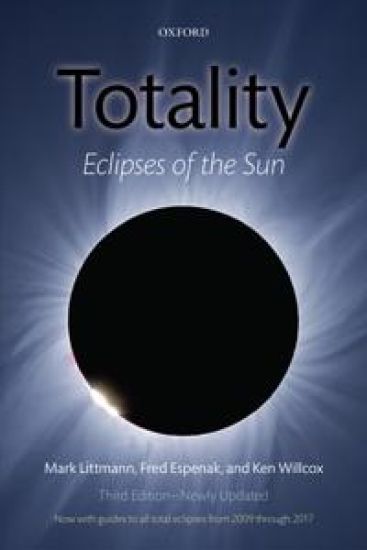
Totality

Totality

Mark Littmann; Fred Espenak; Ken Willcox

Oxford University Press
2009
nidottu
A total eclipse of the Sun is the most awesome sight in the heavens. Totality: Eclipses of the Sun takes you to eclipses of the past, present, and future, and lets you see - and feel - why people travel to the ends of the Earth to observe them. Totality: Eclipses of the Sun is the best guide and reference book on solar eclipses ever written. It explains: how to observe them; how to photograph and videotape them; why they occur; their history and mythology; and future eclipses - when and where to see them Totality also tells the remarkable story of how eclipses shocked scientists, revealed the workings of the Sun, and made Einstein famous. And the book shares the experiences and advice of many veteran eclipse observers. Totality: Eclipses of the Sun is profusely illustrated with stunning photographs (many in color) and more than a hundred maps and diagrams. It can be read by lay people and astronomers with ease and enjoyment.
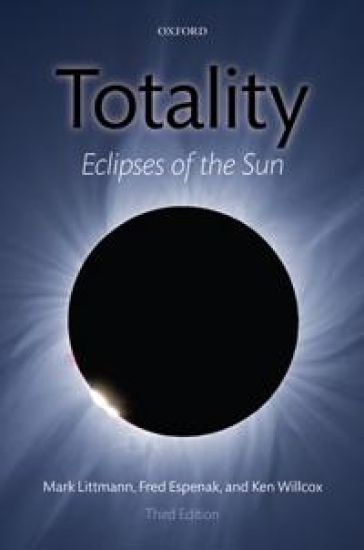
Totality

Totality

Mark Littmann; Fred Espenak; Ken Willcox

Oxford University Press
2008
sidottu
A total eclipse of the Sun is the most awesome sight in the heavens. Totality: Eclipses of the Sun takes you to eclipses of the past, present, and future, and lets you see - and feel - why people travel to the ends of the Earth to observe them. Totality: Eclipses of the Sun is the best guide and reference book on solar eclipses ever written. It explains: how to observe them; how to photograph and videotape them; why they occur; their history and mythology; and future eclipses - when and where to see them Totality also tells the remarkable story of how eclipses shocked scientists, revealed the workings of the Sun, and made Einstein famous. And the book shares the experiences and advice of many veteran eclipse observers. Totality: Eclipses of the Sun is profusely illustrated with stunning photographs (many in color) and more than a hundred maps and diagrams. It can be read by lay people and astronomers with ease and enjoyment.