
Kirjailija
Fred Hoyle
Kirjat ja teokset yhdessä paikassa: 18 kirjaa, julkaisuja vuosilta 1984–2026, suosituimpiin kuuluu Life's Purpose. Vertaile teosten hintoja ja tarkista saatavuus suomalaisista kirjakaupoista.
18 kirjaa
Kirjojen julkaisuvuodet: 1984–2026.
Originally published in 1977 and as second edition in 1979, this book argues that without energy sources on a vast scale our present society cannot survive. According to the author, Fred Hoyle, the technology to tap solar, wind or wave power on a large enough scale just does not exist. He considers nuclear fission to be the only source currently capable of supplying our needs. The author fills in the scientific background necessary to appreciate his arguments in his lucid, direct style, so that the book can act as an ideal introduction for those unfamiliar with the energy debate. This short book is unashamedly provocative and many of the central tenets of it remain as relevant today as when it was first published.
Originally published in 1979, written at a time when the world stood on the brink of (another) energy crisis, this book argued that an alternative primary fuel had to be found and that the answer lay in the exploitation of nuclear fission. The book sought to dispel the anxieties of environmentalists by correcting what the authors felt were basic misconceptions about nuclear energy. The book distinguishes carefully between nuclear energy and nuclear explosions, as the authors believed that it was the confusion between these two very different things which lies at the root of most opposition to nuclear energy. The Relevant facts concerning nuclear energy are presented in a straightforward way and the case made that nuclear energy can be clean and safe. The book includes a discussion of the storage of nuclear waste and the safety record of the nuclear industry.
Originally published in 1957, this book offers a challenging intellectual experience to the reader who wishes to understand the broad historical trends that determine the future of humanity on this planet. The book examines natural laws that govern humanity by looking at communities over long periods of time and noting patterns which become evident. The book includes discussions of communism, the crisis in food and population growth, the significance of industrialism and man and his religious beliefs – all issues that remain as relevant today as when the book was first published.
Originally published in 1979, written at a time when the world stood on the brink of (another) energy crisis, this book argued that an alternative primary fuel had to be found and that the answer lay in the exploitation of nuclear fission. The book sought to dispel the anxieties of environmentalists by correcting what the authors felt were basic misconceptions about nuclear energy. The book distinguishes carefully between nuclear energy and nuclear explosions, as the authors believed that it was the confusion between these two very different things which lies at the root of most opposition to nuclear energy. The Relevant facts concerning nuclear energy are presented in a straightforward way and the case made that nuclear energy can be clean and safe. The book includes a discussion of the storage of nuclear waste and the safety record of the nuclear industry.
Originally published in 1977 and as second edition in 1979, this book argues that without energy sources on a vast scale our present society cannot survive. According to the author, Fred Hoyle, the technology to tap solar, wind or wave power on a large enough scale just does not exist. He considers nuclear fission to be the only source currently capable of supplying our needs. The author fills in the scientific background necessary to appreciate his arguments in his lucid, direct style, so that the book can act as an ideal introduction for those unfamiliar with the energy debate. This short book is unashamedly provocative and many of the central tenets of it remain as relevant today as when it was first published.
Originally published in 1957, this book offers a challenging intellectual experience to the reader who wishes to understand the broad historical trends that determine the future of humanity on this planet. The book examines natural laws that govern humanity by looking at communities over long periods of time and noting patterns which become evident. The book includes discussions of communism, the crisis in food and population growth, the significance of industrialism and man and his religious beliefs – all issues that remain as relevant today as when the book was first published.
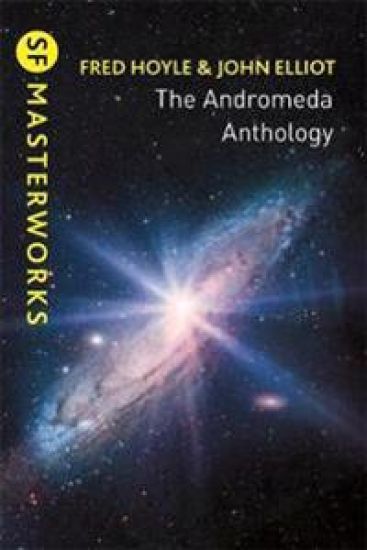
In addition to being the man who coined the term 'the Big Bang', world-renowned astronomer Sir Fred Hoyle also produced a fine body of science fiction. The Andromeda Anthology contains the acclaimed duology A for Andromeda and The Andromeda Breakthrough, co-written with John Elliot. The close-knit group of scientists who work at the new radio telescope are shocked to receive a mysterious signal from the heart of the Andromeda galaxy. Working with mathematician Christine Jones, Dr John Fleming interprets the signal as the instructions to build a super-computer. When the computer begins to relay the information it receives from Andromeda, scientists find themselves possessing knowledge previously unknown to mankind, knowledge that could threaten the security of human life itself.
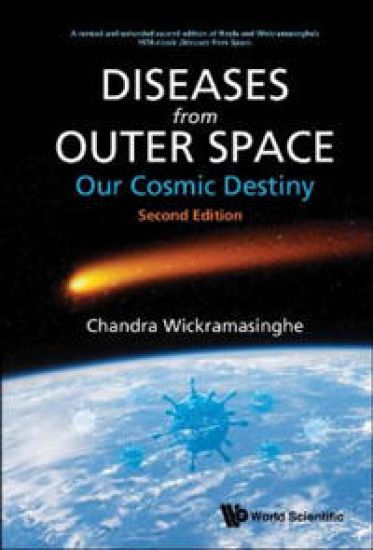
Diseases From Outer Space - Our Cosmic Destiny
Fred Hoyle; Nalin Chandra Wickramasinghe; Edward J Steele
World Scientific Publishing Co Pte Ltd
2020
sidottu
The first edition of the monumental book Diseases from Space by Sir Fred Hoyle and N Chandra Wickramasinghe appeared some 40 years ago, encapsulating the key principles of Panspermia, and it has been the guiding principle in the new scientific field of Astrobiology. This latest edition, revised and expanded by Chandra Wickamasinghe, continues to describe the consequences of the theory of cometary panspermia that relate to the origins of epidemic disease. Available data on historic and modern plagues are analysed to show that extraterrestrial bacteria and viruses are the cause of ongoing pandemics of diseases. Adherence to an inappropriate and obsolete theory of pandemics could put in jeopardy the economic well-being of the entire world, perhaps even threatening the continued existence of our civilization.
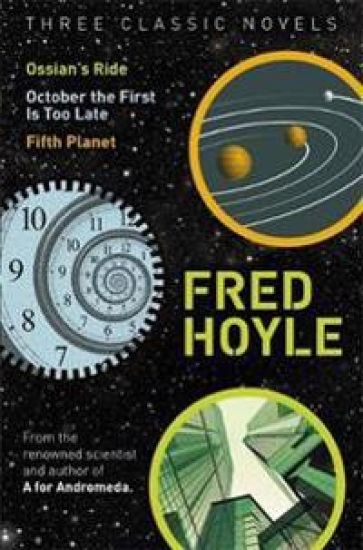
Three classic novels from the renowned scientist and author of A for Andromeda.
Fifth Planet (Valancourt 20th Century Classics)
Fred Hoyle; Geoffrey Hoyle
Valancourt Books
2015
nidottu
A planetary system, consisting of a star and five planets, is travelling through our galaxy and will pass close to Earth. The four largest planets are gaseous, but the fifth, named Achilles, appears capable of supporting life. Two rival expeditions - one Anglo-American and one Russian - set out to land on Achilles and explore its mysteries. But almost from the moment of their arrival things begin to go terribly wrong ... and when they return to Earth, something not human will be coming back with them. One of the most exciting novels by world-renowned scientist Sir Fred Hoyle (1915-2001) and Geoffrey Hoyle, Fifth Planet (1963) is a thrilling science fiction tale that ranks alongside Hoyle's masterpiece The Black Cloud. 'An exciting book for all science fiction enthusiasts ... will leave the reader wondering about our future life on earth.' - Evening Journal 'Fred Hoyle, a celebrated astronomer, is a man of vast imagination ... the story is sharp, clear and full of suspense.' - Washington (D. C.) Evening Star 'A mature performance ... the best so far from the Hoyle stable.' - Sunday Times
October the First Is Too Late (Valancourt 20th Century Classics)
Fred Hoyle
Valancourt Books
2015
nidottu
Renowned scientist John Sinclair and his old school friend Richard, a celebrated composer, are enjoying a climbing expedition in the Scottish Highlands when Sinclair disappears without a trace for thirteen hours. When he resurfaces with no explanation for his disappearance, he has undergone an uncanny alteration: a birthmark on his back has vanished. But stranger events are yet to come: things are normal enough in Britain, but in France it's 1917 and World War I is raging, Greece is in the Golden Age of Pericles, America seems to have reverted to the 18th century, and Russia and China are thousands of years in the future. Against this macabre backdrop of coexisting time spheres, the two young men risk their lives to unravel the truth. But truth is in the mind of the beholder, and who is to say which of these timelines is the 'real' one? In October the First Is Too Late (1966), world-famous astrophysicist Sir Fred Hoyle (1915-2001) explores fascinating concepts of time and consciousness in the form of a thrilling science fiction adventure that ranks among his very best. 'Fred Hoyle is the John Buchan of science fiction. His fantasies are not only rooted in scientific possibility but are told at a galloping pace.' - Julian Jebb, Sunday Times 'Fine storytelling.' - Kirkus Reviews
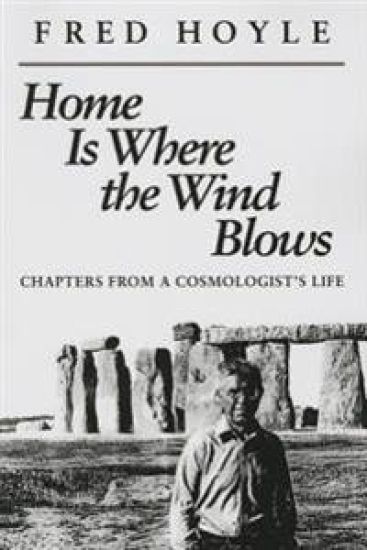
One of this century's most eminent scientist offers a revealing and charming account of his life and work. Mathematician, physicist, astronomer, cosmologist and originator of the term the 'Big Bang'-Sir Fred has always been ready and able to challenge established thinking. One of this century’s most eminent scientist offers a revealing and charming account of his life and work. Mathematician, physicist, astronomer, cosmologist and originator of the term the ‘Big Bang’-Sir Fred has always been ready and able to challenge established thinking.
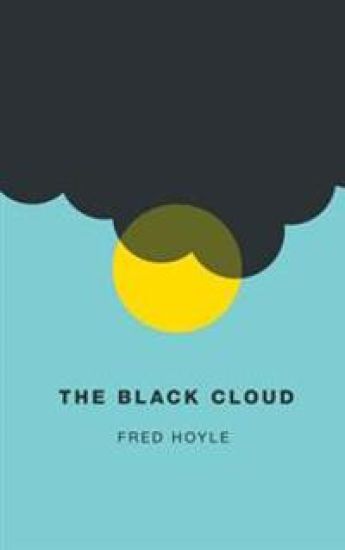
"One of the greatest works of science fiction ever written." - Richard Dawkins "Without a question the most intelligently written science fiction story I have ever read . . . A terrific yarn." - Charlotte Observer "An eerie story which demands the reader's attention from start to finish." - Denver Post " A] rattling good story . . . a really thrilling book. There is a largeness, generosity, and jollity about the whole spirit of the book that reminds one of the early Wells at his best." - G. S. Fraser, New Statesman Astronomers in England and America have made a terrifying discovery: an ominous black cloud the size of Jupiter is travelling straight towards our solar system. If their calculations are correct, the cloud's path will bring it between the Earth and the Sun, blocking out the Sun's rays and threatening unimaginable consequences for our planet. With the fate of every living thing on Earth in the balance, world leaders assemble a team of brilliant scientists to figure out a way to stop the cloud. But when they uncover the truth behind its origins, they will be forced to reconsider everything they think they know about the nature of life in the universe . . . A landmark of British science fiction, The Black Cloud (1957) was the first novel by world-renowned astronomer Sir Fred Hoyle (1915-2001), who used his own scientific background to create a frighteningly real apocalyptic thriller in which, Hoyle said, "there is very little that could not conceivably happen." Long recognized as a classic in Great Britain, Hoyle's novel returns to print in the U. S. for the first time in over 40 years in this edition, published to coincide with the centennial of the author's birth and featuring a new foreword by Geoffrey Hoyle.
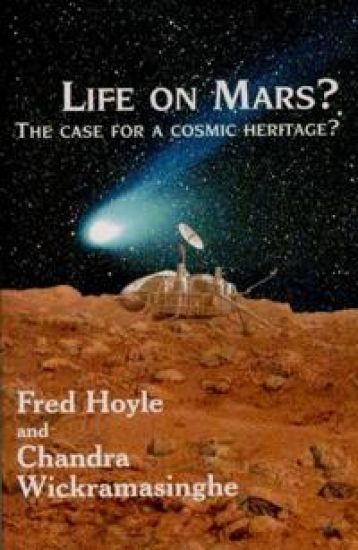
A NASA-funded team of scientists has announced that there is evidence of previous life on Mars. This book analyses the results from the meteorite ALH84001, critically interprets the information from the Vikings 1 and 2 space probes to Mars and looks at the evidence of organic material in the Cosmos. The overwhelmingly most likely explanation and by far the simplest interpretation of all the findings is that life is a cosmic phenomenon seeding the Earth and Mars.
Lectures On Cosmology And Action-at-a-distance Electrodynamics
Fred Hoyle; Jayant V Narlikar
World Scientific Publishing Co Pte Ltd
1996
sidottu
This book describes the subject of electrodynamics at classical as well as quantum level, developed as an interaction at a distance. Thus it has electric charges interacting with one another directly and not through the medium of a field. In general such an interaction travels forward and backward in time symmetrically, thus apparently violating the principle of causality. It turns out, however, that in such a description the cosmological boundary conditions become very important. The theory therefore works only in a cosmology with the right boundary conditions; but when it does work it is free from the divergences that plague a quantum field theory.
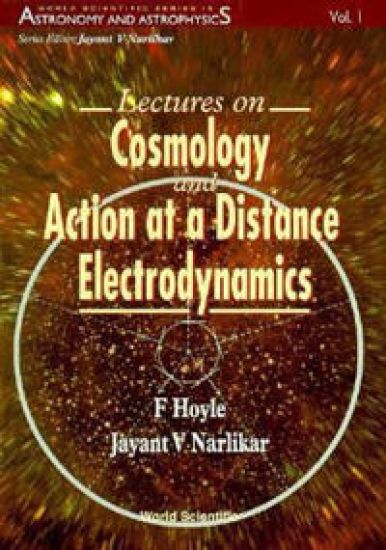
Lectures On Cosmology And Action-at-a-distance Electrodynamics
Fred Hoyle; Jayant V Narlikar
World Scientific Publishing Co Pte Ltd
1996
nidottu
This book describes the subject of electrodynamics at classical as well as quantum level, developed as an interaction at a distance. Thus it has electric charges interacting with one another directly and not through the medium of a field. In general such an interaction travels forward and backward in time symmetrically, thus apparently violating the principle of causality. It turns out, however, that in such a description the cosmological boundary conditions become very important. The theory therefore works only in a cosmology with the right boundary conditions; but when it does work it is free from the divergences that plague a quantum field theory.
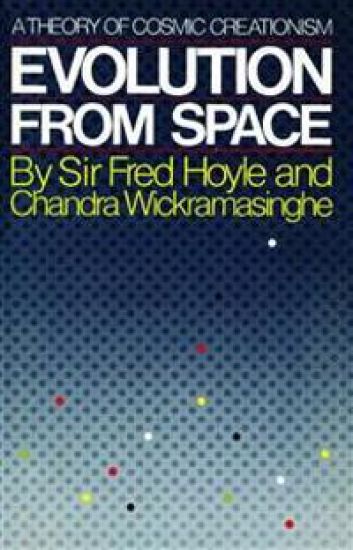
Evolution from Space: A Theory of Cosmic Creationism
Fred Hoyle; Chandra Wickramasinghe
SIMON SCHUSTER
1984
nidottu
From Simon & Schuster, Evolution from Space is Sir Fred Hoyle and Chandra Wickramasinghe's theory of cosmic creationism in this daring and fascinating sequel to Lifecloud and Diseases from Space. Evolution from Space presents the revolutionary theory that mathematics can establish the probable existence of God and suggests that life began in space under the direction of a great intelligence.