Kirjailija
Frederick Cooper
Kirjat ja teokset yhdessä paikassa: 20 kirjaa, julkaisuja vuosilta 1996–2026, suosituimpiin kuuluu Post-Imperial Possibilities. Vertaile teosten hintoja ja tarkista saatavuus suomalaisista kirjakaupoista.
20 kirjaa
Kirjojen julkaisuvuodet: 1996–2026.
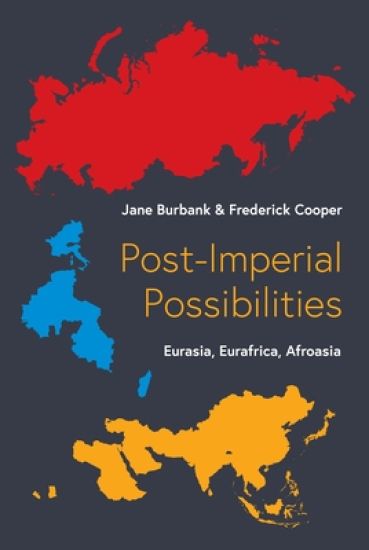
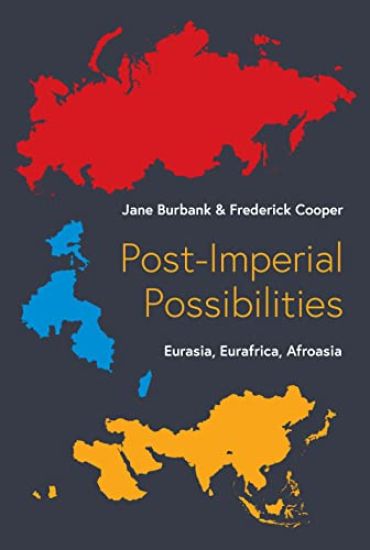
A history of three transnational political projects designed to overcome the inequities of imperialism After the dissolution of empires, was the nation-state the only way to unite people politically, culturally, and economically? In Post-Imperial Possibilities, historians Jane Burbank and Frederick Cooper examine three large-scale, transcontinental projects aimed at bringing together peoples of different regions to mitigate imperial legacies of inequality. Eurasia, Eurafrica, and Afroasia—in theory if not in practice—offered alternative routes out of empire. The theory of Eurasianism was developed after the collapse of imperial Russia by exiled intellectuals alienated by both Western imperialism and communism. Eurafrica began as a design for collaborative European exploitation of Africa but was transformed in the 1940s and 1950s into a project to include France’s African territories in plans for European integration. The Afroasian movement wanted to replace the vertical relationship of colonizer and colonized with a horizontal relationship among former colonial territories that could challenge both the communist and capitalist worlds. Both Eurafrica and Afroasia floundered, victims of old and new vested interests. But Eurasia revived in the 1990s, when Russian intellectuals turned the theory’s attack on Western hegemony into a recipe for the restoration of Russian imperial power. While both the system of purportedly sovereign states and the concentrated might of large economic and political institutions continue to frustrate projects to overcome inequities in welfare and power, Burbank and Cooper’s study of political imagination explores wide-ranging concepts of social affiliation and obligation that emerged after empire and the reasons for their unlike destinies.

The Poems of Winthrop Mackworth Praed.
Winthrop Mackworth Praed; Frederick Cooper
Anson Street Press
2025
pokkari
The Poems of Winthrop Mackworth Praed.
Winthrop Mackworth Praed; Frederick Cooper
Anson Street Press
2025
sidottu
Machtbeziehungen in kolonialen Kontexten: Initiativen von oben, von unten und dazwischen
Frederick Cooper
Bittner, Klaus GmbH
2024
pokkari
A history of three transnational political projects designed to overcome the inequities of imperialismAfter the dissolution of empires, was the nation-state the only way to unite people politically, culturally, and economically? In Post-Imperial Possibilities, historians Jane Burbank and Frederick Cooper examine three large-scale, transcontinental projects aimed at bringing together peoples of different regions to mitigate imperial legacies of inequality. Eurasia, Eurafrica, and Afroasia—in theory if not in practice—offered alternative routes out of empire. The theory of Eurasianism was developed after the collapse of imperial Russia by exiled intellectuals alienated by both Western imperialism and communism. Eurafrica began as a design for collaborative European exploitation of Africa but was transformed in the 1940s and 1950s into a project to include France’s African territories in plans for European integration. The Afroasian movement wanted to replace the vertical relationship of colonizer and colonized with a horizontal relationship among former colonial territories that could challenge both the communist and capitalist worlds. Both Eurafrica and Afroasia floundered, victims of old and new vested interests. But Eurasia revived in the 1990s, when Russian intellectuals turned the theory’s attack on Western hegemony into a recipe for the restoration of Russian imperial power. While both the system of purportedly sovereign states and the concentrated might of large economic and political institutions continue to frustrate projects to overcome inequities in welfare and power, Burbank and Cooper’s study of political imagination explores wide-ranging concepts of social affiliation and obligation that emerged after empire and the reasons for their unlike destinies.

A succinct and comprehensive history of the development of citizenship from the Roman Empire to the present dayCitizenship, Inequality, and Difference offers a concise and sweeping overview of citizenship's complex evolution, from ancient Rome to the present. Political leaders and thinkers still debate, as they did in Republican Rome, whether the presumed equivalence of citizens is compatible with cultural diversity and economic inequality. Frederick Cooper presents citizenship as "claim-making"--the assertion of rights in a political entity. What those rights should be and to whom they should apply have long been subjects for discussion and political mobilization, while the kind of political entity in which claims and counterclaims have been made has varied over time and space. Citizenship ideas were first shaped in the context of empires. The relationship of citizenship to "nation" and "empire" was hotly debated after the revolutions in France and the Americas, and claims to "imperial citizenship" continued to be made in the mid-twentieth century. Cooper examines struggles over citizenship in the Spanish, French, British, Ottoman, Russian, Soviet, and American empires, and he explains the reconfiguration of citizenship questions after the collapse of empires in Africa and India. He explores the tension today between individualistic and social conceptions of citizenship, as well as between citizenship as an exclusionary notion and flexible and multinational conceptions of citizenship. Citizenship, Inequality, and Difference is a historically based reflection on some of the most fundamental issues facing human societies in the past and present.
Africa since 1940
Frederick Cooper
Cambridge University Press
2019
pokkari
Halvin toimitettuna 36,10 €
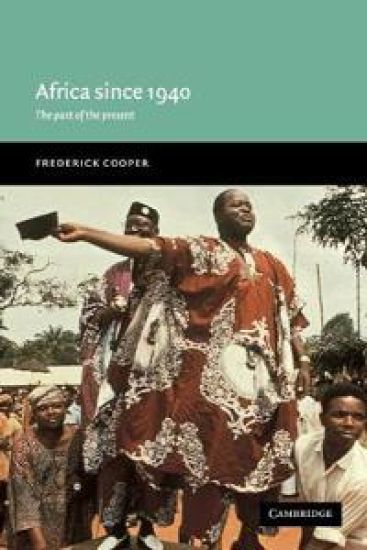
Africa since 1940 is the flagship textbook in Cambridge University Press' New Approaches to African History series. Now revised to include the history and scholarship of Africa since the turn of the millennium, this important book continues to help students understand the process out of which Africa's position in the world has emerged. A history of decolonisation and independence, it allows readers to see just what political independence did and did not signify, and how men and women, peasants and workers, religious and local leaders sought to refashion the way they lived, worked and interacted with each other. Covering the transformation of Africa from a continent marked by colonisation to one of independent states, Frederick Cooper follows the 'development question' across time, seeing how first colonial regimes and then African elites sought to transform African society in their own ways. He shows how people in cities and villages tried to make their way in an unequal world, through times of hope, despair, renewed possibilities, and continued uncertainties. Looking beyond the debate over what or who may be to blame, Cooper explores alternatives for the future.
Frederick Cooper, einer der weltweit wichtigsten Afrika- und Kolonialismushistoriker zur Geschichte der Arbeit in Afrika, reflektiert in diesem Essay Ver nderungen und aktuelle Tendenzen im Feld der afrikanischen Arbeitsgeschichte und setzt sich kritisch mit zentralen Konzepten auseinander. Er beschreibt zun chst den Aufstieg der African Labor History in den 1960er und 70er Jahren, die zu dieser Zeit sehr stark der Proletarisierungsthese folgte, also davon ausging, dass in Afrika ber kurz oder lang Lohnarbeit dominieren w rde. Stattdessen wurden nicht-entlohnte, nicht durch Gesetze regulierte oder durch soziale Regelungen oder Beh rden gesch tzte T tigkeiten zunehmend sichtbar. Die daf r bald eingef hrte Kategorie des "informellen Sektors" mustert Cooper ebenso kritisch wie das derzeit nicht nur im afrikabezogenen Kontext weit verbreitete Konzept der "prek ren Arbeit". Den Kern des Essays bildet eine dichte Analyse der wechselvollen Beziehungen zwischen "unfreier" und "freier" Arbeit in Afrika seit dem 18. Jahrhundert, die in einem d steren Vergleich kulminiert: Im 18. und 19. Jahrhundert wurden Millionen von Afrikanern ber den Atlantik zwangsverschifft, um auf Plantagen in den Amerikas zu schuften. Viele starben w hrend der berfahrt. Heute ergreifen zahlreiche Afrikaner selbst die Initiative und berqueren auf der Suche nach Arbeit das Meer. Und viele lassen dabei ihr Leben. Die Migranten der fr heren Jahrhunderte wurden zur Mobilit t gezwungen. Die gegenw rtigen Migranten seien in gewisser Weise jedoch die Freiesten des Freien. Sie gingen freiwillig von Afrika nach Europa, unter gro en Anstrengungen und mit gro em Risiko. Was fr here und heutige Wanderungen gleichwohl verbinde, sei die Ungleichheit globaler konomischer Beziehungen. Der Sklavenhandel und die Arbeitsmigration des einundzwanzigsten Jahrhunderts seien beide das Resultat der intensivierten Verbindungen und zugleich wachsenden Disparit ten zwischen verschiedenen Weltteilen.
A succinct and comprehensive history of the development of citizenship from the Roman Empire to the present dayCitizenship, Inequality, and Difference offers a concise and sweeping overview of citizenship's complex evolution, from ancient Rome to the present. Political leaders and thinkers still debate, as they did in Republican Rome, whether the presumed equivalence of citizens is compatible with cultural diversity and economic inequality. Frederick Cooper presents citizenship as "claim-making"--the assertion of rights in a political entity. What those rights should be and to whom they should apply have long been subjects for discussion and political mobilization, while the kind of political entity in which claims and counterclaims have been made has varied over time and space. Citizenship ideas were first shaped in the context of empires. The relationship of citizenship to "nation" and "empire" was hotly debated after the revolutions in France and the Americas, and claims to "imperial citizenship" continued to be made in the mid-twentieth century. Cooper examines struggles over citizenship in the Spanish, French, British, Ottoman, Russian, Soviet, and American empires, and he explains the reconfiguration of citizenship questions after the collapse of empires in Africa and India. He explores the tension today between individualistic and social conceptions of citizenship, as well as between citizenship as an exclusionary notion and flexible and multinational conceptions of citizenship. Citizenship, Inequality, and Difference is a historically based reflection on some of the most fundamental issues facing human societies in the past and present.
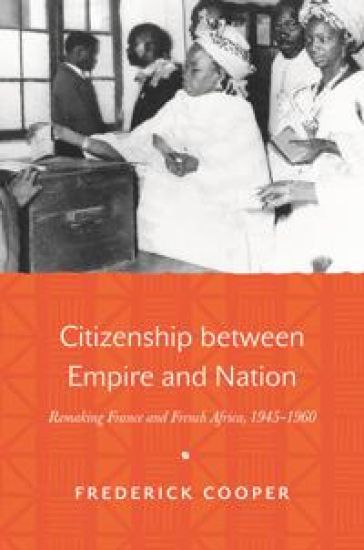
As the French public debates its present diversity and its colonial past, few remember that between 1946 and 1960 the inhabitants of French colonies possessed the rights of French citizens. Moreover, they did not have to conform to the French civil code that regulated marriage and inheritance. One could, in principle, be a citizen and different too. Citizenship between Empire and Nation examines momentous changes in notions of citizenship, sovereignty, nation, state, and empire in a time of acute uncertainty about the future of a world that had earlier been divided into colonial empires. Frederick Cooper explains how African political leaders at the end of World War II strove to abolish the entrenched distinction between colonial "subject" and "citizen." They then used their new status to claim social, economic, and political equality with other French citizens, in the face of resistance from defenders of a colonial order. Africans balanced their quest for equality with a desire to express an African political personality. They hoped to combine a degree of autonomy with participation in a larger, Franco-African ensemble. French leaders, trying to hold on to a large French polity, debated how much autonomy and how much equality they could concede. Both sides looked to versions of federalism as alternatives to empire and the nation-state. The French government had to confront the high costs of an empire of citizens, while Africans could not agree with French leaders or among themselves on how to balance their contradictory imperatives. Cooper shows how both France and its former colonies backed into more "national" conceptions of the state than either had sought.
At the Second World War’s end, it was clear that business as usual in colonized Africa would not resume. W. E. B. Du Bois’s The World and Africa, published in 1946, recognized the depth of the crisis that the war had brought to Europe, and hence to Europe’s domination over much of the globe. Du Bois believed that Africa’s past provided lessons for its future, for international statecraft, and for humanity’s mastery of social relations and commerce. Frederick Cooper revisits a history in which Africans were both empire-builders and the objects of colonization, and participants in the events that gave rise to global capitalism. Of the many pathways out of empire that African leaders envisioned in the 1940s and 1950s, Cooper asks why they ultimately followed the one that led to the nation-state, a political form whose limitations and dangers were recognized by influential Africans at the time. Cooper takes account of the central fact of Africa’s situation—extreme inequality between Africa and the western world, and extreme inequality within African societies—and considers the implications of this past trajectory for the future. Reflecting on the vast body of research on Africa since Du Bois’s time, Cooper corrects outdated perceptions of a continent often relegated to the margins of world history and integrates its experience into the mainstream of global affairs.
The history of decolonization is usually written backward, as if the end-point (a world of juridically equivalent nation-states) was known from the start and the only question was the obstacles to be overcome in order to get there. But if we ask how leaders in France, Britain, and their African colonies saw the political possibilities at the end of World War II, the routes out of colonial empire appear more varied. Some Africans sought equal rights within empire, others to federate among themselves; some sought independence. In London or Paris, officials realized they had to reform colonial empires, but not necessarily give them up. The idea of odevelopmento became a way to assert that empire could be made both more productive and more legitimate. Frederick Cooper explores how these alternative possibilities narrowed between 1945 and approximately 1960. The idea that polities were composite gave way to the fiction of a world of juridically equivalent nation-states. Some African leaders predicted that a world so divided might perpetuate rather than eliminate the powerlessness and poverty against which they were mobilizing.
Empires in World History
Jane Burbank; Frederick Cooper
Princeton University Press
2011
pokkari
Halvin toimitettuna 33,20 €
Empires--vast states of territories and peoples united by force and ambition--have dominated the political landscape for more than two millennia. Empires in World History departs from conventional European and nation-centered perspectives to take a remarkable look at how empires relied on diversity to shape the global order. Beginning with ancient Rome and China and continuing across Asia, Europe, the Americas, and Africa, Jane Burbank and Frederick Cooper examine empires' conquests, rivalries, and strategies of domination--with an emphasis on how empires accommodated, created, and manipulated differences among populations. Burbank and Cooper examine Rome and China from the third century BCE, empires that sustained state power for centuries. They delve into the militant monotheism of Byzantium, the Islamic Caliphates, and the short-lived Carolingians, as well as the pragmatically tolerant rule of the Mongols and Ottomans, who combined religious protection with the politics of loyalty. Burbank and Cooper discuss the influence of empire on capitalism and popular sovereignty, the limitations and instability of Europe's colonial projects, Russia's repertoire of exploitation and differentiation, as well as the "empire of liberty"--devised by American revolutionaries and later extended across a continent and beyond. With its investigation into the relationship between diversity and imperial states, Empires in World History offers a fresh approach to understanding the impact of empires on the past and present.
In this closely integrated collection of essays on colonialism in world history, Frederick Cooper raises crucial questions about concepts relevant to a wide range of issues in the social sciences and humanities, including identity, globalization, and modernity. Rather than portray the past two centuries as the inevitable movement from empire to nation-state. Cooper places nationalism within a much wider range of imperial and diasporic imaginations, of rulers and ruled alike, well into the twentieth century. He addresses both the insights and the blind spots of colonial studies in an effort to get beyond the tendency in the field to focus on a generic colonialism located sometime between 1492 and the 1960s and somewhere in the "West." Broad-ranging, cogently argued, and with a historical focus that moves from Africa to South Asia to Europe, these essays, most published here for the first time, propose a fuller engagement in the give-and-take of history, not least in the ways in which concepts usually attributed to Western universalism - including citizenship and equality - were defined and reconfigured by political mobilizations in colonial contexts.
Africa since 1940
Frederick Cooper
Cambridge University Press
2002
nidottu
Halvin toimitettuna 37,70 €
Frederick Cooper’s latest book on the history of decolonization and independence in Africa initiates a new textbook series: New Approaches to African History. This text will help students understand the historical process out of which Africa’s current position in the world has emerged. Bridging the divide between colonial and post-colonial history, it allows readers to see just what political independence did and did not signify and how men and women, peasants and workers, religious leaders and local leaders sought to refashion the way they lived, worked, and interacted with each other.
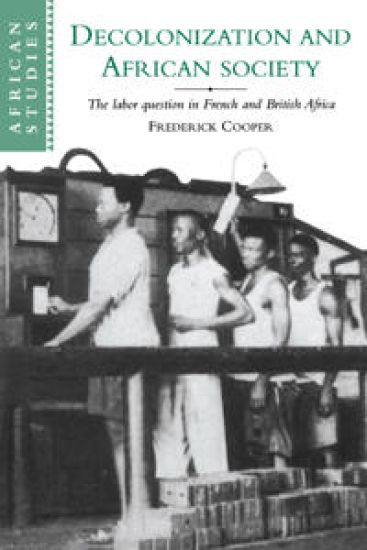
This detailed and authoritative volume changes our conceptions of 'imperial' and 'African' history. Frederick Cooper gathers a vast range of archival sources in French and English to achieve a truly comparative study of colonial policy toward the recruitment, control, and institutionalization of African labor forces from the mid 1930s, when the labor question was first posed, to the late 1950s, when decolonization was well under way. Professor Cooper explores colonial conceptions of the African worker and shows how African trade union and political leaders used the new language of social change to claim equality and a share of power. This helped to persuade European officials that the 'modern' Africa they imagined was unaffordable. Britain and France could not reshape African society. As they left the continent, the question was how they had affected the ways in which Africans could reorganize society themselves.