
Kirjailija
Frederick Law Olmsted
Kirjat ja teokset yhdessä paikassa: 100 kirjaa, julkaisuja vuosilta 1899–2026, suosituimpiin kuuluu A Journey through Texas; or a winter ramble of saddle and camp life on the border country of the United States and Mexico, etc. [Edited by J. H. Olmsted.]. Vertaile teosten hintoja ja tarkista saatavuus suomalaisista kirjakaupoista.
100 kirjaa
Kirjojen julkaisuvuodet: 1899–2026.
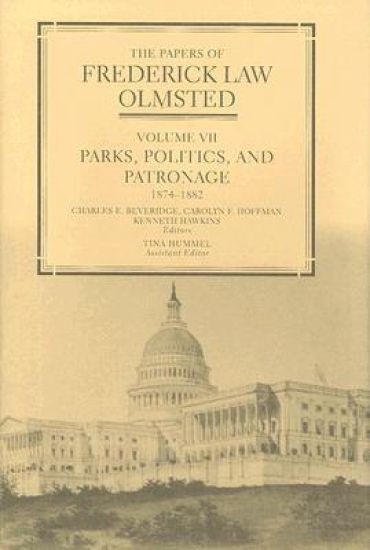
The Papers of Frederick Law Olmsted
Frederick Law Olmsted
Johns Hopkins University Press
2007
sidottu
For decades Frederick Law Olmsted (1822-1903) designed parks and park systems across the United States, leaving an enduring legacy of designed public space that is enjoyed, studied, and protected today. His plans and professional correspondence offer a rich source for understanding his remarkable contribution to the quality of urban life in this country and the development of the profession of landscape architecture. Olmsted's writings also provide a unique record of society and politics in post-Civil War America. Historians, landscape architects, conservationists, city planners, and citizens' groups continue to turn to Olmsted for inspiration in their planning and protection of public open space in our cities. This latest and seventh volume of the Papers of Frederick Law Olmsted presents the record of his last years of residence in New York City. It includes reports on the design of Riverside and Morningside parks and Tompkins Square in Manhattan, as well as his comprehensive plan for the street system and rapid transit routes of the Bronx. It records his continuing work on Central Park and presents his final retrospective statement, "The Spoils of the Park." In addition, volume seven contains an annotated version of the journal in which Olmsted recorded instances of political maneuvering and patronage politics in the years before his dismissal from the New York parks department in 1878. Later documents chronicle the early stages of his planning of the Boston park system-the Back Bay Fens, Arnold Arboretum, and Riverway. Other major commissions, each with its own political complications, were the grounds of the U. S. Capitol, the completion of the new state capitol in Albany, the designing of a park on Mount Royal in Montreal, and construction of the park system of Buffalo, New York. The volume also presents Olmsted's commentary on issues of the times including federal Reconstruction policy and civil-service reform. The Olmsted Papers project is supported by the National Endowment for the Humanities, the National Historical Publications and Records Commission, the National Trust for the Humanities, the National Association for Olmsted Parks, as well as private foundations and individuals.
Walks and Talks of An American Farmer in England. by Frederick Law Olmsted ...
Frederick Law Olmsted
University of Michigan Library
2006
pokkari
Walks and Talks of An American Farmer in England.
Frederick Law Olmsted
University of Michigan Library
2006
pokkari
A Journey Through Texas; or, A Saddle-Trip On the Southwestern Frontier; With A Statistical Appendix. by Frederick Law Olmsted.
Frederick Law Olmsted
University of Michigan Library
2006
pokkari
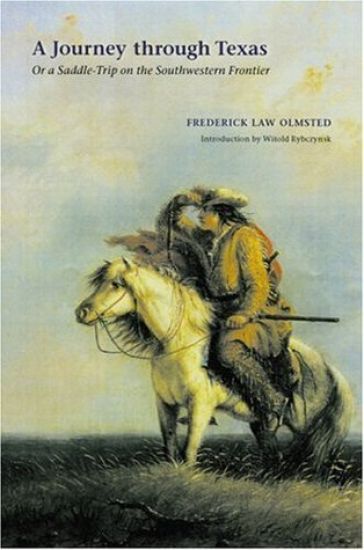
Before he became America's foremost landscape architect, Frederick Law Olmsted (1822–1903) was by turns a surveyor, merchant seaman, farmer, magazine publisher, and traveling newspaper correspondent. In 1856–57 he took a saddle trip through Texas to see the country and report on its lands and peoples. His description of the Lone Star State on the eve of the Civil War remains one of the best accounts of the American West ever published. Unvarnished by sentiment or myth making, based on firsthand observations, and backed with statistical research, Olmsted's narrative captures the manners, foods, entertainments, and conversations of the Texans, as well as their housing, agriculture, business, exotic animals, changeable weather, and the pervasive influence of slavery. Back and forth from the Sabine to the Rio Grande, through San Augustine, Nacogdoches, San Marcos, San Antonio, Neu-Braunfels, Fredericksburg, Lavaca, Indianola, Goliad, Castroville, La Grange, Houston, Harrisburg, and Beaumont, Olmsted rode and questioned and listened and reported. Texas was then already a multiethnic and multiracial state, where Americans, Germans, Mexicans, Africans, and Indians of numerous tribes mixed uneasily. Olmsted interviewed planters, scouts, innkeepers, bartenders, housewives, drovers, loafers, Indian chiefs, priests, runaway slaves, and emigrants and refugees from every part of the known world—most of whom had "gone to Texas" looking for a fresh start. He also observed the breathtaking arrival of spring on the prairie and the starry nights that seemed to prove the truth of the German saying "The sky seems nearer in Texas."
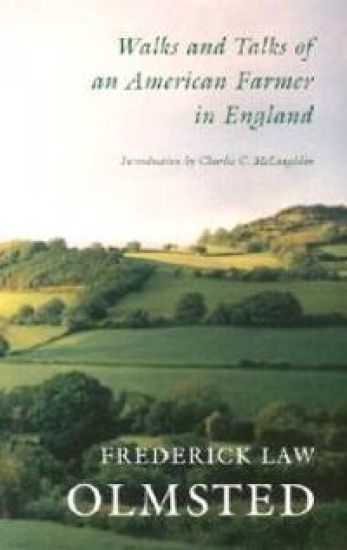
Walks and Talks of an American Farmer in England
Frederick Law Olmsted
University of Massachusetts Press
2002
nidottu
Before he ever dreamed of becoming a landscape architect, Frederick Law Olmsted (1822-1903) visited southern England and Wales during a month-long walking tour. A gifted writer, he recorded his impressions of the trip in this detailed volume, which has long been out of print. Here, Olmsted is reporter, social analyst, narrator, dramatist, scene-painter and humorist, employing a wide range of modes and styles to give us the sights, sounds and mental impressions of rural England in 1850. Olmsted's narrative is, at turns, poetic, funny, critical and meticulous. It is also an important historical document, revealing the extent to which England permeated almost every aspect of Olmsted's emerging world view, soon to find expression in his various careers as a scientific farmer, author and publisher, social critic, reformer, administrator, and landscape architect of major parks and park systems throughout the USA. The introduction clarifies the links between Olmsted's developing picturesque aesthetic, social conscience and reformer's passion for change. McLaughlin offers a persuasive argument that Olmsted would come to adapt many of the features of the cultivated English countryside - first seen on this trip - in designed landscapes such as New York's Central Park. This edition provides extensive annotations to the original text, furnishing background and context to the people and places Olmsted encountered during his journey. McLaughlin's notes are based on his own trips through England, over a 20-year period, to retrace the author's original route.
The Papers of Frederick Law Olmsted
Frederick Law Olmsted
Johns Hopkins University Press
1997
sidottu
This book features historians, landscape architects, conservationists, city planners, students, and citizens' groups continue to turn to Olmsted for ideas about the development and conservation of green spaces in urban areas.
The Yosemite Valley and the Mariposa Grove of Big Trees
Frederick Law Olmsted; Dayton Duncan; Ken Burns
Yosemite Conservancy
1995
pokkari
When Ken Burns and Dayton Duncan visited Yosemite National Park, they both called out Fredrick Law Olmsted as a major influence and inspiration for their documentary film, "The National Parks: America's Best Idea." To celebrate Mr. Olmsted and his contributions to our National Parks, the Yosemite Conservancy, in partnership with Heyday Books, has reprinted "Yosemite and the Mariposa Grove: A Preliminary Report, 1865" with a new foreword by Dayton Duncan and Ken Burns. This seminal book is a must read for anyone interested in the National Parks and our public lands. The first eloquent expression of the need for conservation in 1865 is found in this remarkable and prescient report by Frederick Law Olmsted. No statement since has been so cogent or powerful. Pristine natural landscapes, Olmsted observed, provide people with "refreshing rest and re-invigoration." They are good -- perhaps essential -- for the soul. Which is why, he noted, that from time immemorial they have most often become the exclusive domain of any society's most privileged classes, "a monopoly, in a very peculiar manner, of a very few, very rich people." Olmsted believed a great democracy had a greater obligation: "to provide means of protection for all its citizens in the pursuit of happiness." That meant, he argued, that "the establishment by government of great public grounds for the free enjoyment of the people ...is thus justified and enforced as a political duty." Olmsted gave additional reasons for creating public parks, including that they are undeniably good for the local, state, and national economy because of the tourist business they engender. His report also included practical advice about building roads and shelters, as well as instituting regulations to zealously protect the "dignity of the scenery." All of his points are as pertinent today as they were when he first read them to his fellow Yosemite commissioners nearly 150 years ago. But in deliberately borrowing from our nation's founding document, which proclaims that the "pursuit of happiness" is among the inalienable rights of every human being, and in attaching that notion to why Yosemite (or any other future park) should not be allowed to become "a rich man's park," Olmsted infused the national park idea with its most enduring principle."
The Papers of Frederick Law Olmsted
Frederick Law Olmsted
Johns Hopkins University Press
1992
sidottu
The Years of Olmsted, Vaux & Company, 1865-1874 documents one of the most productive periods of Olmsted's career. During these years he and Vaux created their classic design for Prospect Park in Brooklyn, drew up plans for Riverside and Morningside parks in Manhattan, and designed Chicago's South Park. Its rich assortment of documents will be of interest to historians, landscape architects, urban planners, and anyone concerned with the roots of modern America. The Olmsted Papers project is supported by the Andrew W. Mellon Foundation, the National Endowment for the Humanities, and the National Historical Publications and Records Commission, and is sponsored by The American University.
The Papers of Frederick Law Olmsted
Frederick Law Olmsted
Johns Hopkins University Press
1983
sidottu
'The Years of Olmsted, Vaux & Company, 1865-1874' documents one of the most productive periods of Olmsted's career. During these years he and Vaux created their classic design for Prospect Park in Brooklyn, drew up plans for Riverside and Morningside parks in Manhattan, and designed Chicago's South Park. Its rich assortment of documents will be of interest to historians, landscape architects, urban planners, and anyone concerned with the roots of modern America. 'The Olmsted Papers project is supported by the Andrew W. Mellon Foundation, the National Endowment for the Humanities, and the National Historical Publications and Records Commission, and is sponsored by The American University.'
The Papers of Frederick Law Olmsted
Frederick Law Olmsted
Johns Hopkins University Press
1981
sidottu
"An indispensable work for any student of the Old South. The book is not merely indispensable; it is challenging and controversial."—New York TimesFor decades Frederick Law Olmsted (1822–1903) designed parks and park systems across the United States, leaving an enduring legacy of designed public space that is enjoyed, studied, and protected today. His plans and professional correspondence offer a rich source for understanding his remarkable contribution to the quality of urban life in this country and the development of the profession of landscape architecture. Olmsted's writings also provide a unique record of society and politics in post–Civil War America. Historians, landscape architects, conservationists, city planners, students, and citizens' groups continue to turn to Olmsted for ideas about the development and conservation of green spaces in urban areas. The Olmsted Papers project is supported by the National Endowment for the Humanities, the National Historical Publications and Records Commission, the National Trust for the Humanities, the National Association for Olmsted Parks, as well as private foundations and individuals.
A Journey Through Texas; or, a Saddle-Trip on the Southwestern Frontier
Frederick Law Olmsted
University of Texas Press
1978
pokkari
Early in the year 1854 Frederick Law Olmsted, a young New England journalist, crossed the Louisiana border and set off on horseback into the teeth of the Texas winter. In A Journey through Texas he recounts his travels along the Old San Antonio Road through East Texas' piney woods, the dry prairies further west, the chaparral of South Texas, the coastal prairies, and the rich bottomlands around Houston and Galveston. Olmsted does not romanticize the discomforts of his trip-the monotonous food, crude housing, wet and dry northers, rough companions-yet his book reflects a sense of limitless possibility for this new and open country. The cultured Easterner remembers in relentless detail the squalor and brutality met with in parts of East Texas, but he writes fondly of the civility and cleanliness of the German settlements around New Braunfels. In his introductory "A Letter to a Southern Friend," omitted in earlier reprints, Olmsted sets forth his views opposing the extension of slavery into the West and promoting free-soil agriculture for frontier states. The remarkably versatile Olmsted is best known as the founder of landscape architecture in America and for works including Central Park and Stanford University. In his Foreword, Larry McMurtry calls A Journey through Texas an "intelligent, lively, readable book, packed with keen observation and lightened by a delicate strain of humor."
The Papers of Frederick Law Olmsted
Frederick Law Olmsted
Johns Hopkins University Press
1977
sidottu
"The park throughout is a single work of art, and as such, subject to the primary law of every work of art, namely, that it shall be framed upon a single, noble motive, to which the design of all its parts, in some more or less subtle way, shall be confluent and helpful."-Frederick Law Olmsted For decades Frederick Law Olmsted (1822-1903) designed parks and park systems across the United States, leaving an enduring legacy of designed public space that is enjoyed, studied, and protected today. Olmsted's plans and professional correspondence are a rich source for understanding his remarkable contribution to the quality of urban life in this country and the development of the profession of landscape architecture. His writings also provide a unique record of society and politics in post-Civil War America. Historians, landscape architects, conservationists, city planners and citizens' groups continue to turn to Olmsted for inspiration in their planning and protection of public open space in our cities. This latest volume of the Papers of Frederick Law Olmsted presents the record of his last years of residence in New York City. It includes reports on the design of Riverside and Morningside parks and Tompkins Square in Manhattan, as well as his comprehensive plan for the street system and rapid transit routes of the Bronx. It records his continuing work on Central Park and presents his final retrospective statement, "The Spoils of the Park." In addition, the volume contains an annotated version of the journal in which Olmsted recorded instances of political maneuvering and patronage politics in the years prior to his dismissal from the New York parks department in 1878. Later chapters chronicle the early stages of his planning of the Boston park system-the Back Bay Fens, Arnold Arboretum, and Riverway. Other major commissions, each with its own political complications, were the grounds of the U. S. Capitol, the completion of the new state capitol in Albany, the designing of a park on Mount Royal in Montreal, and construction of the park system of Buffalo, N. Y. The volume also presents Olmsted's commentary on issues of the times including Reconstruction policy and Civil Service reform. The Olmsted Papers project is supported by the National Endowment for the Humanities, the National Historical Publications and Records Commission, the National Trust for the Humanities, the National Association for Olmsted Parks, as well as private foundations and individuals.
The Cotton Kingdom: A Traveller's Observations on Cotton and Slavery in the American Slave States. Based Upon Three Former Volumes of Jour
Frederick Law Olmsted
University of Michigan Library
1899
sidottu
Frederick Law Olmsted (1822-1903) is best known for designing parks in Manhattan, Brooklyn, Chicago, Boston, and the grounds of the Capitol in Washington. But before he embarked upon his career as the nation's foremost landscape architect, he was a correspondent for theNew York Times, and it was under its auspices that he journeyed through the slave states in the 1850s. His day-by-day observations--including intimate accounts of the daily lives of masters and slaves, the operation of the plantation system, and the pernicious effects of slavery on all classes of society, black and white--were largely collected in The Cotton Kingdom. Published in 1861, just as the Southern states were storming out of the Union, it has been hailed ever since as singularly fair and authentic, an unparalleled account of America's "peculiar institution."