Kirjojen hintavertailu – 12 859 818 kirjaa ja 27 kauppaa
Kirjailija
Fredric Jameson
Kirjat ja teokset yhdessä paikassa: 55 kirjaa, julkaisuja vuosilta 1974–2027, suosituimpiin kuuluu Raymond Chandler. Vertaile teosten hintoja ja tarkista saatavuus suomalaisista kirjakaupoista.
In an age of globalization characterized by the dizzying technologies of the First World, and the social disintegration of the Third, is the concept of utopia still meaningful? Archaeologies of the Future, Jameson's most substantial work since Postmodernism, Or, the Cultural Logic of Late Capitalism, investigates the development of this form since Thomas More, and interrogates the functions of utopian thinking in a post-Communist age. The relationship between utopia and science fiction is explored through the representations of otherness . alien life and alien worlds . and a study of the works of Philip K. Dick, Ursula LeGuin, William Gibson, Brian Aldiss, Kim Stanley Robinson and more. Jameson's essential essays, including "The Desire Called Utopia," conclude with an examination of the opposing positions on utopia and an assessment of its political value today.
In such celebrated works as Postmodernism: The Cultural Logic of Late Capitalism, Fredric Jameson has established himself as one of America’s most observant cultural commentators. In Signatures of the Visible, Jameson turns his attention to cinema - the artform that has replaced the novel as the defining cultural form of our time. Historicizing a form that has flourished in a post-modern and anti-historical culture, he explores the allegorical and ideological dimensions of such films as The Shining, Dog Day Afternoon and the works of Alfred Hitchcock, among many others. Fifteen years on from its original publication, this remains a piercing and original analysis of film from a writer and thinker whose influence continues to be felt long after that of the fashionable post-modernists he has always critiqued.
In the name of an assault on "totalization" and "identity," a number of contemporary theorists have been busily washing Marxism's dialectical and utopian projects down the plug-hole of postmodernism and "post-politics." A case in point is recent interpretation of one of the greatest twentieth-century philosophers, Theodor Adorno. In this powerful book, Fredric Jameson proposes a radically different reading of Adorno's work, especially of his major works on philosophy and aesthetics: Negative Dialectics and Aesthetic Theory. Jameson argues persuasively that Adorno's contribution to the development of Marxism remains unique and indispensable. He shows how Adorno's work on aesthetics performs deconstructive operations yet is in sharp distinction to the now canonical deconstructive genre of writing. He explores the complexity of Adorno's very timely affirmation of philosophy - of its possibility after the "end" of grand theory. Above all, he illuminates the subtlety and richness of Adorno's continuing emphasis on late capitalism as a totality within the very forms of our culture. In its lucidity, Late Marxism echoes the writing of its subject, to whose critical, utopian intelligence Jameson remains faithful.
Does history produce discernible meaning? Are human struggles intelligible? These questions form the starting-point for the second volume of Sartre's Critique of Dialectical Reason. Drafted in 1958 and published in France in 1985, this magisterial work first appeared in English in 1991 and now reappears with a major new introduction by Fredric Jameson. Volume Two's theoretical framework is a logical extension of the predecessor's. As in Volume One, Sartre proceeds by moving from the simple to the complex: from individual combat (through a perceptive study of boxing) to the struggle of subgroups within an organized group form and, finally, to social struggle, with an extended analysis of the Bolshevik Revolution. The book concludes with a forceful reaffirmation of dialectical reason: of the dialectic as 'that which is truly irreducible in action'.
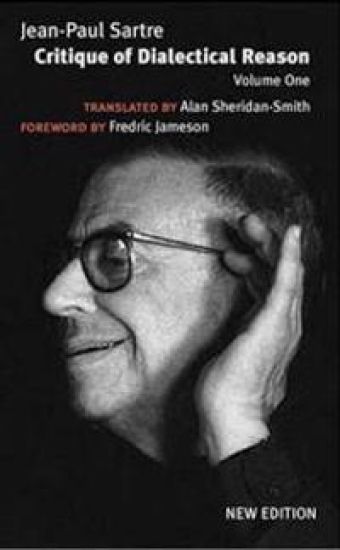
At the height of the Algerian war, Jean-Paul Sartre embarked on a fundamental reappraisal of his philosophical and political thought. The result was the Critique of Dialectical Reason, an intellectual masterpiece of the twentieth century, now republished with a major original introduction by Fredric Jameson. In it, Sartre set out the basic categories for the renovated theory of history that he believed was necessary for post-war Marxism. Sartre's formal aim was to establish the dialectical intelligibility of history itself, as what he called 'a totalisation without a totaliser'. But, at the same time, his substantive concern was the structure of class struggle and the fate of mass movements of popular revolt, from the French Revolution at the end of the eighteenth century to the Russian and Chinese revolutions in the twentieth: their ascent, stabilisation, petrification and decline, in a world still overwhelmingly dominated by scarcity.
In this ground-breaking and influential study Fredric Jameson explores the complex place and function of literature within culture. At the time Jameson was actually writing the book, in the mid to late seventies, there was a major reaction against deconstruction and poststructuralism. As one of the most significant literary theorists, Jameson found himself in the unenviable position of wanting to defend his intellectual past yet keep an eye on the future. With this book he carried it off beautifully. A landmark publication, The Political Unconscious takes its place as one of the most meaningful works of the twentieth century.century.
‘Every now and then a book appears which is literally ahead of its time ... The Political Unconscious is such a book ... it sets new standards of what a classic work is.’ – Slavoj ZizekIn this ground-breaking and influential study, Fredric Jameson explores the complex place and function of literature within culture. A landmark publication, The Political Unconscious takes its place as one of the most meaningful works of the twentieth century. First published: 1983.
Receptive to influences of such diverse theorists as Derrida, Jameson, Foucault, Irigaray, Kristeva, Lacan and Althusser, materialist Shakespeare criticism has long since left behind the days of 'vulgar' Marxism and has emerged as a rich interpretive practice. The essays chosen for this book cover all of Shakespeare's dramatic genres and include works on King Lear, Othello, As You Like It, Measure for Measure, The Tempest, The Merchant of Venice, Henry V, Macbeth, The Taming of the Shrew and Julius Caesar. Contributors: Paul Delany; Louis Adrian Montrose; Walter Cohen; Alan Sinfield; Stephen Greenblatt; Michael D. Bristol; Katherine Eismann Maus; James R. Andreas; Robert Weimann; Graham Holderness; Lynda E. Boose; John Drakakis; Claire McEacherm; Frederic Jameson; and Ivo Kamps.
In his most wide-ranging and accessible work, Fredric Jameson argues that postmodernism is the cultural response to the latest systemic change in world capitalism. He seeks here to crystallize a definition of a term which has taken on so many meanings that it has virtually lost all historical significance. He presents an extensive discussion on the cultural landscape-both 'high' and 'low'-of postmodernity, evaluating the political fortunes of the new term and surveying postmodern developments in a range of different fields-from market ideology to architecture, from painting and instalment art to contemporary punk film, from video art and high literature to deconstruction. Finally, Jameson revaluates the concept of postmodernism in light of postmodern critiques of totalization and historical narratives-from the notion of decadence to the dynamics of small groups, from religious fundamentalism to hi-tech science fiction-while touching on the nature of contemporary cultural critique and the possibilities of cognitive mapping in the present multinational world system. This provocative book will be fundamental to all future discussions of postmodernism.
Now in paperback, Fredric Jameson’s most wide-ranging work seeks to crystalize a definition of ”postmodernism”. Jameson’s inquiry looks at the postmodern across a wide landscape, from “high” art to “low” from market ideology to architecture, from painting to “punk” film, from video art to literature.
First published in 1961, Sartre: The Origins of a Style is a striking attempt not merely to analyze Sartre's work formally, from an aesthetic perspective but above all to replace Sartre in literary history itself. As a study of Sartre's writings this work articulates the antagonism between the modernist tradition and Sartrean narrative or stylistic procedures. From the broader methodological perspective, Jameson turns around the relationship between narrative and narrative closure, the possibility of storytelling, and the kinds of experience-- social and existential--structurally available in a given social formation.
Fredric Jameson, in The Political Unconscious, opposes the view that literary creation can take place in isolation from its political context. He asserts the priority of the political interpretation of literary texts, claiming it to be at the center of all reading and understanding, not just a supplement or auxiliary to other methods current today. Jameson supports his thesis by looking closely at the nature of interpretation. Our understanding, he says, is colored by the concepts and categories that we inherit from our culture's interpretive tradition and that we use to comprehend what we read. How then can the literature of other ages be understood by readers from a present that is culturally so different from the past? Marxism lies at the foundation of Jameson's answer, because it conceives of history as a single collective narrative that links past and present; Marxist literary criticism reveals the unity of that uninterrupted narrative. Jameson applies his interpretive theory to nineteenth- and twentieth-century texts, including the works of Balzac, Gissing, and Conrad. Throughout, he considers other interpretive approaches to the works he discusses, assessing the importance and limitations of methods as different as Lacanian psychoanalysis, semiotics, dialectical analysis, and allegorical readings. The book as a whole raises directly issues that have been only implicit in Jameson's earlier work, namely the relationship between dialectics and structuralism, and the tension between the German and the French aesthetic traditions. The Political Unconscious is a masterly introduction to both the method and the practice of Marxist criticism. Defining a mode of criticism and applying it successfully to individual works, it bridges the gap between theoretical speculation and textual analysis.
Fredric Jameson's survey of Structuralism and Russian Formalism is, at the same time, a critique of their basic methodology. He lays bare the presuppositions of the two movements, clarifying the relationship between the synchronic methods of Saussurean linguistics and the realities of time and history.
For more than thirty years, Fredric Jameson has been one of the most productive, wide-ranging, and distinctive literary theorists in the United States and the Anglophone world. Marxism and Form provided a pioneering account of the work of the major European Marxist theorists--T. W. Adorno, Walter Benjamin, Herbert Marcuse, Ernst Bloch, Georg Lukacs, and Jean-Paul Sartre--work that was, at the time, largely neglected in the English-speaking world. Through penetrating readings of each theorist, Jameson developed a critical mode of engagement that has had tremendous in.uence. He provided a framework for analyzing the connection between art and the historical circumstances of its making--in particular, how cultural artifacts distort, repress, or transform their circumstances through the abstractions of aesthetic form. Jameson's presentation of the critical thought of this Hegelian Marxism provided a stark alternative to the Anglo-American tradition of empiricism and humanism. It would later provide a compelling alternative to poststructuralism and deconstruction as they became dominant methodologies in aesthetic criticism. One year after Marxism and Form, Princeton published Jameson's The Prison-House of Language (1972), which provided a thorough historical and philosophical description of formalism and structuralism. Both books remain central to Jameson's main intellectual legacy: describing and extending a tradition of Western Marxism in cultural theory and literary interpretation.