Kirjojen hintavertailu – 12 903 725 kirjaa ja 27 kauppaa

Kirjailija

Friedrich Hirzebruch

Kirjat ja teokset yhdessä paikassa: 14 kirjaa, julkaisuja vuosilta 1956–2019, suosituimpiin kuuluu Topological Methods in Algebraic Geometry. Vertaile teosten hintoja ja tarkista saatavuus suomalaisista kirjakaupoista.

14 kirjaa

Kirjojen julkaisuvuodet: 1956–2019.

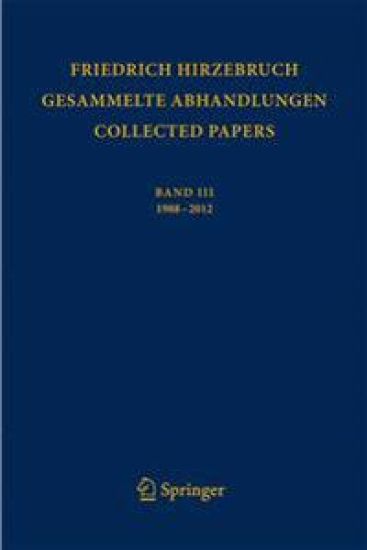
Gesammelte Abhandlungen  -  Collected Papers III

Gesammelte Abhandlungen - Collected Papers III

Friedrich Hirzebruch

Springer Nature Switzerland AG
2019
sidottu
The present volume contains Friedrich Hirzebruch's works from 1987 until 2012. It is the continuation of the two volumes "Friedrich Hirzebruch, Gesammelte Abhandlungen", published by Springer-Verlag in 1987. The volume, edited by Joachim Schwermer, Silke Wimmer-Zagier and Don Zagier, includes all of Friedrich Hirzebruch's mathematical publications from this period as well as two lecture reports written by him. These are supplemented by a number of articles and addresses containing historical or biographical material, as well as obituaries or appreciations of people who were mathematically or personally close to him.
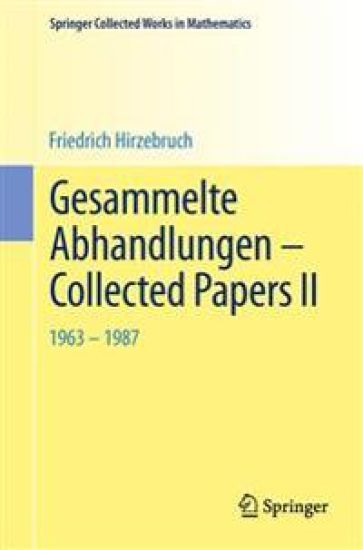
Gesammelte Abhandlungen - Collected Papers II

Gesammelte Abhandlungen - Collected Papers II

Friedrich Hirzebruch

Springer-Verlag Berlin and Heidelberg GmbH Co. K
2014
nidottu
? Friedrich Hirzebruch (1927 –2012) was a German mathematician, working in the fields of topology, complex manifolds and algebraic geometry, and a leading figure of his generation. Hirzebruch’s first great mathematical achievement was the proof, in 1954, of the generalization of the classical Riemann-Roch theorem to higher dimensional complex manifolds, now known as the Hirzebruch-Riemann-Roch theorem. This used the new techniques of sheaf cohomology and was one of the centerpieces of the explosion of new results in geometry and topology during the 1950s. Further generalization of this led to the Grothendieck-Riemann-Roch theorem, and the Atiyah-Singer index theorem. He received many awards and honors, including the Wolf prize in 1988, the Lobachevsky prize in 1990, and fifteen honorary doctorates. These two volumes collect the majority of his research papers, which cover a variety of topics. In zwei Bänden sind fast alle Veröffentlichungen enthalten, die F. Hirzebruch verfasst hat.
Gesammelte Abhandlungen - Collected Papers I

Gesammelte Abhandlungen - Collected Papers I

Friedrich Hirzebruch

Springer-Verlag Berlin and Heidelberg GmbH Co. K
2014
nidottu
Friedrich Hirzebruch (1927 –2012) was a German mathematician, working in the fields of topology, complex manifolds and algebraic geometry, and a leading figure of his generation. Hirzebruch’s first great mathematical achievement was the proof, in 1954, of the generalization of the classical Riemann-Roch theorem to higher dimensional complex manifolds, now known as the Hirzebruch-Riemann-Roch theorem. This used the new techniques of sheaf cohomology and was one of the centerpieces of the explosion of new results in geometry and topology during the 1950s. Further generalization of this led to the Grothendieck-Riemann-Roch theorem, and the Atiyah-Singer index theorem. He received many awards and honors, including the Wolf prize in 1988, the Lobachevsky prize in 1990, and fifteen honorary doctorates. These two volumes collect the majority of his research papers, which cover a variety of topics.
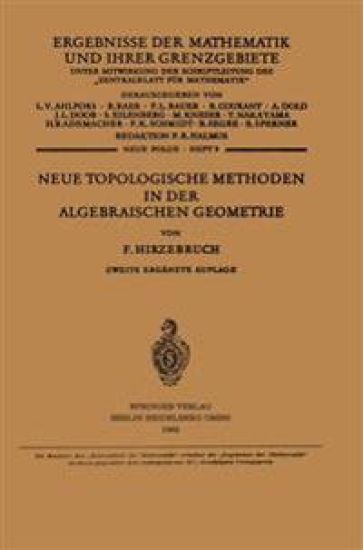
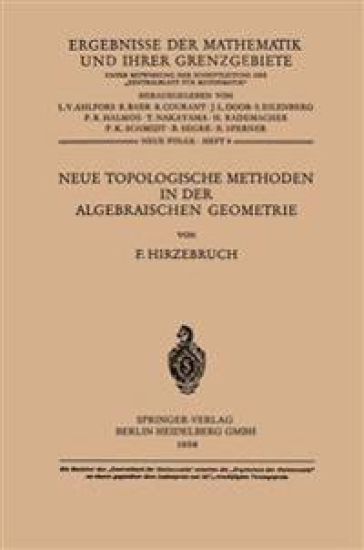
Topological Methods in Algebraic Geometry

Topological Methods in Algebraic Geometry

Friedrich Hirzebruch

Springer-Verlag Berlin and Heidelberg GmbH Co. K
1995
nidottu
In recent years new topological methods, especially the theory of sheaves founded by J. LERAY, have been applied successfully to algebraic geometry and to the theory of functions of several complex variables. H. CARTAN and J. -P. SERRE have shown how fundamental theorems on holomorphically complete manifolds (STEIN manifolds) can be for­ mulated in terms of sheaf theory. These theorems imply many facts of function theory because the domains of holomorphy are holomorphically complete. They can also be applied to algebraic geometry because the complement of a hyperplane section of an algebraic manifold is holo­ morphically complete. J. -P. SERRE has obtained important results on algebraic manifolds by these and other methods. Recently many of his results have been proved for algebraic varieties defined over a field of arbitrary characteristic. K. KODAIRA and D. C. SPENCER have also applied sheaf theory to algebraic geometry with great success. Their methods differ from those of SERRE in that they use techniques from differential geometry (harmonic integrals etc. ) but do not make any use of the theory of STEIN manifolds. M. F. ATIYAH and W. V. D. HODGE have dealt successfully with problems on integrals of the second kind on algebraic manifolds with the help of sheaf theory. I was able to work together with K. KODAIRA and D. C. SPENCER during a stay at the Institute for Advanced Study at Princeton from 1952 to 1954.
Zahlen

Zahlen

Heinz-Dieter Ebbinghaus; Hans Hermes; Friedrich Hirzebruch; Max Koecher; Klaus Mainzer; Jürgen Neukirch; Alexander Prestel; Reinhold Remmert

Springer-Verlag Berlin and Heidelberg GmbH Co. K
1992
nidottu
Die Schwierigkeit Mathematik zu lernen und zu lehren ist jedem bekannt, der einmal mit diesem Fach in Berührung gekommen ist. Begriffe wie "reelle oder komplexe Zahlen, Pi" sind zwar jedem geläufig, aber nur wenige wissen, was sich wirklich dahinter verbirgt. Die Autoren dieses Bandes geben jedem, der mehr wissen will als nur die Hülle der Begriffe, eine meisterhafte Einführung in die Magie der Mathematik und schlagen einzigartige Brücken für Studenten. Die Rezensenten der ersten beiden Auflagen überschlugen sich.
Manifolds and Modular Forms

Manifolds and Modular Forms

Friedrich Hirzebruch

Vieweg+Teubner Verlag
1992
nidottu
During the winter term 1987/88 I gave a course at the University of Bonn under the title "Manifolds and Modular Forms". Iwanted to develop the theory of "Elliptic Genera" and to leam it myself on this occasion. This theory due to Ochanine, Landweber, Stong and others was relatively new at the time. The word "genus" is meant in the sense of my book "Neue Topologische Methoden in der Algebraischen Geometrie" published in 1956: A genus is a homomorphism of the Thom cobordism ring of oriented compact manifolds into the complex numbers. Fundamental examples are the signature and the A-genus. The A-genus equals the arithmetic genus of an algebraic manifold, provided the first Chem class of the manifold vanishes. According to Atiyah and Singer it is the index of the Dirac operator on a compact Riemannian manifold with spin structure. The elliptic genera depend on a parameter. For special values of the parameter one obtains the signature and the A-genus. Indeed, the universal elliptic genus can be regarded as a modular form with respect to the subgroup r (2) of the modular group; the two cusps o giving the signature and the A-genus. Witten and other physicists have given motivations for the elliptic genus by theoretical physics using the free loop space of a manifold.
Einführung in die Funktionalanalysis

Einführung in die Funktionalanalysis

Friedrich Hirzebruch; Winfried Scharlau

Spektrum Akademischer Verlag
1991
nidottu
"Lange Zeit in meinem Mathematikstudium habe ich nicht den Vorteil kleiner, kompakter Ausführungen gegenüber goßen Wälzern gesehen. Gewiß decken Lang einen großen Teil der Algebra, Heuser einen großen Teil der Analysis (übrigens auch Funktionalanalysis) und Werner eben einen der Funktionalanalysis. Spätestens im Hauptstudium, in Spezialvorlesungen fängt man an, nach eben solchen Monographien Ausschau zu halten, die einen möglichst schnell zu einem ersten Überblick führen, ohne den sauberen mathematischen Aufbau zu entbehren." Amazon Rezension
Numbers

Numbers

Heinz-Dieter Ebbinghaus; Hans Hermes; Friedrich Hirzebruch; Max Koecher; Klaus Mainzer; Jürgen Neukirch; Alexander Prestel; Reinhold Remmert

Springer-Verlag New York Inc.
1990
nidottu
A book about numbers sounds rather dull. This one is not. Instead it is a lively story about one thread of mathematics-the concept of "number"­ told by eight authors and organized into a historical narrative that leads the reader from ancient Egypt to the late twentieth century. It is a story that begins with some of the simplest ideas of mathematics and ends with some of the most complex. It is a story that mathematicians, both amateur and professional, ought to know. Why write about numbers? Mathematicians have always found it diffi­ cult to develop broad perspective about their subject. While we each view our specialty as having roots in the past, and sometimes having connec­ tions to other specialties in the present, we seldom see the panorama of mathematical development over thousands of years. Numbers attempts to give that broad perspective, from hieroglyphs to K-theory, from Dedekind cuts to nonstandard analysis.
Geradenkonfigurationen und Algebraische Flächen

Geradenkonfigurationen und Algebraische Flächen

Gottfried Barthel; Friedrich Hirzebruch; Thomas Höfer

Friedrich Vieweg Sohn Verlagsgesellschaft mbH
1987
nidottu
Im Mittelpunkt des Buches steht eine Konstruktion mit Hilfe von Geradenkonfigurationen in der komplex-projektiven Ebene, die überraschende Beziehungen zur elementaren Geometrie aufzeigt: Aus der berühmten Miyaoka-Yau-Ungleichung für die Chernschen Zahlen einer algebraischen Fläche folgen Aussagen über Geraden- und Punktkonfigurationen, für die kein direkter Beweis bekannt ist. Der Grenzfall der Ungleichung ist eine Proportionalitätsbeziehung, die genau die Flächen charakterisiert, deren universelle Überlagerung die Vollkugel im komplex-zweidimensionalen Raum ist. Die Methoden gestatten die Konstruktion von Flächen aus dieser besonders interessanten Klasse, für die bislang wenig explizite Beispiele bekannt waren.
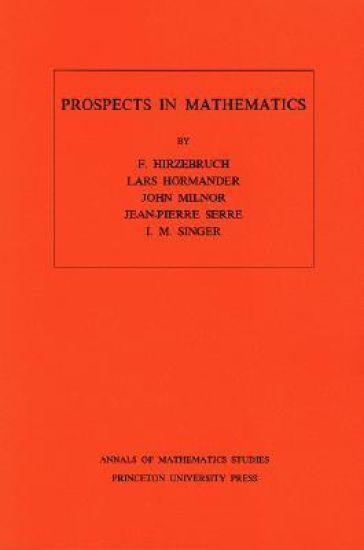
Prospects in Mathematics

Prospects in Mathematics

Friedrich Hirzebruch; Lars Hörmander; John Milnor; Jean-Pierre Serre; I. M. Singer

Princeton University Press
1971
pokkari
Five papers by distinguished American and European mathematicians describe some current trends in mathematics in the perspective of the recent past and in terms of expectations for the future. Among the subjects discussed are algebraic groups, quadratic forms, topological aspects of global analysis, variants of the index theorem, and partial differential equations.