

Kirjailija
Friedrich Julius Stahl
Kirjat ja teokset yhdessä paikassa: 38 kirjaa, julkaisuja vuosilta 2009–2025, suosituimpiin kuuluu Die Philosophie des Rechts. Vertaile teosten hintoja ja tarkista saatavuus suomalaisista kirjakaupoista.
38 kirjaa
Kirjojen julkaisuvuodet: 2009–2025.


The Doctrine of State and the Principles of State Law
Friedrich Julius Stahl
Wordbridge Pub
2025
sidottu
Halvin toimitettuna 48,90 €
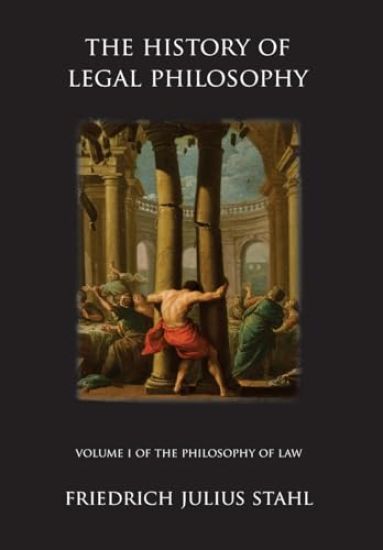
The History of Legal Philosophy
Friedrich Julius Stahl
Wordbridge Pub
2025
sidottu
Halvin toimitettuna 48,90 €


The Doctrine of State and the Principles of State Law
Friedrich Julius Stahl
Wordbridge Pub
2025
pokkari
Rechts-und Staatslehre, Zweite Abheilung, 1856
Friedrich Julius Stahl
Hutson Street Press
2025
sidottu
Rechts-und Staatslehre, Zweite Abheilung, 1856
Friedrich Julius Stahl
Hutson Street Press
2025
pokkari

Die Kirchenverfassung nach Lehre und Recht der Protestanten, Zweite Ausgabe
Friedrich Julius Stahl
Hutson Street Press
2025
pokkari

Die Kirchenverfassung nach Lehre und Recht der Protestanten, Zweite Ausgabe
Friedrich Julius Stahl
Hutson Street Press
2025
sidottu



This book is a translation of Book III of The Doctrine of Law and State on the Basis of the Christian Worldview. It provides Stahl's detailed outworking in private law of the principles of law developed in Book II. Private law forms the cornerstone of individual freedom. Even so, it is not derived from individual freedom, which is what modern legal philosophy claims. Rather, it is derived from the law of God, which establishes the principles of which it is the further outworking. In line with the understanding of law as given in Book II of this series, it establishes the institutions and authorities within which individual freedom can effectively function. The law forms part of the ethical world. The two poles around which the ethical world revolves are the fear of God and full humanity. Both of these need to be given their due in a properly-regulated legal order. The problem with modernist law is that "it only seeks man while being detached from what stands above man. Of the two parts through which the law is fulfilled - you shall love the Lord your God above all things, and your neighbor as yourself - it has arbitrarily picked out the second while ignoring the first, it has demolished the first of the two tables of the law while proposing to establish only the second" ( . 21). Therefore the rights of man - that shibboleth of modernist legal philosophy - receive full explanation only within the context of higher, God-given legal principles. As such, human rights do not serve as the source of law but as a secondary principle subservient to a higher law. That higher law establishes, besides the free action of the individual, family and property as the bases of private law. The further outworking of this concept in rights of property, contract, the law of the family, is masterfully laid out. Institutions such as property and marriage are not made the creature of will and contract but are fully explained as given realities which the human will cannot alter. This book constitutes a return to sound principles of private law and an antidote to contemporary individualism, emotivism, and primacy of the will. Sections left out of the first edition have been included in this second edition of Private Law. The text has been corrected where necessary and improved where appropriate.
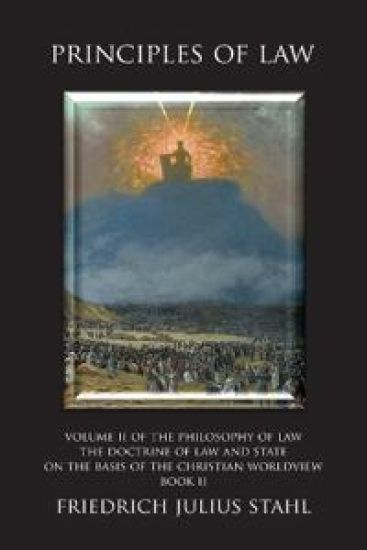
The Christian difference to the legal order is not to be found in any religious test or requirement of conformity, but in the Christian character of legal institutions. Stahl accomplishes this by making institutions rather than actions the cornerstone of law. Law is a general rule, not a specific command; and institutions, not persons, are its primary object. Persons operate within the framework established by law, but that law is an external, objective framework, not an internal, subjective one. The right of the person and the rights of persons are established and defended precisely by this objectively Christian order. Therefore, what is Christian about this legal order is the principles, the law-ideas, upon which it is based, not the level of faith of those living within it. This Christian orientation also demands a respect for the inheritance of the nation, conservation of its received institutions and laws. Law is rooted in custom and tradition, supplemented through legislation. The courts are bound to the law as the expression of the historical people, not ephemeral public opinion. The major error of modern legal philosophy is its natural-rights orientation, which makes law and the state into the creatures of individual choice, in which individuals through a social contract choose to leave the "state of nature" and form a government and a set of laws under which to be ruled. This whole approach is oblivious to the fact that human social order, being an inheritance, is a higher order transcending individual choice. Modern legal philosophy compounds its error by making natural law into a directly applicable legal standard, or alternatively by abandoning the law to the play of interests, cutting off any influence from higher principles. For its part, natural law lacks objectivity, universal recognition, and publicity in the sense that it can be known by everyone ahead of time; it therefore cannot be enforced by the state. In fact, to do so is to establish opinion and thus injustice as law. God's divine order is the archetype of law, but it is not directly applicable as law. In fact, God commands that the law as it stands is to be obeyed, regardless of its correspondence to the higher principles of law. Human freedom under God is the freedom to crystallize and make concrete those God-revealed principles of law as a positive legal order. In this second edition of Principles of Law, there is no difference in content as compared with the first, but the text has been corrected where necessary and improved where appropriate.

Die Philosophie des Rechts - Zweiter Band: Rechts- und Staatslehre auf der Grundlage christlicher Weltanschauung ist ein unver nderter, hochwertiger Nachdruck der Originalausgabe aus dem Jahr 1870. Hansebooks ist Herausgeber von Literatur zu unterschiedlichen Themengebieten wie Forschung und Wissenschaft, Reisen und Expeditionen, Kochen und Ern hrung, Medizin und weiteren Genres. Der Schwerpunkt des Verlages liegt auf dem Erhalt historischer Literatur. Viele Werke historischer Schriftsteller und Wissenschaftler sind heute nur noch als Antiquit ten erh ltlich. Hansebooks verlegt diese B cher neu und tr gt damit zum Erhalt selten gewordener Literatur und historischem Wissen auch f r die Zukunft bei.

Die Philosophie des Rechts - Erster Band: Geschichte der Rechtsphilosophie ist ein unver nderter, hochwertiger Nachdruck der Originalausgabe aus dem Jahr 1870. Hansebooks ist Herausgeber von Literatur zu unterschiedlichen Themengebieten wie Forschung und Wissenschaft, Reisen und Expeditionen, Kochen und Ern hrung, Medizin und weiteren Genres. Der Schwerpunkt des Verlages liegt auf dem Erhalt historischer Literatur. Viele Werke historischer Schriftsteller und Wissenschaftler sind heute nur noch als Antiquit ten erh ltlich. Hansebooks verlegt diese B cher neu und tr gt damit zum Erhalt selten gewordener Literatur und historischem Wissen auch f r die Zukunft bei.

Die Philosophie des Rechts - Zweiter Band: Rechts- und Staatslehre auf der Grundlage christlicher Weltanschauung ist ein unver nderter, hochwertiger Nachdruck der Originalausgabe aus dem Jahr 1870. Hansebooks ist Herausgeber von Literatur zu unterschiedlichen Themengebieten wie Forschung und Wissenschaft, Reisen und Expeditionen, Kochen und Ern hrung, Medizin und weiteren Genres. Der Schwerpunkt des Verlages liegt auf dem Erhalt historischer Literatur. Viele Werke historischer Schriftsteller und Wissenschaftler sind heute nur noch als Antiquit ten erh ltlich. Hansebooks verlegt diese B cher neu und tr gt damit zum Erhalt selten gewordener Literatur und historischem Wissen auch f r die Zukunft bei.

Die Kirchenverfassung nach Lehre und Recht der Protestanten
Friedrich Julius Stahl
Salzwasser-Verlag
2022
sidottu

Die Kirchenverfassung nach Lehre und Recht der Protestanten
Friedrich Julius Stahl
Salzwasser-Verlag
2022
pokkari
Philosophical Foundations
Friedrich Julius Stahl
Wordbridge Pub
2022
pokkari
Halvin toimitettuna 24,10 €
Philosophical Foundations is an introduction to the philosophy of law, but it also furnishes the foundations for a Christian philosophy. In this ethically discombobulated time, it provides us with the metaphysical and ethical tools to slash our way through the wilderness of ideologies and power-craving opinions which threaten to overwhelm civilization. Indeed, a solid metaphysical and ethical framework is the crying need of our age and the indispensable presupposition for the various arts and sciences that make up the encyclopedia ("circle of learning"). The most basic datum such a framework can provide is very simply the either/or of a personal God from Whom all things originated or an ultimate reality that is impersonal. That is the starting point for inquiry. And it cannot be the case that the decision for an impersonal ultimate reality is a requirement for science. Functional atheism can be no requirement for participation either in academia or in public life and policymaking. Is science truly science that ignores the most basic fact of existence - the existence of God? It cannot be so. "If there were a God and He created the world, should that not be accepted because it is unscientific? If reason really did not carry the world in itself and could not find the world out by itself, would it nevertheless have to remove the world from itself, because that alone would be scientific? One might just as well require on the basis of science that man should not be born but rather should exist from eternity; or that man should feed himself from himself without food; or that the eye should see of itself, without objects and their impressions from outside. Scientificness demands that you be gods, but the fact is that you are only human - do you have to comply with scientificness?.... Is it the trick to explain the world without God, in and for itself, regardless of whether the explanation is sufficient - is this the essence and the glory of the scientific character? It is no subjection of science to authority if one expects of it that its knowledge should correspond to the object. No natural scientist will want to avoid the fact that his teaching must pass the test of the phenomena of nature - and yet the philosopher should have the privilege of his teaching merely being seen as logically consistent in order to be considered true, even if contradicted by all the facts, even if it leaves the great object it is supposed to solve untouched "The proof of the pudding is in the eating, for the Christian worldview is the only key that unlocks the riddle of life, the only explanation of the otherwise unfathomable reality in which we live.