Kirjojen hintavertailu – 12 879 986 kirjaa ja 26 kauppaa

Kirjailija

Fritz H. Schweingruber

Kirjat ja teokset yhdessä paikassa: 6 kirjaa, julkaisuja vuosilta 2012–2021, suosituimpiin kuuluu The Plant Stem. Vertaile teosten hintoja ja tarkista saatavuus suomalaisista kirjakaupoista.

6 kirjaa

Kirjojen julkaisuvuodet: 2012–2021.

Anatomic Atlas of Aquatic and Wetland Plant Stems

Anatomic Atlas of Aquatic and Wetland Plant Stems

Fritz H. Schweingruber; Andrea Kucerová; Lubomír Adamec; Jirí Doležal

Springer Nature Switzerland AG
2021
nidottu
This book presents light microscopic anatomical images of aquatic and wetland plant stem. It features double-stained cross- and longitudinal sections of almost 400 species of vascular plants from the lowland to the alpine zone in Central Europe, including plants from lakes, ponds, rivers, bogs, fens, wet meadows, saline meadows, tall herb associations and alpine snow beds. The microscopic photographs at various magnifications are supplemented with detailed anatomical descriptions. For each species it provides a photo of the whole plant, a short morphological and ecological description as well as indications about its world- and Central European distribution. The book includes a hydrobotanical and an anatomical section. The hydrobotanical section describes the ecological classification of aquatic and wetland plants and explains major ecophysiological processes e.g., photosynthesis, mineral nutrition, gas exchange, adaptations to soil anoxia, turion formation and ecology. The anatomical section highlights the variety of structures and anatomical features of vascular plants in all wet environments.

Anatomic Atlas of Aquatic and Wetland Plant Stems

Anatomic Atlas of Aquatic and Wetland Plant Stems

Fritz H. Schweingruber; Andrea Kucerová; Lubomír Adamec; Jirí Doležal

Springer Nature Switzerland AG
2020
sidottu
This book presents light microscopic anatomical images of aquatic and wetland plant stem. It features double-stained cross- and longitudinal sections of almost 400 species of vascular plants from the lowland to the alpine zone in Central Europe, including plants from lakes, ponds, rivers, bogs, fens, wet meadows, saline meadows, tall herb associations and alpine snow beds. The microscopic photographs at various magnifications are supplemented with detailed anatomical descriptions. For each species it provides a photo of the whole plant, a short morphological and ecological description as well as indications about its world- and Central European distribution. The book includes a hydrobotanical and an anatomical section. The hydrobotanical section describes the ecological classification of aquatic and wetland plants and explains major ecophysiological processes e.g., photosynthesis, mineral nutrition, gas exchange, adaptations to soil anoxia, turion formation and ecology. The anatomical section highlights the variety of structures and anatomical features of vascular plants in all wet environments.
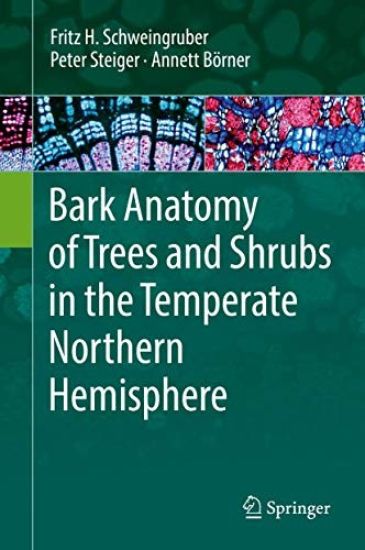
Bark Anatomy of Trees and Shrubs in the Temperate Northern Hemisphere

Bark Anatomy of Trees and Shrubs in the Temperate Northern Hemisphere

Fritz H. Schweingruber; Peter Steiger; Annett Börner

Springer Nature Switzerland AG
2019
sidottu
This book presents the microscopic and macroscopic bark structure of more than 180 different tree and shrub species from Europe, Asia and North America. It is the first compendium to demonstrate the anatomical variability in bark since almost 70 years (Holdheide 1951). The introductory chapter explains with high-quality microphotographs the anatomical traits most important for identification and ecological interpretation of barks, and the monographic part demonstrates in text and pictures the species-specific patterns. The species treatments are grouped by their main biomes. Each species description first characterizes the macroscopic aspects with its main form, features and habitat with text and pictures of the whole plant and the barks in a young and old stage. This is followed by the microscopical description of each species. The microscopic photographs are based on double-stained slides, revealing the quality and distribution of unlignified and lignified tissues in low and highmagnification. The book fills a scientific gap: Archeologists and soil scientists want to identify prehistoric and historical remnants. Ecophysiologists are interested in the distribution of conducting and non-conducting tissues in the phloem and xylem along the stem axis and the internal longevity of cells. Ecologists get information about internal defense mechanisms and technologists are enabled to recognize indicators relevant in biophysics and technology.
The Plant Stem

The Plant Stem

Fritz H. Schweingruber; Annett Börner

Springer Nature Switzerland AG
2019
nidottu
This unique and attractive open access textbook combines the beauty of macroscopic pictures of plant stems with the corresponding colorfully stained images of anatomical micro-structures. In contrast to most botanical textbooks, it presents all the stem characteristics as photographs and shows the microscopic reality. The amount of text is reduced to a minimum, and the scientific information is highlighted with short legends and labeled photographs, allowing readers to focus on the pictures to easily understand how the anatomical structures relate to genetic, ecological, decomposition and technical influences. It includes a chapter devoted to simple anatomical preparation techniques, and further chapters showing the cell content, cell walls, meristematic tissues and stem structures of all major taxonomic units and morphological growth forms in various ecological and climatic regions from subarctic to equatorial latitudes, as well as structures of fossil, subfossil and technically altered wood. This textbook appeals to students and researchers in the fields of plant anatomy, taxonomy, ecology, dendrochronology, history, plant pathology, and evolutionary biology as well as to technologists.
The Plant Stem

The Plant Stem

Fritz H. Schweingruber; Annett Börner

Springer International Publishing AG
2018
sidottu
This unique and attractive open access textbook combines the beauty of macroscopic pictures of plant stems with the corresponding colorfully stained images of anatomical micro-structures. In contrast to most botanical textbooks, it presents all the stem characteristics as photographs and shows the microscopic reality. The amount of text is reduced to a minimum, and the scientific information is highlighted with short legends and labeled photographs, allowing readers to focus on the pictures to easily understand how the anatomical structures relate to genetic, ecological, decomposition and technical influences. It includes a chapter devoted to simple anatomical preparation techniques, and further chapters showing the cell content, cell walls, meristematic tissues and stem structures of all major taxonomic units and morphological growth forms in various ecological and climatic regions from subarctic to equatorial latitudes, as well as structures of fossil, subfossil and technically altered wood. This textbook appeals to students and researchers in the fields of plant anatomy, taxonomy, ecology, dendrochronology, history, plant pathology, and evolutionary biology as well as to technologists.
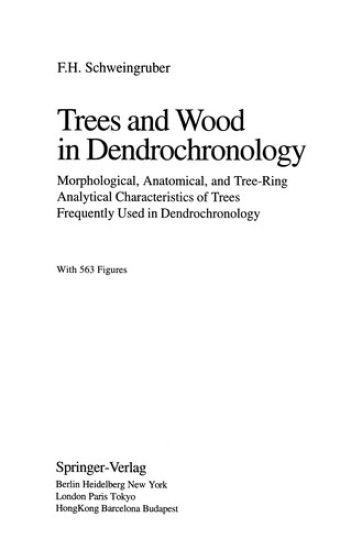
Trees and Wood in Dendrochronology

Trees and Wood in Dendrochronology

Fritz H. Schweingruber

Springer-Verlag Berlin and Heidelberg GmbH Co. K
2012
nidottu
The science of dendrochronology has grown significantly in the past 20 years. In the 1950s and 1960s, interest in the subject was limited to only a handful of scientists who perceived in dendrochronology a "l'art pour l'art". Today, however, specialists from many different fields recognize and are pursuing the problems of dendrochronology. Tree-ring research has acquired a permanent role in the various sciences of archeology, history, geology, ecology, and climatology. The founders of dendrochronology themselves were of varied scientific backgrounds and interests. For example, A. E. Douglass in the United States was an astronomer, B. Huber in Germany a forest-biologist, and F. N. Shvedov in Russia a climatologist. Today the spectrum is even broader. Many den­ drochronologists are authorities in mathematics, archeology, history, forestry, botany, wood technology, ecology geography, geology, etc. It is, therefore, understandable that it has become almost impossible for one individual to encompass the entire field. Bitvinskas (1974), Fritts (1976), Schweingruber (1983), and Mitsutani (1990) have attempted, each guided by his own interests, to provide at least an overview of the field. Recently, individual aspects have been presented by groups of authors in books edited by Fletscher (1978), Hughes et al. (1982), Jacoby and Hornbeck (1987) and Bradley and Jones (1992). It is very likely that in the future summaries covering each branch of dendrochronology will be published.