Kirjailija
Fyodor Dostoyevsky
Kirjat ja teokset yhdessä paikassa: 690 kirjaa, julkaisuja vuosilta 1864–2027, suosituimpiin kuuluu Called to Community. Vertaile teosten hintoja ja tarkista saatavuus suomalaisista kirjakaupoista.
690 kirjaa
Kirjojen julkaisuvuodet: 1864–2027.
Poor Folk sometimes translated as Poor People, is the first novel by Fyodor Dostoevsky, written over the span of nine months between 1844 and 1845. Dostoevsky was in financial difficulty because of his extravagant lifestyle and his developing gambling addiction; although he had produced some translations of foreign novels, they had little success, and he decided to write a novel of his own to try to raise funds. Inspired by the works of Gogol, Pushkin and Karamzin, as well as English and French authors, Poor Folk is written in the form of letters between the two main characters, Makar Devushkin and Varvara Dobroselova, who are poor third cousins twice removed. The novel showcases the life of poor people, their relationship with rich people, and poverty in general, all common themes of literary naturalism. A deep but odd friendship develops between them until Dobroselova loses her interest in literature, and later in communicating with Devushkin after a rich widower Mr. Bykov proposes to her. Devushkin, a prototype of the clerk found in many works of naturalistic literature at that time, retains his sentimental characteristics; Dobroselova abandons art, while Devushkin cannot live without literature. Contemporary critics lauded Poor Folk for its humanitarian themes. While Vissarion Belinsky dubbed the novel Russia's first "social novel" and Alexander Herzen called it a major socialist work, other critics detected parody and satire. The novel uses a complicated polyphony of voices from different perspectives and narrators. Initially offered by Dostoyevsky to the liberal-leaning magazine Fatherland Notes, the novel was published in the almanac, St. Petersburg Collection, on January 15, 1846. It became a huge success nationwide. Parts of it were translated into German by Wilhelm Wolfsohn and published in an 1846/1847 magazine. The first English translation was provided by Lena Milman in 1894, with an introduction by George Moore, cover art design by Aubrey Beardsley and publication by London's Mathews and Lane. (wikipedia.org)
The House of the Dead is a semi-autobiographical novel published in 1860-2 in the journal Vremya by Russian author Fyodor Dostoevsky, which portrays the life of convicts in a Siberian prison camp. The novel has also been published under the titles Memoirs from the House of The Dead, Notes from the Dead House (or Notes from a Dead House), and Notes from the House of the Dead. The book is, essentially, a disguised memoir; a loosely-knit collection of facts, events and philosophical discussion organised by "theme" rather than as a continuous story. Dostoevsky himself spent four years in exile in such a prison following his conviction for involvement in the Petrashevsky Circle. This experience allowed him to describe with great authenticity the conditions of prison life and the characters of the convicts. (wikipedia.org)
Fyodor Mikhailovich Dostoevsky (11 November 1821 - 9 February 1881), sometimes transliterated as Dostoyevsky, was a Russian novelist, philosopher, short story writer, essayist, and journalist. Dostoevsky's literary works explore human psychology in the troubled political, social, and spiritual atmospheres of 19th-century Russia, and engage with a variety of philosophical and religious themes. His most acclaimed works include Crime and Punishment (1866), The Idiot (1869), Demons (1872), and The Brothers Karamazov (1880). Dostoevsky's body of works consists of 12 novels, four novellas, 16 short stories, and numerous other works. Many literary critics rate him as one of the greatest psychological novelists in world literature. His 1864 novel Notes from Underground is considered to be one of the first works of existentialist literature. Dostoevsky was influenced by a wide variety of philosophers and authors including Pushkin, Gogol, Augustine, Shakespeare, Dickens, Balzac, Lermontov, Hugo, Poe, Plato, Cervantes, Herzen, Kant, Belinsky, Hegel, Schiller, Solovyov, Bakunin, Sand, Hoffmann, and Mickiewicz. His writings were widely read both within and beyond his native Russia and influenced an equally great number of later writers including Russians such as Aleksandr Solzhenitsyn and Anton Chekhov, philosophers Friedrich Nietzsche and Jean-Paul Sartre and the emergence of Existentialism and Freudianism. His books have been translated into more than 170 languages, and served as the basis for many films. (wikipedia.org)
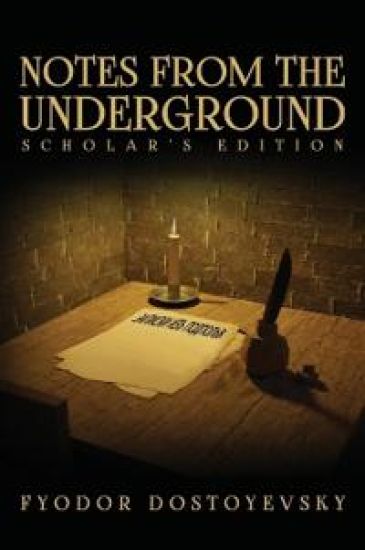
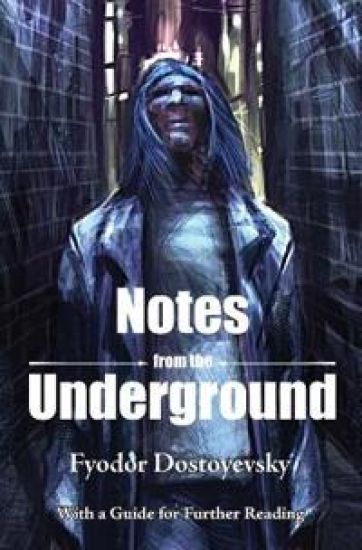
Notes from Underground (also translated as Notes from the Underground or Letters from the Underworld) is an 1864 novel by Fyodor Dostoevsky, and is considered by many to be one of the first existentialist novels. It presents itself as an excerpt from the rambling memoirs of a bitter, isolated, unnamed narrator (generally referred to by critics as the Underground Man), who is a retired civil servant living in St. Petersburg. The first part of the story is told in monologue form through the Underground Man's diary, and attacks contemporary Russian philosophy, especially Nikolay Chernyshevsky's What Is to Be Done?. The second part of the book is called "Apropos of the Wet Snow" and describes certain events that appear to be destroying and sometimes renewing the underground man, who acts as a first person, unreliable narrator and anti-hero. (wikipedia.org)
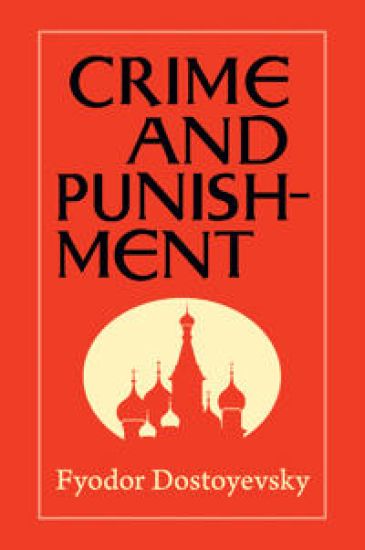
Complete and unabridged, and including a timeline of the life and times of Fyodor Dostoyevsky, this elegantly designed, jacketed hardcover edition of Crime and Punishment is an essential collectible. Young law student Rodion Raskolnikov lives in poverty in St. Petersburg. In desperation, he sells the last of his valuables, a watch, to an elderly pawnbroker. But what the pawnbroker doesn’t know is that Raskolnikov is rehearsing the crime he has resolved to commit: to rob and murder her. Though the robbery will service his own needs—and that of his family who has sacrificed for him to study—Raskolnikov feels he is righting a wrong committed by the old woman, whom he feels preys on the poor and desolate. When interrupted by the pawnbroker’s sister, he kills her too. Though he felt justified in killing the pawnbroker, the murder of the sister unravels his rational reasoning, and from there we witness the unraveling of the human psyche. While Raskolnikov worries about being caught, he is consumed with his own emotional turmoil about his desire to confess to relieve himself of his guilt. First serialized in 1866, Crime and Punishment has become one of the best-known works of Russian literature. Essential volumes for the shelves of every classic literature lover, the Chartwell Classics series includes beautifully presented works and collections from some of the most important authors in literary history. Chartwell Classics are the editions of choice for the most discerning literature buffs. Other titles in the Chartwell Classics Series include: The Essential Tales & Poems of Edgar Allen Poe; The Essential Tales of H. P. Lovecraft; The Federalist Papers; The Inferno; The Call of the Wild and White Fang; Moby Dick; The Odyssey; Pride and Prejudice; Grimm’s Fairy Tales; Emma; The Great Gatsby; The Secret Garden; Anne of Green Gables; The Phantom of the Opera; The Communist Manifesto and Das Kapital; The Republic; Frankenstein; Twenty Thousand Leagues Under the Sea; The Picture of Dorian Gray; Meditations; Alice’s Adventures in Wonderland and Through the Looking-Glass; A Tales of Two Cities; Beowulf; The Strange Case of Dr. Jekyll and Mr. Hyde; Adventures of Huckleberry Finn; Little Women; Wuthering Heights; Peter Pan; Persuasion; Aesop’s Fables; The Constitution of the United States and Selected Writings; The Alchemist; Dracula; Great Expectations; The Iliad; Irish and Fairy Folk Tales; The Legend of Sleepy Hollow; The War of the Worlds; and The Time Machine and The Invisible Man.
Are we witnessing a psychotic break? Or, has someone with physical features strikingly similar to his own spotted an opportunity, and seized it? In Fyodor Dostoevsky's The Double the question lingers to the end. As with all of Dostoevsky's writings, however, we are also left wondering if social commentary is being made, although in reality he is driving us all to maddening introspection. Are we so different from Golyadkin Sr. and Golyadkin Jr.? Are we at war with ourselves? Or, are others at war with us? Are these mutually exclusive propositions? In this edition, translated faithfully by Constance Garnett and published in 1923, readers can wrestle with these questions themselves.
A stunning book packed with thought-provoking ideas, amazing statements, and elegant sentences, "Notes from the Underground" is a novel written by Fyodor Dostoevsky in 1864. Yet it remains as fresh and relevant today as the day it was first published. It is the first existentialist novel, a sarcastic, self-effacing account of a man living by his own terms - the "Underground Man" - who narrates his thoughts and ideas to the reader as he walks the dark streets of a city's underworld.
The book "" The Grand Inquisitor "" has been considered important throughout the human history, and so that this work is never forgotten we have made efforts in its preservation by republishing this book in a modern format for present and future generations. This whole book has been reformatted, retyped and designed. These books are not made of scanned copies and hence the text is clear and readable.
The Brothers Karamazov also translated as The Karamazov Brothers, is the final novel by the Russian author Fyodor Dostoevsky. Dostoevsky spent nearly two years writing The Brothers Karamazov, which was published as a serial in The Russian Messenger from January 1879 to November 1880. Dostoevsky died less than four months after its publication. The Brothers Karamazov is a passionate philosophical novel set in 19th-century Russia, that enters deeply into the ethical debates of God, free will, and morality. It is a spiritual drama of moral struggles concerning faith, doubt, judgment, and reason, set against a modernizing Russia, with a plot which revolves around the subject of patricide. Dostoevsky composed much of the novel in Staraya Russa, which inspired the main setting. Since its publication, it has been acclaimed as one of the supreme achievements in world literature. Although written in the 19th century, The Brothers Karamazov displays a number of modern elements. Dostoevsky composed the book with a variety of literary techniques. Though privy to many of the thoughts and feelings of the protagonists, the narrator is a self-proclaimed writer he discusses his own mannerisms and personal perceptions so often in the novel that he becomes a character. Through his descriptions, the narrator's voice merges imperceptibly into the tone of the people he is describing, often extending into the characters' most personal thoughts. There is no voice of authority in the story (see Mikhail Bakhtin's Problems of Dostoevsky's Poetics for more on the relationship between Dostoevsky and his characters). In addition to the principal narrator there are several sections narrated by other characters entirely, such as the story of the Grand Inquisitor and Zosima's confessions. This technique enhances the theme of truth, making many aspects of the tale completely subjective. Dostoevsky uses individual styles of speech to express the inner personality of each person. For example, the attorney Fetyukovich (based on Vladimir Spasovich) is characterized by malapropisms citation needed] (e.g. 'robbed' for 'stolen', and at one point declares possible suspects in the murder 'irresponsible' rather than innocent). Several plot digressions provide insight into other apparently minor characters. For example, the narrative in Book Six is almost entirely devoted to Zosima's biography, which contains a confession from a man whom he met many years before.
Crime and Punishment is the 19th-century psychological thriller by esteemed Russian writer Fyodor Dostoevsky. Now 200 years after his birth, we celebrate this bicentennial with a new introduction by Professor Robin Miller, the perfect lead-in to the celebrated translation by Constance Garnett.
The Crocodile is a masterful satire of Russia's government bureaucracy. The story is written as a bizarre event in a matter-of-fact manner. The parody relates the events that befall one Ivan Matveich when he, his wife Elena Ivanovna, and the narrator visit the Arcade to see a crocodile that has been put on display by a German entrepreneur. After teasing the crocodile, Ivan Matveich is swallowed alive. He finds the inside of the crocodile to be quite comfortable, and the animal's owner refuses to allow it to be cut open, in spite of the pleas from Elena Ivanovna. Ivan Matveich urges the narrator to arrange for the crocodile to be purchased and cut open, but the owner asks so much for it that nothing is done. As the story ends Elena Ivanovna is contemplating divorce and Ivan Matveich resolves to carry on his work as a civil servant as best he can from inside the crocodile. Fyodor Dostoyevsky (1821-1881) was a Russian novelist, short story writer, essayist, journalist and philosopher. His literary works explore human psychology in the troubled political, social, and spiritual atmosphere of 19th-century Russia.
Fyodor Dostoevsky's short story "The Gambler" is about a young teacher working for a once-rich Russian general. The novella, which was in many respects inspired by Dostoevsky's own addiction to roulette, illustrates this behavior: Dostoevsky finished the book in 1866 under pressure to finish it before he had to pay off gambling debts. The Gambler dealt with gambling, a topic that Fyodor Dostoevsky was familiar with. In 1863, Fyodor Dostoevsky played a hand of cards at a Wiesbaden casino. He played frequently at Baden-Baden, Homburg, and Saxon-Les-Bains from that point on until 1871, when his fervor for gambling petered out. Frequently, he would start out winning a modest sum of money and end up losing much more. Fyodor Dostoevsky and F. T. Stellovsky then entered into a risky contract whereby Stellovsky would acquire the right to publish Dostoevsky's works for nine years, until 1 November 1875, without paying the author any money. This clause would apply if Dostoevsky failed to deliver a novel with 12 or more signatures by 1 November 1866. He jotted down some of his story's details before dictating them to one of Russia's earliest stenographers and his future bride, young Anna Grigorevna, who carefully wrote them out for him.
Financial difficulties resulting from an extravagant lifestyle and excessive gambling led Fyodor Dostoevsky to pen his first novel "Poor Folk". First published in 1846, "Poor Folk" is the story of impoverished cousins Varvara Dobroselova and Makar Devushkin. The two live in run-down apartments across the street from each other in St. Petersburg. Through a series of letters to each other we learn of the suffering, humiliation, and isolation that results from their poverty. Varvara Dobroselova is the daughter of cruel father and severely depressed mother. Dobroselova falls in love with the poor student Pokrovsky who has been tutoring her, but when he falls severely ill their courtship ends in tragedy. Devushkin works as a copyist where he is treated badly by his coworkers. The two bond over a love of literature exchanging books with each other. Eventually a series of fortunate circumstances improve their relative conditions but these changes draw the two apart from each other. An important social work that highlighted the struggles of the lower classes in 19th century Russia, "Poor Folk" received widespread acclaim upon its original publication and launched the career of one of Russia's most distinguished novelists. This edition is printed on premium acid-free paper and follows the translation of C. J. Hogarth.
The book "" The Gambler, has been considered important throughout the human history, and so that this work is never forgotten we have made efforts in its preservation by republishing this book in a modern format for present and future generations. This whole book has been reformatted, retyped and designed. These books are not made of scanned copies and hence the text is clear and readable.