Kirjojen hintavertailu – 12 859 818 kirjaa ja 27 kauppaa
Kirjailija
Fyodor Dostoyevsky
Kirjat ja teokset yhdessä paikassa: 690 kirjaa, julkaisuja vuosilta 1864–2027, suosituimpiin kuuluu Called to Community. Vertaile teosten hintoja ja tarkista saatavuus suomalaisista kirjakaupoista.
Is Russia So Different Now, 150 Years Later? Notes from Underground, also translated as Notes from the Underground or Letters from the Underworld, is an 1864 novella by Fyodor Dostoevsky. Notes is considered by many to be one of the first existentialist novels. It presents itself as an excerpt from the rambling memoirs of a bitter, isolated, unnamed narrator (generally referred to by critics as the Underground Man) who is a retired civil servant living in St. Petersburg. The first part of the story is told in monologue form, or the underground man's diary, and attacks emerging Western philosophy, especially Nikolay Chernyshevsky's What Is to Be Done?. The second part of the book is called "Apropos of the Wet Snow", and describes certain events that, it seems, are destroying and sometimes renewing the underground man, who acts as a first person,unreliable narrator and anti-hero. Get Your Copy Now.
The title is an ironic reference to the central character of the novel, Prince Lyov Nikolaevich Myshkin, a young man whose goodness and open-hearted simplicity lead many of the more worldly characters he encounters to mistakenly assume that he lacks intelligence and insight. In the character of Prince Myshkin, Dostoevsky set himself the task of depicting "the positively good and beautiful man". The novel examines the consequences of placing such a unique individual at the centre of the conflicts, desires, passions and egoism of worldly society, both for the man himself and for those with whom he becomes involved. The result, according to philosopher A. C. Grayling, is "one of the most excoriating, compelling and remarkable books ever written; and without question one of the greatest."
Notes is considered by many to be one of the first existentialist novels. It presents itself as an excerpt from the rambling memoirs of a bitter, isolated, unnamed narrator (generally referred to by critics as the Underground Man) who is a retired civil servant living in St. Petersburg. The first part of the story is told in monologue form, or the underground man's diary, and attacks emerging Western philosophy, especially Nikolay Chernyshevsky's What Is to Be Done?. The second part of the book is called " propos of the Wet Snow," and describes certain events that, it seems, are destroying and sometimes renewing the underground man, who acts as a first person, unreliable narrator and anti-hero.
Returning to St Petersburg from a Swiss sanatorium, the gentle and na ve epileptic Prince Myshkin - the titular 'idiot' - pays a visit to his distant relative General Yepanchin and proceeds to charm the General, his wife, and his three daughters. But his life is thrown into turmoil when he chances on a photograph of the beautiful Nastasya Filippovna. Utterly infatuated with her, he soon finds himself caught up in a love triangle and drawn into a web of blackmail, betrayal, and finally, murder. Inspired by an image of Christ's suffering Dostoyevsky sought to portray in Prince Myshkin the purity of a 'truly beautiful soul' and explore the perils that innocence and goodness face in a corrupt world.
El protagonista como persona que us los servicios de la usurera, es interrogado por el comisario, que sospecha de l como uno de los autores e intenta sorprenderlo con preguntas. Ello inquieta mucho a Rodi n. El crimen deja a Rodi n en gran confusi n, se debate consigo mismo sobre si su acci n ha sido buena o mala. Confiesa a su amiga Sonia, una muchacha pobre y buena, las razones de su crimen.
'My God! A whole minute of bliss! Is that really so little for the whole of a man's life?'A poignant tale of love and loneliness from Russia's foremost writer. One of 46 new books in the bestselling Little Black Classics series, to celebrate the first ever Penguin Classic in 1946. Each book gives readers a taste of the Classics' huge range and diversity, with works from around the world and across the centuries - including fables, decadence, heartbreak, tall tales, satire, ghosts, battles and elephants.
Fi dor Mikhailovitch Dostoi vski (Moscovo, 30 de outubro (c. juliano) / 11 de novembro de 1821 - S o Petersburgo, 28 de janeiro (c. juliano) / 9 de fevereiro de 1881) - ocasionalmente grafado como Dostoievsky - foi um escritor e fil sofo russo, considerado um dos maiores romancistas da hist ria e um dos mais inovadores artistas de todos os tempos. tido como o fundador do existencialismo, mais frequentemente por Notas do Subterr neo, descrito por Walter Kaufmann como a "melhor proposta para existencialismo j escrita". A obra dostoievskiana explora a autodestrui o, a humilha o e o assassinato, al m de analisar estados patol gicos que levam ao suic dio, loucura e ao homic dio: seus escritos s o chamados por isso de "romances de ideias", pela retrata o filos fica e atemporal dessas situa es. O modernismo liter rio e v rias escolas da teologia e psicologia foram influenciados por suas ideias.
Notes from Underground, also translated as Notes from the Underground or Letters from the Underworld, is an 1864 novella by Fyodor Dostoevsky. Notes is considered by many to be one of the first existentialist novels. It presents itself as an excerpt from the rambling memoirs of a bitter, isolated, unnamed narrator (generally referred to by critics as the Underground Man) who is a retired civil servant living in St. Petersburg. The first part of the story is told in monologue form, or the underground man's diary, and attacks emerging Western philosophy, especially Nikolay Chernyshevsky's What Is to Be Done?. The second part of the book is called " propos of the Wet Snow", and describes certain events that, it seems, are destroying and sometimes renewing the underground man, who acts as a first person, unreliable narrator and anti-hero.
"The Grand Inquisitor" is a parable in Fyodor Dostoyevsky's novel The Brothers Karamazov (1879-1880). It is told by Ivan, who questions the possibility of a personal and benevolent God, to his brother Alyosha, a novice monk. The Grand Inquisitor is an important part of the novel and one of the best-known passages in modern literature because of its ideas about human nature and freedom, and its fundamental ambiguity. Scholars cite Friedrich Schiller's play Don Carlos as a major inspiration for Dostoyevsky's Grand Inquisitor. However, it is also said that "The sources of the legend are extraordinarily varied and complex."
Fiodor Mikha lovitch Dosto evski est un crivain russe, n Moscou le 11 novembre (30 octobre) 1821 et mort Saint-P tersbourg le 28 janvier 1881. Consid r comme l'un des plus grands romanciers russes, il a influenc de nombreux crivains et philosophes. Apr s une enfance difficile, il fr quente une cole d'officiers et se lie avec les mouvements progressistes p tersbourgeois. Arr t en avril 1849, condamn mort, il est finalement d port dans un bagne de Sib rie pendant quatre ans. Redevenu sous-lieutenant, il d missionne de l'arm e en 1859 et s'engage compl tement dans l' criture. pileptique, joueur couvert de dettes et d'un caract re sombre, Dosto evski fuit ses cr anciers et m ne une vie d'errance en Europe au cours de laquelle il abandonne toute foi dans le socialisme et devient un patriote convaincu.
Sometimes also translated as "The Meek One", is a short story by Fyodor Dostoyevsky in 1876. The piece comes with the subtitle of "A Fantastic Story", and it chronicles the relationship between a pawnbroker and a girl that frequents his shop. The story was inspired by a news report that Dostoyevsky read in April 1876 about the suicide of a seamstress. Dostoyevsky referred to it as a "meek suicide" that "keeps haunting you for a long time."
The Gambler is a short novel by Fyodor Dostoyevsky about a young tutor in the employment of a formerly wealthy Russian general. The novella reflects Dostoyevsky's own addiction to roulette, which was in more ways than one the inspiration for the book: Dostoyevsky completed the novella under a strict deadline to pay off gambling debts. The novel was the basis of an opera by Sergei Prokofiev, also called The Gambler. Several films have been inspired by the book. The Great Sinner, a loose adaptation, starred Gregory Peck and Ava Gardner under the direction of Robert Siodmak in 1949. 1972 co-production of the USSR and Czechoslovakia by Lenfilm studio and Barrandov Studios, directed by Alexei Batalov which follows the book closely. Some see The Gambler (1974) written by James Toback, directed by Karel Reisz and starring James Caan, Paul Sorvino, and Lauren Hutton as a loose adaptation of the story in a twentieth-century American setting. The Gamblers, a German film released in 2007, was directed by Sebastian Bieniek. There are also two movies based on Dostoyevsky's life during the time when he was writing the novella. 1981 Soviet movie, Twenty Six Days from the Life of Dostoyevsky is the most notable one. Hungarian director K roly Makk's film The Gambler was released in 1997, and the romantic comedy Alex & Emma-freely adapted and with a modern setting-was released in 2003. An adaptation of the novella, The Gamblers, is among the early unpublished plays of Tom Stoppard. The Gambler (2014) is an American crime drama film directed by Rupert Wyatt from a screenplay by William Monahan, based on the original screenplay by James Toback. It is a remake of the 1974 film. A radio play version was aired by BBC Radio 4 in December 2010, written by Glyn Maxwell and directed by Guy Retallack.
The Gambler is a riveting portrait of a desperate young man in the grip of gambling addiction, a compulsion that author Dostoyevsky knew about intimately. In this succinct but powerful novel, the Russian master examines the irresistible impulses in human nature that take us to the dark side. The heroine of the story, Polina, is based on Polina Suslova, Dostoyevsky's lover in 1862-63.
The Gambler is a riveting portrait of a desperate young man in the grip of gambling addiction, a compulsion that author Dostoyevsky knew about intimately. In this succinct but powerful novel, the Russian master examines the irresistible impulses in human nature that take us to the dark side. The heroine of the story, Polina, is based on Polina Suslova, Dostoyevsky's lover in 1862-63.
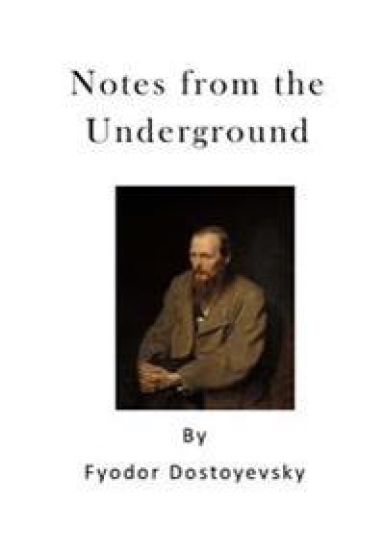
Notes from the UndergroundBy Fyodor DostoyevskyTranslated by Constance GarnettNotes from Underground, also translated as Notes from the Underground or Letters from the Underworld, is an 1864 novella by Fyodor Dostoyevsky. Notes is considered by many to be the first existentialist novel. It presents itself as an excerpt from the rambling memoirs of a bitter, isolated, unnamed narrator (generally referred to by critics as the Underground Man) who is a retired civil servant living in St. Petersburg. The first part of the story is told in monologue form, or the underground man's diary, and attacks emerging Western philosophy, especially Nikolay Chernyshevsky's What Is to Be Done?. The second part of the book is called "Apropos of the Wet Snow," and describes certain events that, it seems, are destroying and sometimes renewing the underground man, who acts as a first person, unreliable narrator.