
Kirjailija
G. R. S. Mead
Kirjat ja teokset yhdessä paikassa: 339 kirjaa, julkaisuja vuosilta 1992–2026, suosituimpiin kuuluu Selections: Essays of G.R.S. Mead. Vertaile teosten hintoja ja tarkista saatavuus suomalaisista kirjakaupoista.
Nimi esiintyy myös muodoissa: G R S Mead, G. R. S Mead, G.R.S Mead
339 kirjaa
Kirjojen julkaisuvuodet: 1992–2026.
Mystical Quests and the Search for Inner Illumination
G. R. S. Mead
Literary Licensing, LLC
2014
nidottu
Apollonius of Tyana: The Philosopher Reformer of the First Century A.D.
G. R. S. Mead
Literary Licensing, LLC
2014
nidottu
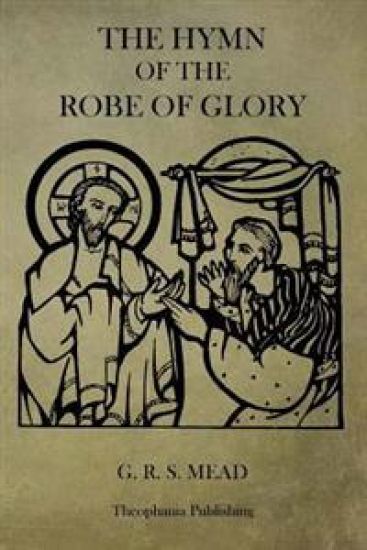
The Hymn of the Robe of Glory
G. R. S. Mead
Createspace Independent Publishing Platform
2013
nidottu
Thank you for checking out this book by Theophania Publishing. We appreciate your business and look forward to serving you soon. We have thousands of titles available, and we invite you to search for us by name, contact us via our website, or download our most recent catalogues. The original title of this beautiful Gnostic Poem has been lost, and it is now generally referred to as The Hymn of the Soul. Preuschen, however, calls it The Song of Deliverance (Das Lied von der Erl sung); while in my Fragments (1900) I ventured to name it The Hymn of the Robe of Glory. I here, also, prefer to retain this title, as it seems the more appropriate. The original text of the Poem is in Old Syriac, in lines of twelve syllables with a c sura, and so in couplets, for the most part of six syllables. A text of a Greek version has recently been discovered by Bonnet at Rome (C. Vallicellanus B. 35) and published in his text of The Acts of Thomas (1903). It is partly literal, partly paraphrastic, with occasional doublets and omissions of whole lines. In addition there is a summary in Greek by a certain Nicetas, Archibishop of Thessalonica, who flourished prior to the XIth century (the date of the MS. in which his abridgment is found), but who is otherwise unknown. This seems to be based on another Greek version. The copy of the original Syriac text is found in a single MS. only (Brit. Mus. Add. 14645), which contains a collection of Lives of Saints, and bears the precise date 936 A. D. Our Poem is found in the text of the Syriac translation from the Greek of The Acts of Judas Thomas the Apostle; it has, however, evidently nothing to do with the original Greek text of these Acts, and its style and contents are quite foreign to the rest of the matter. It is manifestly an independent document incorporated by the Syrian redactor, who introduces it in the usual na ve fashion of such compilations.
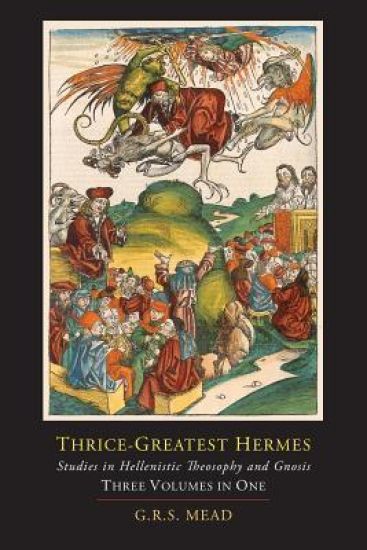
Thrice-Greatest Hermes; Studies in Hellenistic Theosophy and Gnosis [Three Volumes in One]
G R S Mead; Trismegistus Hermes
Martino Fine Books
2013
pokkari
The Quest: A Quarterly Review
G. R. S. Mead
Literary Licensing, LLC
2013
sidottu
Halvin toimitettuna 37,10 €
The Quest: A Quarterly Review is a collection of essays and articles written by G. R. S. Mead. Mead was a prominent scholar and writer in the field of esotericism, and this book reflects his deep knowledge and understanding of various spiritual and mystical traditions. The essays cover a wide range of topics, including Hermeticism, Gnosticism, theosophy, and the occult. Mead's writing is clear and insightful, and he presents complex ideas in a way that is accessible to readers of all levels of knowledge. The Quest is a valuable resource for anyone interested in the history and philosophy of esotericism, and Mead's contributions to the field continue to be highly regarded today. This is a new release of the original 1926 edition. This scarce antiquarian book is a facsimile reprint of the old original and may contain some imperfections such as library marks and notations. Because we believe this work is culturally important, we have made it available as part of our commitment for protecting, preserving, and promoting the world's literature in affordable, high quality, modern editions, that are true to their original work.
The Hymns of Hermes: Echoes from the Gnosis
G. R. S. Mead
Createspace Independent Publishing Platform
2013
nidottu
These volumes, complete in themselves as a series of studies in a definite body of tradition, are intended to serve ultimately as a small contribution to the preparation of the way leading towards a solution of the vast problems involved in the scientific study of the Origins of the Christian Faith. They might thus perhaps be described as the preparation of materials to serve for the historic, mythic, and mystic consideration of the Origins of Christianity, -where the term "mythic" is used in its true sense of inner, typical, sacred and "logic", as opposed to the external processioning of physical events known as "historic", and where the term "mystic" is used as that which pertains to initiation and the mysteries. The serious consideration of the matter contained in these pages will, I hope, enable the attentive reader to outline in his mind, however vaguely, some small portion of the environment of infant Christianity, and allow him to move a few steps round the cradle of Christendom. Though the material that we have collected, has, as to its externals, been tested, as far as our hands are capable of the work, by the methods of scholarship and criticism, it has nevertheless at the same time been allowed ungrudgingly to show itself the outward expression of a truly vital endeavour of immense interest and value to all who are disposed to make friends with it. For along this ray of the Trismegistic tradition we may allow ourselves to be drawn backwards in time towards the holy of holies of the Wisdom of Ancient Egypt. The sympathetic study of this material may well prove an initiatory process towards an understanding of that Archaic Gnosis.
The first part of his mental question is: How came this cosmos into being? The answer is the changing of the Boundless Presence into "Light, sweet joyous Light". He loses all sight of "all things" in his mind, the mental image he bad formed of cosmos, and is plunged into the infinitude of Limitless Light and Joy, which transports him out of himself in highest ecstasy. But he has craved for Gnosis, not Joy and Light, but Wisdom, the understanding and reconciliation of the great Opposites, the Cross of all Manifestation. Therefore must he know the Mystery of Ignorance as well as that of Knowledge. Within the Infinitude of Light appears the Shadow of the Unknown, which translates itself to his consciousness as Darkness, -the Shadow of the Thrice-unknown Darkness, which, as Damascus tells us, was the First Principle of the Egyptians, the Ineffable Mystery, of which they "said nothing", and of which our author says nothing. This Darkness comes forth from within outwards to the disciple's consciousness, it spreads "downwards" in sinuous folds like a Great Snake, symbolizing, presumably, the unknown, and to him unknowable, mysteries of the differentiation of the root of matter of the cosmos that was to be; its motion was spiral, sinuous, unending vibrations, not yet confined into a sphere; not yet ordered, but chaotic, in unceasing turmoil, a terrible contrast to the sweet peace of the Light, gradually changing from Dark Space or Spirit into a Fluid or Flowing Matter, or Moist Nature; that is, presumably, what the Greek mystics would have called Rhea, the Primal Mother or Matter of the future universe.