Kirjojen hintavertailu – 12 903 725 kirjaa ja 27 kauppaa

Kirjailija

Gabor Lugosi

Kirjat ja teokset yhdessä paikassa: 7 kirjaa, julkaisuja vuosilta 1996–2016, suosituimpiin kuuluu Concentration Inequalities. Vertaile teosten hintoja ja tarkista saatavuus suomalaisista kirjakaupoista.

Nimi esiintyy myös muodoissa: Gábor Lugosi

7 kirjaa

Kirjojen julkaisuvuodet: 1996–2016.

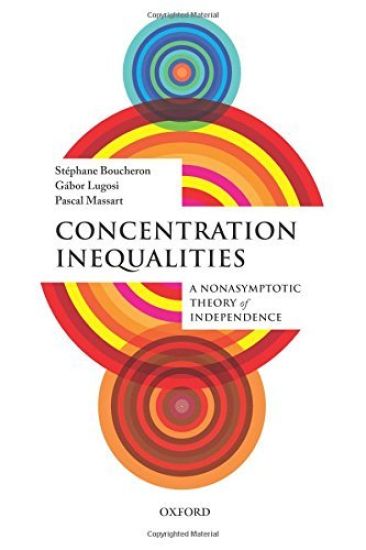
Concentration Inequalities

Concentration Inequalities

Stéphane Boucheron; Gábor Lugosi; Pascal Massart

Oxford University Press
2016
nidottu
Concentration inequalities for functions of independent random variables is an area of probability theory that has witnessed a great revolution in the last few decades, and has applications in a wide variety of areas such as machine learning, statistics, discrete mathematics, and high-dimensional geometry. Roughly speaking, if a function of many independent random variables does not depend too much on any of the variables then it is concentrated in the sense that with high probability, it is close to its expected value. This book offers a host of inequalities to illustrate this rich theory in an accessible way by covering the key developments and applications in the field. The authors describe the interplay between the probabilistic structure (independence) and a variety of tools ranging from functional inequalities to transportation arguments to information theory. Applications to the study of empirical processes, random projections, random matrix theory, and threshold phenomena are also presented. A self-contained introduction to concentration inequalities, it includes a survey of concentration of sums of independent random variables, variance bounds, the entropy method, and the transportation method. Deep connections with isoperimetric problems are revealed whilst special attention is paid to applications to the supremum of empirical processes. Written by leading experts in the field and containing extensive exercise sections this book will be an invaluable resource for researchers and graduate students in mathematics, theoretical computer science, and engineering.
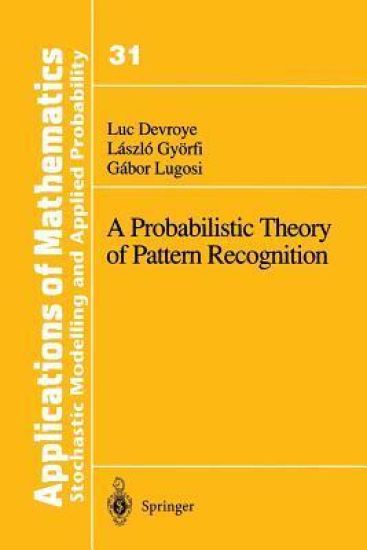
A Probabilistic Theory of Pattern Recognition

A Probabilistic Theory of Pattern Recognition

Luc Devroye; Laszlo Györfi; Gabor Lugosi

Springer-Verlag New York Inc.
2013
nidottu
Pattern recognition presents one of the most significant challenges for scientists and engineers, and many different approaches have been proposed. The aim of this book is to provide a self-contained account of probabilistic analysis of these approaches. The book includes a discussion of distance measures, nonparametric methods based on kernels or nearest neighbors, Vapnik-Chervonenkis theory, epsilon entropy, parametric classification, error estimation, free classifiers, and neural networks. Wherever possible, distribution-free properties and inequalities are derived. A substantial portion of the results or the analysis is new. Over 430 problems and exercises complement the material.
Concentration Inequalities

Concentration Inequalities

Stéphane Boucheron; Gábor Lugosi; Pascal Massart

Oxford University Press
2013
sidottu
Concentration inequalities for functions of independent random variables is an area of probability theory that has witnessed a great revolution in the last few decades, and has applications in a wide variety of areas such as machine learning, statistics, discrete mathematics, and high-dimensional geometry. Roughly speaking, if a function of many independent random variables does not depend too much on any of the variables then it is concentrated in the sense that with high probability, it is close to its expected value. This book offers a host of inequalities to illustrate this rich theory in an accessible way by covering the key developments and applications in the field. The authors describe the interplay between the probabilistic structure (independence) and a variety of tools ranging from functional inequalities to transportation arguments to information theory. Applications to the study of empirical processes, random projections, random matrix theory, and threshold phenomena are also presented. A self-contained introduction to concentration inequalities, it includes a survey of concentration of sums of independent random variables, variance bounds, the entropy method, and the transportation method. Deep connections with isoperimetric problems are revealed whilst special attention is paid to applications to the supremum of empirical processes. Written by leading experts in the field and containing extensive exercise sections this book will be an invaluable resource for researchers and graduate students in mathematics, theoretical computer science, and engineering.
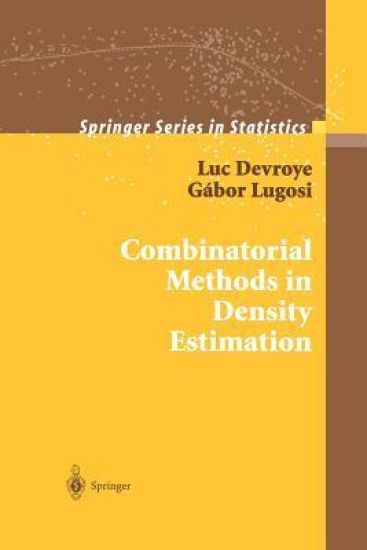
Combinatorial Methods in Density Estimation

Combinatorial Methods in Density Estimation

Luc Devroye; Gabor Lugosi

Springer-Verlag New York Inc.
2012
nidottu
Density estimation has evolved enormously since the days of bar plots and histograms, but researchers and users are still struggling with the problem of the selection of the bin widths. This text explores a new paradigm for the data-based or automatic selection of the free parameters of density estimates in general so that the expected error is within a given constant multiple of the best possible error. The paradigm can be used in nearly all density estimates and for most model selection problems, both parametric and nonparametric. It is the first book on this topic. The text is intended for first-year graduate students in statistics and learning theory, and offers a host of opportunities for further research and thesis topics. Each chapter corresponds roughly to one lecture, and is supplemented with many classroom exercises. A one year course in probability theory at the level of Feller's Volume 1 should be more than adequate preparation. Gabor Lugosi is Professor at Universitat Pompeu Fabra in Barcelona, and Luc Debroye is Professor at McGill University in Montreal. In 1996, the authors, together with Lászlo Györfi, published the successful text, A Probabilistic Theory of Pattern Recognition with Springer-Verlag. Both authors have made many contributions in the area of nonparametric estimation.
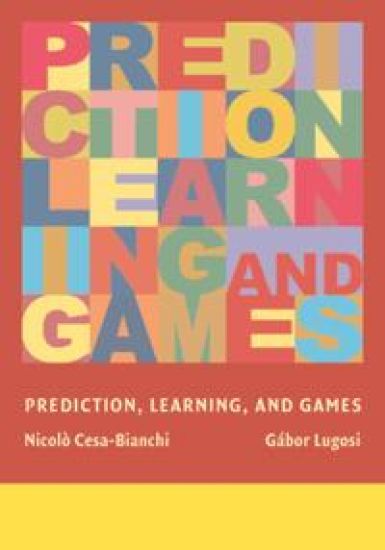
Prediction, Learning, and Games

Prediction, Learning, and Games

Nicolo Cesa-Bianchi; Gabor Lugosi

Cambridge University Press
2006
sidottu
This important text and reference for researchers and students in machine learning, game theory, statistics and information theory offers a comprehensive treatment of the problem of predicting individual sequences. Unlike standard statistical approaches to forecasting, prediction of individual sequences does not impose any probabilistic assumption on the data-generating mechanism. Yet, prediction algorithms can be constructed that work well for all possible sequences, in the sense that their performance is always nearly as good as the best forecasting strategy in a given reference class. The central theme is the model of prediction using expert advice, a general framework within which many related problems can be cast and discussed. Repeated game playing, adaptive data compression, sequential investment in the stock market, sequential pattern analysis, and several other problems are viewed as instances of the experts' framework and analyzed from a common nonstochastic standpoint that often reveals new and intriguing connections.
Combinatorial Methods in Density Estimation

Combinatorial Methods in Density Estimation

Luc Devroye; Gabor Lugosi

Springer-Verlag New York Inc.
2001
sidottu
Users of density estimation methods still struggle with selection of bin widths. This text explores a paradigm for data-based or automatic selection of free parameters of density estimates in general so that expected error is within a given constant multiple of best possible error.
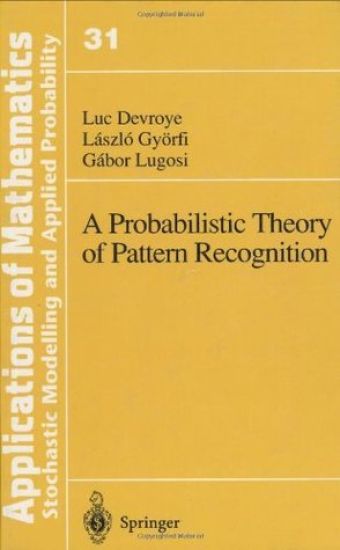
A Probabilistic Theory of Pattern Recognition

A Probabilistic Theory of Pattern Recognition

Luc Devroye; Laszlo Györfi; Gabor Lugosi

Springer-Verlag New York Inc.
1996
sidottu
Pattern recognition presents one of the most significant challenges for scientists and engineers, and many different approaches have been proposed. The aim of this book is to provide a self-contained account of probabilistic analysis of these approaches. The book includes a discussion of distance measures, nonparametric methods based on kernels or nearest neighbors, Vapnik-Chervonenkis theory, epsilon entropy, parametric classification, error estimation, free classifiers, and neural networks. Wherever possible, distribution-free properties and inequalities are derived. A substantial portion of the results or the analysis is new. Over 430 problems and exercises complement the material.