Kirjojen hintavertailu – 12 903 725 kirjaa ja 27 kauppaa

Kirjailija

Gabriel Gorodetsky

Kirjat ja teokset yhdessä paikassa: 7 kirjaa, julkaisuja vuosilta 2000–2021, suosituimpiin kuuluu Geopolitikens återkomst : striden om framtidens historia. Vertaile teosten hintoja ja tarkista saatavuus suomalaisista kirjakaupoista.

7 kirjaa

Kirjojen julkaisuvuodet: 2000–2021.

Geopolitikens återkomst : striden om framtidens historia

Geopolitikens återkomst : striden om framtidens historia

Jeremy Black; Philip Bobbitt; Michael Broers; Roger Crowley; Gregory Feifer; Noah Feldman; Jonathan Fenby; David Frum; Gabriel Gorodetsky; Peter Heather; Josef Joffe; Anna-Lena Laurén; John H. Maurer; Sean McMeekin; Walter Russell Mead; Richard Miles; Fraser Nelson; Richard Overy; Lincoln Paine; Andrew Preston; Morris Rossabi; Charly Salonius-Pasternak; Norman Stone; Barry Strauss; Mikael Wigell

Bokförlaget Stolpe
2021
sidottu
Det var inte länge sedan idén om att vi nått historiens slut vann kraft och spridning: tanken att människans sociokulturella evolution nått fram till en punkt där den knappast kunde nå längre. Ett kvartssekel senare verkar denna optimism ha försvunnit. I stället bevittnar vi nu geopolitikens återkomst. Ett tjugotal experter utforskar i denna antologi hur vi hamnade där vi är idag men också vart vi kan tänkas vara på väg. Huvudredaktörer är Kurt Almqvist och Alexander Linklater.
The Precarious Truce

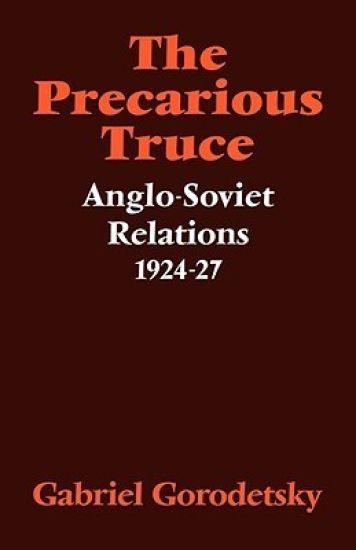
The Precarious Truce

Gabriel Gorodetsky

Cambridge University Press
2008
pokkari
Lenin's death at the beginning of 1924 coincided with an exhaustive search by the USSR for a modus vivendi with the capitalist world. In laying the foundations of peaceful co-existence, priority was given to the cultivation of relations with Britain. This study examines the British government's various responses to the Soviet overtures. The scope of the work ranges from Labour's de jure recognition of the Soviet Union at the beginning of 1924 to the Conservatives' severance of relations in May 1927. The bulk of the study is set against the background of rapidly deteriorating relations and traces the unsparing measures employed by the Russians to forestall an open breach. Equal attention is paid to the Soviet government's straightforward diplomatic moves and to activities under the auspices of Comintern and the Soviet trade unions which rallied support without regard to frontiers or international protocol. The main aim was to strengthen the security and economic recovery of the Soviet Union, but revolutionary aspirations remain on the agenda.
Stafford Cripps in Moscow, 1940-1942

Stafford Cripps in Moscow, 1940-1942

Gabriel Gorodetsky

Vallentine Mitchell Co Ltd
2007
nidottu
Sir Stafford Cripps, a country gentleman, ascetic, vegetarian and a devout Christian with a lucrative career at the bar, cut an incongruous figure in British politics of the 1930s. By the time war broke out, his position among Labour's most radical backbenchers had made him an outcast. It was his fortuitous appointment as ambassador to Moscow in 1940 which secured for him a prominent position in the War Cabinet and later on a key role in Attlee's Labour government. The diary, which he meticulously kept while in Moscow, describes the metamorphosis in his political fortune. As significant is the witness he bears to the dramatic turnabouts of the war: the German-Soviet collaboration following the Ribbentrop-Molotov Pact, the perfidious German invasion of Russia on 22 June 1941, and the emergence of the Grand Alliance. The diary offers candid glimpses of diplomatic life in Moscow and of the Kremlin on the eve of the war and reflects the sombre mood in the following months as the Wehrmacht reached the gates of Moscow. On the political front, Cripps' diary reveals the controversy surrounding the forging and nature of the Grand Alliance, which was deliberately glossed over in the memoirs of Winston Churchill. A sharp critic of Churchill's political vision, Cripps foresaw the emergence of a conflict between the Allies which he hoped to avert by devising a common strategy, and by formulating clear and perceptive guidelines for the post-war settlement.
Stafford Cripps' Mission to Moscow, 1940–42

Stafford Cripps' Mission to Moscow, 1940–42

Gabriel Gorodetsky

Cambridge University Press
2002
pokkari
This book offers a lively revisionist account of a crucial phase in the life of Stafford Cripps: his meteoric rise from the radical fringe of Parliament on the eve of the war to membership of the War Cabinet in 1942. Cripps’ ambassadorship to Moscow was of prime importance in view of the dramatic events during this period - the German conquest of Europe, Britain’s struggle for survival and Russia’s transformation from neutral to belligerent. Dr Gorodetsky assesses how Britain adapted to react to the changing circumstances and examines the recurrent controversy between Cripps and Churchill over Anglo-Soviet relations. New perspectives are opened on related issues such as the role of the civil service in policymaking, the British and Soviet appreciations of and reactions to intelligence on the planned German invasion of the Soviet Union and the origins of the controversies over assistance to Russia, the launching of the Second Front and the frontier issues.
Grand Delusion

Grand Delusion

Gabriel Gorodetsky

Yale University Press
2001
pokkari
This important book draws on vital new archival material to unravel the mystery of Hitler’s invasion of Russia in 1941 and Stalin’s enigmatic behavior on the eve of the attack. Gabriel Gorodetsky challenges the currently popular view that Stalin was about to invade Germany when Hitler made a preemptive strike. He argues instead that Stalin was actually negotiating for European peace, asserting that Stalin followed an unscrupulous Realpolitik that served well-defined geopolitical interests by seeking to redress the European balance of power. Gorodetsky substantiates his argument through the most thorough scrutiny ever of Soviet archives for the period, including the files of the Russian foreign ministry, the general staff, the security forces, and the entire range of military intelligence available to Stalin at the time. According to Gorodetsky, Stalin was eagerly anticipating a peace conference where various accords imposed on Russia would be revised. But the delusion of being able to dictate a new European order blinded him to the lurking German danger, and his erroneous diagnosis of the political scene—colored by his perennial suspicion of Great Britain—led him to misconstrue the evidence of his own and Britain’s intelligence services. Gorodetsky highlights the sequence of military blunders that resulted from Stalin’s determination to appease Germany—blunders that provide the key to understanding the calamity that befell Russia on 22 June 1941.
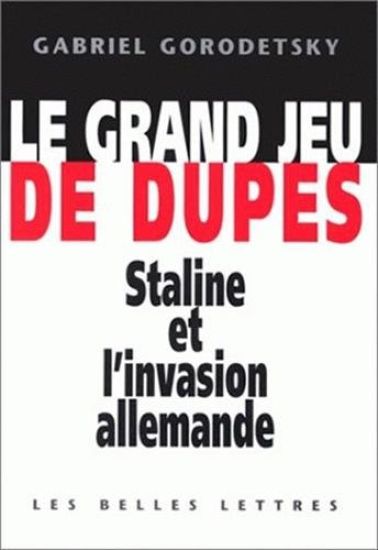
Le Grand Jeu de Dupes

Le Grand Jeu de Dupes

Gabriel Gorodetsky

Les Belles Lettres
2000
nidottu
Ce livre utilise des archives inedites pour elucider le mystere de l'invasion de la Russie par Hitler en 1941, et l'attitude enigmatique de Staline a la veille de l'attaque. Gabriel Gorodetsky conteste a la fois la vision officielle russe - Staline etait sur le point d'envahir l'Allemagne quand Hitler declencha une attaque preventive - et la vision occidentale - Staline s'est tout bonnement trompe. Il affirme, arguments a l'appui, que Staline etait un politicien sans scrupule mais rationnel, qui servait des interets geopolitiques bien precis en negociant activement une paix europeenne. Gabriel Gorodetsky s'appuie sur une etude minutieuse des archives sovietiques de cette periode, y compris les fichiers du ministere russe des Affaires etrangeres, de l'etat-major, des forces de securite, et sur la totalite des archives des services secrets militaires dont Staline disposait a cette epoque. D'apres Gabriel Gorodetsky, Staline preparait fievreusement une conference de paix ou seraient revises un certain nombre d'accords qui avaient ete imposes a la Russie. L'illusion de pouvoir imposer un nouvel ordre europeen l'aveugla au point de lui cacher le danger allemand, et son erreur de diagnostic - ainsi que sa mefiance permanente vis-a-vis de la Grande-Bretagne - l'amena a nier l'evidence que lui montraient a la fois ses propres services secrets et les services secrets britanniques. Gabriel Gorodetsky montre clairement la serie de gaffes militaires qui resulta de cette determination de Staline a apaiser l'Allemagne - gaffes qui donnent la cle du deluge qui s'abattit sur la Russie le 22 juin 1941. Gabriel Gorodetsky est professeur d'histoire et directeur du Curiel Center for International Affairs a l'Universite de Tel Aviv, ou il occupe la chaire Samuel Rubin d'histoire russe et d'Europe de l'Est. Il a notamment publie Stafford Cripps' Mission to Moscow (1987) et The Icebreaker Myth, edite a Moscou en 1995. Traduit de l'anglais par Isabelle Rozenbaumas.