Kirjojen hintavertailu – 12 903 725 kirjaa ja 27 kauppaa

Kirjailija

Gaetano Rossi

Kirjat ja teokset yhdessä paikassa: 59 kirjaa, julkaisuja vuosilta 2009–2025, suosituimpiin kuuluu Relation Logico-Mathématique Adressée À Mgr R. J. Schimmelpenninck À Fin de Lui Donner. Vertaile teosten hintoja ja tarkista saatavuus suomalaisista kirjakaupoista.

59 kirjaa

Kirjojen julkaisuvuodet: 2009–2025.
Evellina

Evellina

Carlo Coccia; Gaetano Rossi

Palala Press
2018
pokkari
This work has been selected by scholars as being culturally important, and is part of the knowledge base of civilization as we know it. This work was reproduced from the original artifact, and remains as true to the original work as possible. Therefore, you will see the original copyright references, library stamps (as most of these works have been housed in our most important libraries around the world), and other notations in the work. This work is in the public domain in the United States of America, and possibly other nations. Within the United States, you may freely copy and distribute this work, as no entity (individual or corporate) has a copyright on the body of the work. As a reproduction of a historical artifact, this work may contain missing or blurred pages, poor pictures, errant marks, etc. Scholars believe, and we concur, that this work is important enough to be preserved, reproduced, and made generally available to the public. We appreciate your support of the preservation process, and thank you for being an important part of keeping this knowledge alive and relevant.
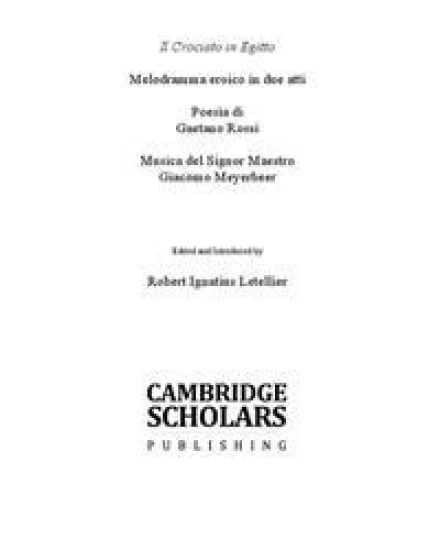
Il Crociato in Egitto

Il Crociato in Egitto

Gaetano Rossi; Gaetano Rossi

Cambridge Scholars Publishing
2009
sidottu
This book reproduces the Ricordi vocal score of Meyerbeer's last Italian opera (Milan, c. 1825). More than hardly any other opera of the first third of the nineteenth century, Il Crociato in Egitto (Venice, 1814) appears as work standing between the epochs. In its engagement with the traditions of the melodramma, Meyerbeer exploited here to the full all the possibilities offered by the form, without actually questioning its nature. Whereas Rossini in his Neapolitan operas had undertaken a transformation of the genre, moving it in the direction of French grand opera, Meyerbeer on the one hand continued a heightened development of the generic tendencies, while on the other affecting a deliberate resumption of older forms, already obsolete at this time (like simple romance structures and the use of recitativo secco, especially to mark the closure of scenes). The disparate medium of presentation spans isolated individual numbers and highly integrated tableaux of solo and chorus, traditional lyrical virtuosity and the dramaturgy of modern instrumental colour, melodic models from the eighteenth century, and anticipation of middle Verdi, integrated only by the strongly imprinted force of the individual style. Even more than in Margherita d'Anjou and L'Esule di Granata, the Crociato opens up to the historical opera. The personal conflict still determines the dramaturgy, but this is projected onto historical circumstances and given a philosophical component through the figure of the religious fanatic Adriano. Throughout the whole opera, the antagonism between the Crusaders and the Egyptians, until their final magnanimous reconciliation, is depicted in contrasting dramatic terms as the confrontation between two cultures and religions. The formal structures for such a dramaturgy also shapes the tableaux in this opera.