
Kirjailija
Galileo Galilei
Kirjat ja teokset yhdessä paikassa: 88 kirjaa, julkaisuja vuosilta 1914–2025, suosituimpiin kuuluu Dialogo Sopra I Due Massimi Sistemi Tolemaico E Copernicano 2. Vertaile teosten hintoja ja tarkista saatavuus suomalaisista kirjakaupoista.
88 kirjaa
Kirjojen julkaisuvuodet: 1914–2025.
Two New Sciences/A History of Free Fall
Galileo Galilei; Stillman Drake
Wall Emerson, Inc.
2000
nidottu
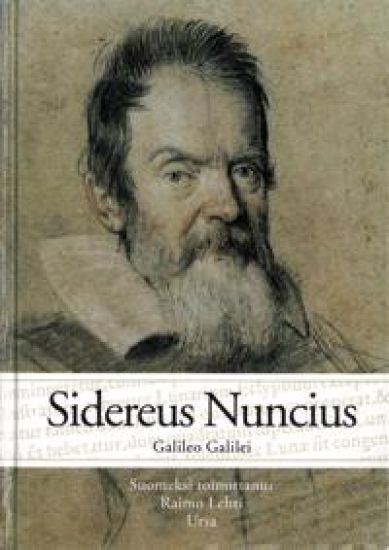
Sidereus Nuncius on vaikutuksiltaan ehkä dramaattisin koskaan julkaistu tieteellinen teos. Kirjassa Galileo Galilei paljastaa aikalaisilleen täysin tuntemattomia ilmiöitä, jotka hän oli havainnut uudella salaperäisellä laitteella, kaukoputkella. Nämä havainnot mullistivat maailmankuvan: Se pyörii sittenkin! Tämä on klassikon ensimmäinen suomenkielinen laitos. Käännöstekstin lisäksi teoksessa on selitysosa, jossa kerrotaan millaiseen maailmaan Sidereus Nuncius ilmestyi ja mikä Galilei oli miehiään. Puuhakas Galilei juoni itselleen taloudellisia etuja Venetsiasta ja Firenzestä. Galilei hioi erinomaisia linssejä, mutta ymmärsikö hän lainkaan, miten kaukoputki toimii?
Galileo's 1632 book, "Dialogue on the Two Chief World Systems, Ptolemaic and Copernican", comes alive for twentieth-century readers thanks to Maurice Finocchiaro's brilliant new translation and presentation. Condemned by the Inquisition for its heretical proposition that the earth revolves around the sun, Galileo's masterpiece takes the form of a debate, divided into four 'days,' among three highly articulate gentlemen. Finocchiaro sets the stage with his introduction, which not only provides the human and historical framework for the Dialogue but also admits the reader gracefully into the basic non-Copernican understanding of the universe that would have been shared by Galileo's original audience. The translation of the Dialogue is abridged in order to highlight its essential content, and Finocchiaro gives titles to the various parts of the debate as a guide to the principal topics. By explicating his own critical reading of this text that is itself an exercise in critical reasoning on a gripping real-life controversy, he illuminates those universal, perennial activities of the human mind that make Galileo's book a living document. This is a concrete, hands-on introduction to critical thinking. The translation has been made from the Italian text provided in volume 7 of the Critical National Edition of Galileo's complete works edited by Antonio Favaro. The translator has also consulted the 1632 edition, as well as the other previous English translations, including California's 1967 version. "Galileo on the World Systems" is a remarkably nuanced interpretation of a classic work and will give readers the tools to understand and evaluate for themselves one of the most influential scientific books in Western civilization.
Galileo Galilei was a great scientist, and therefore not afraid of causing controversy, even if he had to pay a great price. His public advocacy of the Copernican over the Aristotelian system of the universe flew directly in the face of biblical authority and ecclesiastical tradition. Condemned and placed under house arrest by the Inquisition, Galileo nonetheless devoted his last years to the completion of his Dialogues Concerning Two New Sciences, which deals with motion and the resistance of solids. The Two New Sciences, which Galileo called his most important work, may be regarded as the summary statement of a life devoted to scientific experimentation and free inquiry untrammeled by tradition and authority.
Galileo Galilei was a great scientist, and therefore not afraid of causing controversy, even if he had to pay a great price. His public advocacy of the Copernican over the Aristotelian system of the universe flew directly in the face of biblical authority and ecclesiastical tradition. Condemned and placed under house arrest by the Inquisition, Galileo nonetheless devoted his last years to the completion of his Dialogues Concerning Two New Sciences, which deals with motion and the resistance of solids. The Two New Sciences, which Galileo called his most important work, may be regarded as the summary statement of a life devoted to scientific experimentation and free inquiry untrammeled by tradition and authority.
Dialogue Concerning the Two Chief World Systems, Ptolemaic and Copernican, Second Revised edition
Galileo Galilei; Albert Einstein
University of California Press
1962
pokkari
This 1967 edition of the "Dialogue Concerning the Two Chief World Systems" is a revision of a 1953 edition. It includes a foreword by Albert Einstein, which is presented in en face German and English versions. The translation itself is based on the definitive National Edition prepared under the direction of Antonio Favaro and published at Florence in 1897. The material specifically added to the text by Galileo himself after publication of the first edition (1632) has been included as well. In addition, the margins of the book include translations of Galileo's own postils (running notes), placed as nearly as possible beside their textual references.
Galileo's groundbreaking dialogues are a summation of three decades of scientific work he had undertaken in the fledgling field of physics. This edition includes the diagrams crucial for understanding the text. Writing these dialogues in 1638, the elderly Galileo had a life of achievements behind him. Despite attempts at suppression of his writings by the Roman Inquisition, his ideas were successfully communicated across Europe. The motion of objects and resistance to such motion, the concept of velocity, and the laws of gravity are merely a few of the topics covered in these detailed dialogues. At the outset, we are introduced to the three conversation partners: Salviati, Sagredo and Simplicio. These three Venetians embark on a scientific discussion, hoping to explain the curiosities of things such as speed and movement. Over the course of four days, their meetings grow in complexity and scope as they strive to explain physical phenomena. Later, we encounter many propositions and theorems concerning a wide variety of subjects; these represent the sum of Galileo's progress in understanding gravity, motion, resistance, acceleration, velocity, and the behavior of material structures. The 'Two New Sciences' referred to by the title are the nature of materials, and the motion of objects. A total of 130 illustrations and charts populate this text; for the most part, they are situated adjacent to their respective proposition or theorem. In many of the more complex explanations, they are important in aiding the reader to grasp what Galileo means. Through absorbing these wide-ranging investigations, we may appreciate the justness of Galileo's moniker: "The father of modern physics." This edition's translation to English is by Alfonso de Salvio and Henry Crew. The former was an expert on the technical aspects of the Italian language, while the latter was a longstanding scholar of physics with much experience teaching in the field.