Kirjojen hintavertailu – 12 903 725 kirjaa ja 27 kauppaa

Kirjailija

Gangolf Groh

Kirjat ja teokset yhdessä paikassa: 5 kirjaa, julkaisuja vuosilta 2000–2012, suosituimpiin kuuluu Keynesianische Makroökonomik. Vertaile teosten hintoja ja tarkista saatavuus suomalaisista kirjakaupoista.

5 kirjaa

Kirjojen julkaisuvuodet: 2000–2012.

Keynesianische Makroökonomik

Keynesianische Makroökonomik

Peter Flaschel; Gangolf Groh; Hans-Martin Krolzig; Christian Proaño

Springer-Verlag Berlin and Heidelberg GmbH Co. K
2012
nidottu
Dieses Lehrbuch zur makroökonomischen Theorie betrachtet die Einkommens-, Zins- und Beschäftigungstheorie, die Analyse von Inflation und Unterbeschäftigung und die Wachstumstheorie durchgängig aus keynesianscher Sicht. Es konfrontiert die dabei erzielten Aussagen und Ergebnisse insbesondere mit den Resultaten der Neo- und Neuklassik, des Monetarismus wie auch der Theorie realer Konjunkturzykeln und des momentan vorherrschenden Ansatzes der New-Keynesians. Dieses Textbuch stellt deshalb ein wichtiges Supplement zu allen Lehrbüchern dar, die Inflations- und Wachstumsprozesse primär aus neoklassischer Sicht analysieren. Sein erster Teil kann als Einführung in makroökonomische Sichtweisen verwendet werden, während Teil II die Integration von Inflations- und Wachstumstheorie mit der keynesianischen Analyse von Einkommen, Zins und Beschäftigung vorbehalten ist.
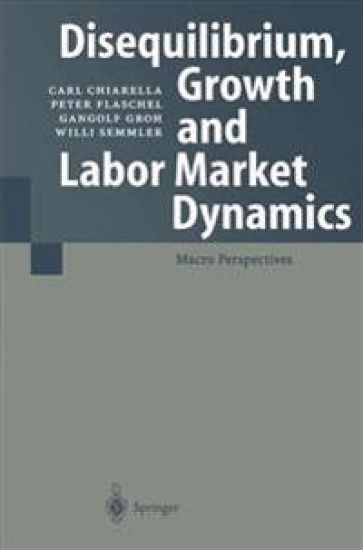
Disequilibrium, Growth and Labor Market Dynamics

Disequilibrium, Growth and Labor Market Dynamics

Carl Chiarella; Peter Flaschel; Gangolf Groh; Willi Semmler

Springer-Verlag Berlin and Heidelberg GmbH Co. K
2011
nidottu
In this book on disequilibrium, growth and labor market dynamics we take predominantly a macroeconomic perspective. We present a working model that can easily be varied in different directions in order to subsume innovations in the literature on macroeconomics, old and new, and to contribute to important currently discussed macroeconomic issues. Our working model is set up in a way that there is a close relationship between our presented dynamic models and modern macro econometric models with disequilibrium both in the labor and the goods markets. One of our objectives is, therefore, to narrow the gap between theoretical and applied structural macrodynamic model building. We hope that the book will be a useful reference for all researchers, academic teachers and practitioners of macroeconomic and macro econometric model building who are interested in economic dynamics, independently of whether they use equilibrium or disequilibrium methods in their own research. We base this hope on the fact that our approach contains a number of unique features. The emphasis on the identification and analysis of the basic feedback mechanisms at work in modern macro economies. A detailed study of the partial as well as integrated dynamic interaction between these feedback mechanisms that consti­ tute the interdependence of markets and sectors of the modern macro economy. The rela­ tionship between the macroeconomic framework of our working model and the Walrasian, Non-Walrasian and New-Keynesian reformulations of macroeconomics.
Topics in Applied Macrodynamic Theory

Topics in Applied Macrodynamic Theory

Peter Flaschel; Gangolf Groh; Christian Proano; Willi Semmler

Springer-Verlag Berlin and Heidelberg GmbH Co. K
2010
nidottu
This book is about the study of topics in macro dynamics from an applied, empirical perspective. The modeling philosophy behind most of the chapters ofthisbookisofKeynesiannature,representinganattempttorevivethist- oreticalperspectiveontheworkingofthemacroeconomy. Themacroeconomic research pursued here is somewhat di?erent from the mainstream literature using the Dynamic Stochastic General Equilibrium (DSGE) approach as the basic modeling device. The main features of the latter are the assumptions of intertemporally optimizing agents, rational expectations, competitive m- kets and price mediated market clearing through su?ciently ?exible prices and wages. The New Keynesian approach to macroeconomics has, in the last decade or so, to a large extent, also adopted the DSGE framework, building on intertemporally optimizing agents and market clearing, but favoring more the concept of monopolistic competition, sticky wages and prices and nominal as well as real rigidities. An path breaking work of this type is the recent book by Woodford (2003). However, it is well known that the intertemporal approach of smoothly optimizing agents and fast adjustments in order to establish temporal or - tertemporal marginal conditions in the product market, labor and capital markets, has not been very successful to match certain stylized facts on those markets. A further de?ciency of those intertemporal decision models is that macroeconomic feedback e?ects—and their stabilizing or destabilizing impact on the macroeconomy—have rarely been considered in those models. Yet, those feedback mechanisms, relevant for the interaction of all three markets, have been theoretically and empirically explored since the 1930s.
Topics in Applied Macrodynamic Theory

Topics in Applied Macrodynamic Theory

Peter Flaschel; Gangolf Groh; Christian Proano; Willi Semmler

Springer-Verlag Berlin and Heidelberg GmbH Co. K
2008
sidottu
This book is about the study of topics in macro dynamics from an applied, empirical perspective. The modeling philosophy behind most of the chapters ofthisbookisofKeynesiannature,representinganattempttorevivethist- oreticalperspectiveontheworkingofthemacroeconomy. Themacroeconomic research pursued here is somewhat di?erent from the mainstream literature using the Dynamic Stochastic General Equilibrium (DSGE) approach as the basic modeling device. The main features of the latter are the assumptions of intertemporally optimizing agents, rational expectations, competitive m- kets and price mediated market clearing through su?ciently ?exible prices and wages. The New Keynesian approach to macroeconomics has, in the last decade or so, to a large extent, also adopted the DSGE framework, building on intertemporally optimizing agents and market clearing, but favoring more the concept of monopolistic competition, sticky wages and prices and nominal as well as real rigidities. An path breaking work of this type is the recent book by Woodford (2003). However, it is well known that the intertemporal approach of smoothly optimizing agents and fast adjustments in order to establish temporal or - tertemporal marginal conditions in the product market, labor and capital markets, has not been very successful to match certain stylized facts on those markets. A further de?ciency of those intertemporal decision models is that macroeconomic feedback e?ects—and their stabilizing or destabilizing impact on the macroeconomy—have rarely been considered in those models. Yet, those feedback mechanisms, relevant for the interaction of all three markets, have been theoretically and empirically explored since the 1930s.
Disequilibrium, Growth and Labor Market Dynamics

Disequilibrium, Growth and Labor Market Dynamics

Carl Chiarella; Peter Flaschel; Gangolf Groh; Willi Semmler

Springer-Verlag Berlin and Heidelberg GmbH Co. K
2000
sidottu
In this book on disequilibrium, growth and labor market dynamics we take predominantly a macroeconomic perspective. We present a working model that can easily be varied in different directions in order to subsume innovations in the literature on macroeconomics, old and new, and to contribute to important currently discussed macroeconomic issues. Our working model is set up in a way that there is a close relationship between our presented dynamic models and modern macro econometric models with disequilibrium both in the labor and the goods markets. One of our objectives is, therefore, to narrow the gap between theoretical and applied structural macrodynamic model building. We hope that the book will be a useful reference for all researchers, academic teachers and practitioners of macroeconomic and macro econometric model building who are interested in economic dynamics, independently of whether they use equilibrium or disequilibrium methods in their own research. We base this hope on the fact that our approach contains a number of unique features. The emphasis on the identification and analysis of the basic feedback mechanisms at work in modern macro economies. A detailed study of the partial as well as integrated dynamic interaction between these feedback mechanisms that consti­ tute the interdependence of markets and sectors of the modern macro economy. The rela­ tionship between the macroeconomic framework of our working model and the Walrasian, Non-Walrasian and New-Keynesian reformulations of macroeconomics.