Kirjojen hintavertailu – 12 903 724 kirjaa ja 27 kauppaa

Kirjailija

Gary Marks

Kirjat ja teokset yhdessä paikassa: 13 kirjaa, julkaisuja vuosilta 1996–2019, suosituimpiin kuuluu Community, Scale, and Regional Governance. Vertaile teosten hintoja ja tarkista saatavuus suomalaisista kirjakaupoista.

13 kirjaa

Kirjojen julkaisuvuodet: 1996–2019.

A Theory of International Organization

A Theory of International Organization

Liesbet Hooghe; Tobias Lenz; Gary Marks

Oxford University Press
2019
sidottu
Why do international organizations (IOs) look so different, yet so similar? The possibilities are diverse. Some international organizations have just a few member states, while others span the globe. Some are targeted at a specific problem, while others have policy portfolios as broad as national states. Some are run almost entirely by their member states, while others have independent courts, secretariats, and parliaments. Variation among international organizations appears as wide as that among states. This book explains the design and development of international organization in the postwar period. It theorizes that the basic set up of an IO responds to two forces: the functional impetus to tackle problems that spill beyond national borders and a desire for self-rule that can dampen cooperation where transnational community is thin. The book reveals both the causal power of functionalist pressures and the extent to which nationalism constrains the willingness of member states to engage in incomplete contracting. The implications of postfunctionalist theory for an IO's membership, policy portfolio, contractual specificity, and authoritative competences are tested using annual data for 76 IOs for 1950-2010. Transformations in Governance is a major academic book series from Oxford University Press. It is designed to accommodate the impressive growth of research in comparative politics, international relations, public policy, federalism, environmental and urban studies concerned with the dispersion of authority from central states up to supranational institutions, down to subnational governments, and side-ways to public-private networks. It brings together work that significantly advances our understanding of the organization, causes, and consequences of multilevel and complex governance. The series is selective, containing annually a small number of books of exceptionally high quality by leading and emerging scholars. The series targets mainly single-authored or co-authored work, but it is pluralistic in terms of disciplinary specialization, research design, method, and geographical scope. Case studies as well as comparative studies, historical as well as contemporary studies, and studies with a national, regional, or international focus are all central to its aims. Authors use qualitative, quantitative, formal modeling, or mixed methods. A trade mark of the books is that they combine scholarly rigour with readable prose and an attractive production style. The series is edited by Liesbet Hooghe and Gary Marks of the University of North Carolina, Chapel Hill, and the VU Amsterdam, and Walter Mattli of the University of Oxford.
A Theory of International Organization

A Theory of International Organization

Liesbet Hooghe; Tobias Lenz; Gary Marks

Oxford University Press
2019
nidottu
Why do international organizations (IOs) look so different, yet so similar? The possibilities are diverse. Some international organizations have just a few member states, while others span the globe. Some are targeted at a specific problem, while others have policy portfolios as broad as national states. Some are run almost entirely by their member states, while others have independent courts, secretariats, and parliaments. Variation among international organizations appears as wide as that among states. This book explains the design and development of international organization in the postwar period. It theorizes that the basic set up of an IO responds to two forces: the functional impetus to tackle problems that spill beyond national borders and a desire for self-rule that can dampen cooperation where transnational community is thin. The book reveals both the causal power of functionalist pressures and the extent to which nationalism constrains the willingness of member states to engage in incomplete contracting. The implications of postfunctionalist theory for an IO's membership, policy portfolio, contractual specificity, and authoritative competences are tested using annual data for 76 IOs for 1950-2010. Transformations in Governance is a major academic book series from Oxford University Press. It is designed to accommodate the impressive growth of research in comparative politics, international relations, public policy, federalism, environmental and urban studies concerned with the dispersion of authority from central states up to supranational institutions, down to subnational governments, and side-ways to public-private networks. It brings together work that significantly advances our understanding of the organization, causes, and consequences of multilevel and complex governance. The series is selective, containing annually a small number of books of exceptionally high quality by leading and emerging scholars. The series targets mainly single-authored or co-authored work, but it is pluralistic in terms of disciplinary specialization, research design, method, and geographical scope. Case studies as well as comparative studies, historical as well as contemporary studies, and studies with a national, regional, or international focus are all central to its aims. Authors use qualitative, quantitative, formal modeling, or mixed methods. A trade mark of the books is that they combine scholarly rigour with readable prose and an attractive production style. The series is edited by Liesbet Hooghe and Gary Marks of the University of North Carolina, Chapel Hill, and the VU Amsterdam, and Walter Mattli of the University of Oxford.
Measuring International Authority

Measuring International Authority

Liesbet Hooghe; Gary Marks; Tobias Lenz; Jeanine Bezuijen; Besir Ceka; Svet Derderyan

Oxford University Press
2017
sidottu
This is the third of five ambitious volumes theorizing the structure of governance above and below the central state. This book is written for those interested in the character, causes, and consequences of governance within the state. This book sets out a measure of authority for seventy-six international organizations (IOs) from 1950, or the time of their establishment, to 2010 which can allow researchers to test expectations about the character, sources, and consequences of international governance. The international organizations considered are regional (e.g. the EU, Andean Community, NAFTA), cross-regional (e.g. Commonwealth of Nations, the Organization of Islamic Cooperation), and global (e.g. the UN, World Bank, WTO). Firstly, the book introduces carefully constructed estimates for the scope and depth of authority exercised by international governments. The estimates are unique in their comparative scope, their specificity, and time span. Secondly, it describes describe broad trends in IO authority by comparing delegation and pooling, over time, across IOs, and across decision areas. Thirdly, it presents the evidence gathered by the authors to estimate international authority by carefully discussing forty-seven international organizations, and showing how their bodies are composed, what decisions each body makes, and how they make decisions. Transformations in Governance is a major new academic book series from Oxford University Press. It is designed to accommodate the impressive growth of research in comparative politics, international relations, public policy, federalism, environmental and urban studies concerned with the dispersion of authority from central states up to supranational institutions, down to subnational governments, and side-ways to public-private networks. It brings together work that significantly advances our understanding of the organization, causes, and consequences of multilevel and complex governance. The series is selective, containing annually a small number of books of exceptionally high quality by leading and emerging scholars. The series targets mainly single-authored or co-authored work, but it is pluralistic in terms of disciplinary specialization, research design, method, and geographical scope. Case studies as well as comparative studies, historical as well as contemporary studies, and studies with a national, regional, or international focus are all central to its aims. Authors use qualitative, quantitative, formal modeling, or mixed methods. A trade mark of the books is that they combine scholarly rigour with readable prose and an attractive production style. The series is edited by Liesbet Hooghe and Gary Marks of the University of North Carolina, Chapel Hill, and Walter Mattli of the University of Oxford.
Community, Scale, and Regional Governance

Community, Scale, and Regional Governance

Liesbet Hooghe; Gary Marks

Oxford University Press
2016
sidottu
This is the second of five ambitious volumes theorizing the structure of governance above and below the central state. This book is written for those interested in the character, causes, and consequences of governance within the state. The book argues that jurisdictional design is shaped by the functional pressures that arise from the logic of scale in providing public goods and by the preferences that people have regarding self-government. The first has to do with the character of the public goods provided by government: their scale economies, externalities, and informational asymmetries. The second has to do with how people conceive and construct the groups to which they feel themselves belonging. In this book, the authors demonstrate that scale and community are principles that can help explain some basic features of governance, including the growth of multiple tiers over the past six decades, how jurisdictions are designed, why governance within the state has become differentiated, and the extent to which regions exert authority. The authors propose a postfunctionalist theory which rejects the notion that form follows function, and argue that whilst functional pressures are enduring, one must engage human passions regarding self-rule to explain variation in the structures of rule over time and around the world. Transformations in Governance is a major new academic book series from Oxford University Press. It is designed to accommodate the impressive growth of research in comparative politics, international relations, public policy, federalism, environmental and urban studies concerned with the dispersion of authority from central states up to supranational institutions, down to subnational governments, and side-ways to public-private networks. It brings together work that significantly advances our understanding of the organization, causes, and consequences of multilevel and complex governance. The series is selective, containing annually a small number of books of exceptionally high quality by leading and emerging scholars. The series targets mainly single-authored or co-authored work, but it is pluralistic in terms of disciplinary specialization, research design, method, and geographical scope. Case studies as well as comparative studies, historical as well as contemporary studies, and studies with a national, regional, or international focus are all central to its aims. Authors use qualitative, quantitative, formal modeling, or mixed methods. A trade mark of the books is that they combine scholarly rigour with readable prose and an attractive production style. The series is edited by Liesbet Hooghe and Gary Marks of the University of North Carolina, Chapel Hill, and the VU Amsterdam, and Walter Mattli of the University of Oxford.
Measuring Regional Authority

Measuring Regional Authority

Liesbet Hooghe; Gary Marks; Arjan H. Schakel; Sandra Chapman Osterkatz; Sara Niedzwiecki; Sarah Shair-Rosenfield

Oxford University Press
2016
sidottu
This is the first of five ambitious volumes theorizing the structure of governance above and below the central state. This book is written for those interested in the character, causes, and consequences of governance within the state and for social scientists who take measurement seriously. The book sets out a measure of regional authority for 81 countries in North America, Europe, Latin America, Asia, and the Pacific from 1950 to 2010. Subnational authority is exercised by individual regions, and this measure is the first that takes individual regions as the unit of analysis. On the premise that transparency is a fundamental virtue in measurement, the authors chart a new path in laying out their theoretical, conceptual, and scoring decisions before the reader. The book also provides summaries of regional governance in 81 countries for scholars and students alike. Transformations in Governance is a major new academic book series from Oxford University Press. It is designed to accommodate the impressive growth of research in comparative politics, international relations, public policy, federalism, environmental and urban studies concerned with the dispersion of authority from central states up to supranational institutions, down to subnational governments, and side-ways to public-private networks. It brings together work that significantly advances our understanding of the organization, causes, and consequences of multilevel and complex governance. The series is selective, containing annually a small number of books of exceptionally high quality by leading and emerging scholars. The series targets mainly single-authored or co-authored work, but it is pluralistic in terms of disciplinary specialization, research design, method, and geographical scope. Case studies as well as comparative studies, historical as well as contemporary studies, and studies with a national, regional, or international focus are all central to its aims. Authors use qualitative, quantitative, formal modeling, or mixed methods. A trade mark of the books is that they combine scholarly rigour with readable prose and an attractive production style. The series is edited by Liesbet Hooghe and Gary Marks of the University of North Carolina, Chapel Hill, and the VU Amsterdam, and Walter Mattli of the University of Oxford.
The Rise of Regional Authority

The Rise of Regional Authority

Liesbet Hooghe; Gary Marks; Arjan Schakel

Routledge
2010
nidottu
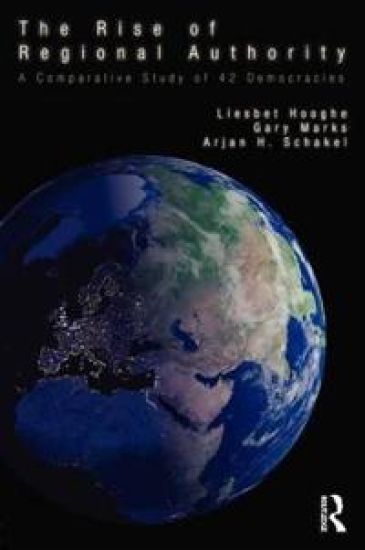
Most countries around the globe have one or two levels of regional or intermediate government, yet we have little systematic idea of how much authority they wield, or how this has changed over time. This book measures and explains the formal authority of intermediate or regional government in 42 advanced democracies, including the 27 EU member states. It tracks regional authority on an annual basis from 1950 to 2006. The measure reveals wide variation both cross-sectionally and over time. The authors examine four influences – functional pressures, democratization, European integration, and identity – to explain regionalization over the past half-century. This unique and comprehensive volume will be a vital resource for students and scholars of comparative politics, public administration and public management, federalism, democratization, nationalism, and multilevel governance.
The Rise of Regional Authority

The Rise of Regional Authority

Liesbet Hooghe; Gary Marks; Arjan Schakel

Routledge
2010
sidottu
Most countries around the globe have one or two levels of regional or intermediate government, yet we have little systematic idea of how much authority they wield, or how this has changed over time. This book measures and explains the formal authority of intermediate or regional government in 42 advanced democracies, including the 27 EU member states. It tracks regional authority on an annual basis from 1950 to 2006. The measure reveals wide variation both cross-sectionally and over time. The authors examine four influences – functional pressures, democratization, European integration, and identity – to explain regionalization over the past half-century. This unique and comprehensive volume will be a vital resource for students and scholars of comparative politics, public administration and public management, federalism, democratization, nationalism, and multilevel governance.
Rocking Wall Street

Rocking Wall Street

Gary Marks; John Mauldin

John Wiley Sons Inc
2007
sidottu
Praise for Rocking Wall Street ". . . the only four investment strategies you will ever need. . . I dare anyone to read this book and not wake up to the realities of Wall Street, and change their investing habits on the spot." —Steve Trager Watson Retired CEO and CIO of the hedge fund Watson Investment Partners, LP "A true Renaissance man and teacher, Gary Marks adeptly explores four investment strategies that can achieve strong results and peace of mind-two concepts usually considered mutually exclusive in the world of Wall Street investing. Using his vast experience and folksy storytelling, Gary provides lessons, anecdotes, and strategies that will help readers find multiple levels of success." —Mitch Levine Founder and CEO, Enable Capital Management "Rocking Wall Street brings a musician's heart and soul to the investment process, balancing strategic investing with 'living your life.' Marks's creative approach is sure to strike a major chord with both new and seasoned investors." —Kerry Paul Altman, PhD Clinical Psychologist "Rocking Wall Street tips the scales over to the side of the investor and away from the hype masters and media 'experts,' whose lures and promises all seem to vanish in a bear market." —Michael J. Sell Former auditor, CPA, Investment Consultant
Multi-Level Governance and European Integration

Multi-Level Governance and European Integration

Liesbet Hooghe; Gary Marks

Rowman Littlefield Publishers
2001
sidottu
European politics has been reshaped in recent decades by a dual process of centralization and decentralization. At the same time that authority in many policy areas has shifted to the suprantional level of the European Union, so national governments have given subnational regions within countries more say over the lives of their citizens. At the forefront of scholars who characterize this dual process as Omulti-level governance,OLiesbet Hooghe and Gary Marks argue that its emergence in the second half of the twentieth century is a watershed in the political development of Europe. Hooghe and Marks explain why multi-level governance has taken place and how it shapes conflict in national and European political arenas. Drawing on a rich body of original research, the book is at the same time written in a clear and accessible style for undergraduates and non-experts.
Multi-Level Governance and European Integration

Multi-Level Governance and European Integration

Liesbet Hooghe; Gary Marks

Rowman Littlefield Publishers
2001
nidottu
European politics has been reshaped in recent decades by a dual process of centralization and decentralization. At the same time that authority in many policy areas has shifted to the suprantional level of the European Union, so national governments have given subnational regions within countries more say over the lives of their citizens. At the forefront of scholars who characterize this dual process as Omulti-level governance,OLiesbet Hooghe and Gary Marks argue that its emergence in the second half of the twentieth century is a watershed in the political development of Europe. Hooghe and Marks explain why multi-level governance has taken place and how it shapes conflict in national and European political arenas. Drawing on a rich body of original research, the book is at the same time written in a clear and accessible style for undergraduates and non-experts.
Governance in the European Union

Governance in the European Union

Gary Marks; Fritz W Scharpf; Philippe C Schmitter; Wolfgang Streeck

SAGE Publications Inc
1996
sidottu
A fresh alternative to traditional state-centred analyses of the process of European integration is presented in this book. World-renowned scholars analyze the state in terms of its component parts and clearly show the interaction of subnational, national and supranational actors in the emerging European polity. This `multi-level politics' approach offers a powerful lens through which to view the future course of European integration. The contributors' empirical exploration of areas such as regional governance, social policy and social movements underpins their broad conceptual and theoretical framework providing significant new insight into European politics.
Governance in the European Union

Governance in the European Union

Gary Marks; Fritz W Scharpf; Philippe C Schmitter; Wolfgang Streeck

SAGE Publications Inc
1996
nidottu
A fresh alternative to traditional state-centred analyses of the process of European integration is presented in this book. World-renowned scholars analyze the state in terms of its component parts and clearly show the interaction of subnational, national and supranational actors in the emerging European polity. This `multi-level politics' approach offers a powerful lens through which to view the future course of European integration. The contributors' empirical exploration of areas such as regional governance, social policy and social movements underpins their broad conceptual and theoretical framework providing significant new insight into European politics.