Kirjojen hintavertailu – 12 859 819 kirjaa ja 27 kauppaa

Kirjailija

Gary Paul Nabhan

Kirjat ja teokset yhdessä paikassa: 32 kirjaa, julkaisuja vuosilta 1993–2026, suosituimpiin kuuluu Sonoran Desert Bestiary. Vertaile teosten hintoja ja tarkista saatavuus suomalaisista kirjakaupoista.

Nimi esiintyy myös muodoissa: Gary Paul Nabhan

32 kirjaa

Kirjojen julkaisuvuodet: 1993–2026.

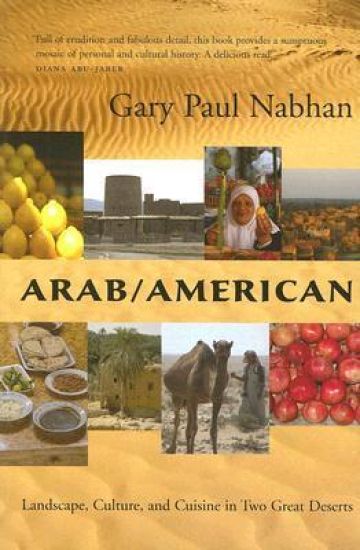
Arab/American

Arab/American

Gary Paul Nabhan

University of Arizona Press
2008
nidottu
The landscapes, cultures, and cuisines of deserts in the Middle East and North America have commonalities that have seldom been explored by scientists, nd have hardly been celebrated by society at large. Sonoran Desert ecologist Gary Nabhan grew up around Arab grandparents, aunts, uncles, and cousins in a family that has been emigrating to the United States and Mexico from Lebanon for more than a century, and he himself frequently travels to the deserts of the Middle East. In an era when some Arabs and Americans have markedly distanced themselves from one another, Nabhan has been prompted to explore their common ground, historically, ecologically, linguistically, and gastronomically. Arab/American is not merely an exploration of his own multicultural roots but also a revelation of the deep cultural linkages between the inhabitants of two of the world's great desert regions. Here, in beautifully crafted essays, Nabhan explores how these seemingly disparate cultures are bound to each other in ways we would never imagine. With an extraordinary ear for language and a truly adventurous palate, Nabhan uncovers surprising convergences between the landscape ecology, ethnogeography, agriculture, and cuisines of the Middle East and the binational Desert Southwest. There are the words and expressions that have moved slowly westward from Syria to Spain and to the New World to become incorporatedfaintly but recognizably?into the language of the people of the U. S.? Mexico borderlands. And there are the flavorspiquant mixtures of herbs and spices that have crept silently across the globe and into our kitchens without our knowing where they came from or how they got here. And there is much, much more. We also learn of others whose work historically spanned these deserts, from Hadji Ali (? Hi Jolly?), the first Moslem Arab to bring camels to America, to Robert Forbes, an Arizonan who explored the desert oases of the Sahara. These men crossed not only oceans but political and cultural barriers as well. We are, we recognize, builders of walls and borders, but with all the talk of ?homeland today, Nabhan reminds us that, quite often, borders are simply lines drawn in the sand.
Unnatural Landscapes

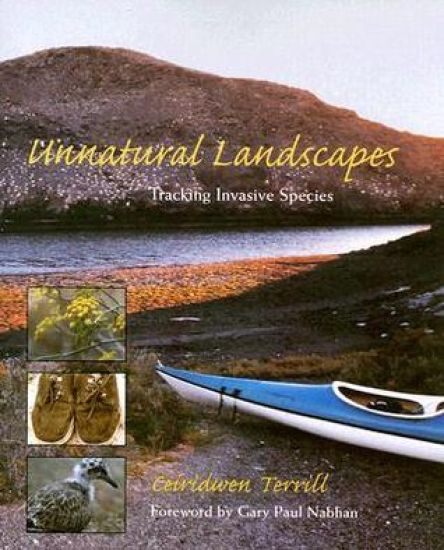
Unnatural Landscapes

Ceiridwen Terrill; Gary Paul Nabhan

University of Arizona Press
2007
nidottu
Louisiana crawfish, cheatgrass, Russian thistle, Hottentot figs, rats, and sweet fennel. These and dozens of other seemingly benign flora and fauna have become some of the worst culprits in the destruction of ecosystems and native wildlife in the American Southwest and Baja California. Although widely publicized threats'such as pollution, land development, changes in the atmospheric condition, fire, and drought, re frequently credited with posing the greatest danger to indigenous animals and plants, invasive species are quickly becoming a far more insidious peril to the survival of native wildlife. A result of both accident and human intervention, the frequency with which exotic species are being introduced into nonnative environments is increasing at an alarming rate. In Unnatural Landscapes, Ceiridwen Terrill combines lucid science writing with first-person tales of adventure to provide a compelling introduction to invasion ecology and restoration management. Traveling aboard her trusty kyak, The Grebe, Terrill brings readers on a firsthand tour of various ?islands? in the Southwest and Mexico both actual islands and self-contained habitat communities. From the islands of Anaho, Santa Cruz, and Anacapa to Isla Tiburon in the Sea of Cortez, Mexicali irrigation canals, and Pyramid Lake, Terrill takes an in-depth look at the damage that invasive species cause. Drawing on field observations, research, and interviews with scientists, resource managers, and local residents, this book provides readers with the background and knowledge they need to understand and to begin combating what is quickly becoming the most important environmental crisis facing the fragile ecosystems of the Southwest. For more information on invasive species visit the "http://faculty.cu-portland.edu/cterrill/index.html" target="new">Author's Web site.
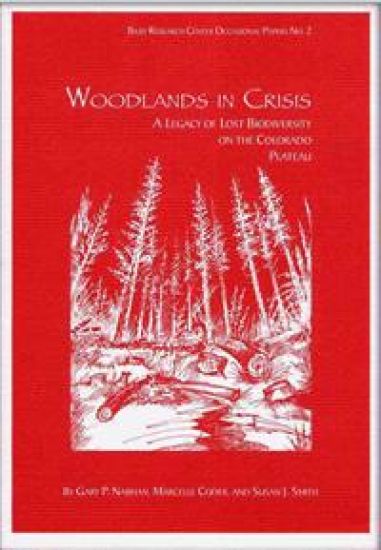
Woodlands in Crisis: A Legacy of Lost Biodiversity on the Colorado Plateau

Woodlands in Crisis: A Legacy of Lost Biodiversity on the Colorado Plateau

Gary Paul Nabhan; Marcelle Coder; Susan J. Smith

Bilby Research Center
2004
nidottu
In recent years, the West has suffered from unprecedented stand-replacing wildfires, and the government has invested more money in preventative forest thinning than ever before. This forest crisis has led to much controversy over the Healthy Forests legislation passed by Congress in 2003. On the Colorado Plateau, it has also spurred heated debates regarding the degree to which thinning can truly serve to restore wooded habitats and what reference conditions and or restoration goals are needed to guide such plans. This book offers a primer for understanding how diverse land-use histories have impacted the health of pine-dominated ecosystems in the West and points to measures for better managing them in the future. It draws on a systematic review of the historic effects of land use and climate on ecosystem health, biodiversity, and non-timber forest products in four specific landscapes on the Colorado Plateau the Jemez Mountains in New Mexico, the Chuska Mountains in Arizona, Mesa Verde in Colorado, and the San Francisco Volcanic Shield in Arizona all of which have long histories of human occupation and use of forest products. The authors evaluate the degree to which livestock grazing and other cultural land uses have historically reduced the frequency, severity and areal extent of fires, the species richness of understory plants, and the availability of non-timber forest products formerly harvested by Native, Hispanic and Anglo American communities. By examining the many natural and cultural influences upon biodiversity and ecosystem health, a much more robust and site-specific understanding of each place is possible. With improved and localized information, management decisions can be guided by a deeper and broader understanding of reference conditions, current threats, and goals for management and restoration. Now that there is new support for forest management, this book considers how that support can be used not merely to reduce the frequency of property-damaging fires over the short-term, but to restore the overall health and diversity of our woodlands."
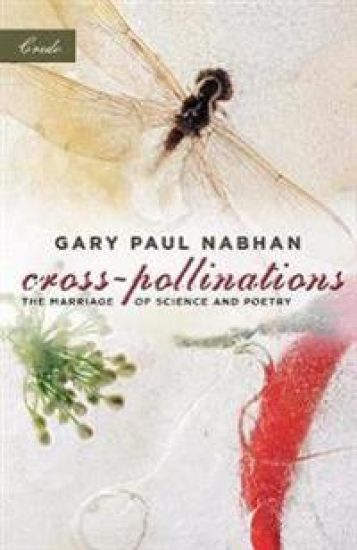
Cross-Pollinations

Cross-Pollinations

Gary Paul Nabhan

Milkweed Editions
2004
pokkari
Cross-Pollinations is a book about dissolving boundaries and blending disciplines to reveal a world rich in possibility, one where unthinkable solutions emerge. Gary Paul Nabhan, an accomplished biologist and writer—and “a voice that speaks to the laity in clear and coherent sentences” (New York Times)—believes that the free movement between science and literature, between cultivated and wild habitats, and between culture and language engenders the kind of unlikely and seemingly incompatible perceptions that are essential to discovery of any kind. In Cross-Pollinations, he illustrates the successful marriage of science and poetry with true stories about color-blind scientists, the knowledge stored in ancient Native American songs, the link between an Amy Clampitt poem and diabetes research, and a unique collaboration in support of the Ironwood Forest National Monument.
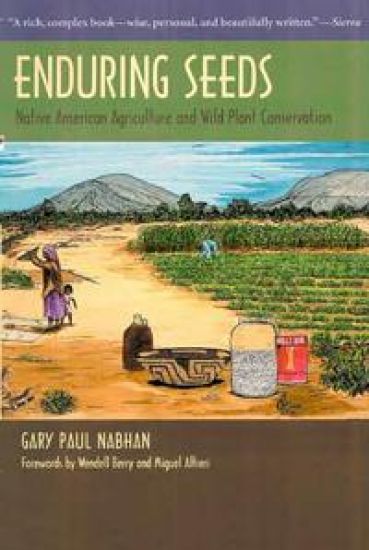
Enduring Seeds

Enduring Seeds

Gary Paul Nabhan

University of Arizona Press
2002
nidottu
As biological diversity continues to shrink at an alarming rate, the loss of plant species poses a threat seemingly less visible than the loss of animals but in many ways more critical. In this book, one of America's leading ethnobotanists warns about our loss of natural vegetation and plant diversity while providing insights into traditional Native agricultural practices in the Americas. Gary Paul Nabhan here reveals the rich diversity of plants found in tropical forests and their contribution to modern crops, then tells how this diversity is being lost to agriculture and lumbering. He then relates "local parables" of Native American agriculture from wild rice in the Great Lakes region to wild gourds in Florida that convey the urgency of this situation and demonstrate the need for saving the seeds of endangered plants. Nabhan stresses the need for maintaining a wide gene pool, not only for the survival of these species but also for the preservation of genetic strains that can help scientists breed more resilient varieties of other plants. Enduring Seeds is a book that no one concerned with our environment can afford to ignore. It clearly shows us that, as agribusiness increasingly limits the food on our table, a richer harvest can be had by preserving ancient ways. This edition features a new foreword by Miguel Altieri, one of today's leading spokesmen for sustainable agriculture and the preservation of indigenous farming methods.
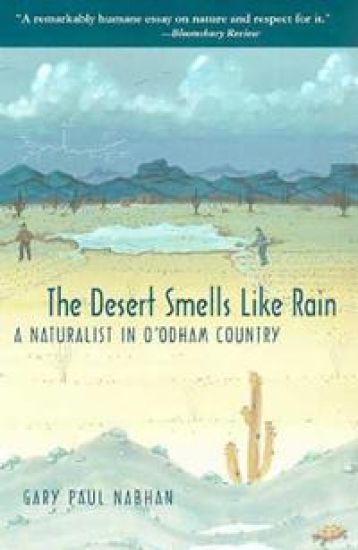
The Desert Smells Like Rain

The Desert Smells Like Rain

Gary Paul Nabhan

University of Arizona Press
2002
nidottu
Longtime residents of the Sonoran Desert, the Tohono O'odham people have spent centuries living off the land a land that most modern citizens of southern Arizona consider totally inhospitable. Ethnobotanist Gary Nabhan has lived with the Tohono O'odham, long known as the Papagos, observing the delicate balance between these people and their environment. Bringing O'odham voices to the page at every turn, he writes elegantly of how they husband scant water supplies, grow crops, and utilize wild edible foods. Woven through his account are coyote tales, O'odham children's impressions of the desert, and observations on the political problems that come with living on both sides of an international border. Whether visiting a sacred cave in the Baboquivari Mountains or attending a saguaro wine-drinking ceremony, Nabhan conveys the everyday life and extraordinary perseverance of these desert people in a book that has become a contemporary classic of environmental literature.
People, Plants and Protected Areas

People, Plants and Protected Areas

John Tuxill; Gary Paul Nabhan; with Elizabeth Drexler; Michael Hathaway

Earthscan Ltd
2001
nidottu
Conservation of plant resources is often focused on seed banks and botanical gardens. However, the two authors of this volume present a comprehensive conservation strategy that complements this ex-situ approach with practical guidance on in-situ management and conservation of plant resources. The book aims to facilitate better management of protected areas and to illustrate new approaches to conservation of plants within their landscapes. It draws on concepts from forestry, the agricultural sciences, anthropology, ethnology and ethnobotany and should be useful to practitioners, academics and policy-makers.
Cultures Of Habitat

Cultures Of Habitat

Gary Paul Nabhan

Counterpoint
1998
nidottu
Many ecologists write of nature, treating it as an object separate from people. Gary Nabhan writes in nature, finding aspects of human existence in the life of the wild. In a new collection of 26 essays, Nabhan explores the deep and complex connections between nature and people, seeking to further a more realistic understanding of the impact of various cultures on the planets biodiversity. There are many ecologists who write of nature, treating it as an object separate from the world of people. Gary Paul Nabhan writes in nature, finding elemental aspects of human existence in the life of the wild. One day while studying population maps with a colleague at the Arizona-Sonora Desert Museum, Nabhan recognized a surprising correlation between upheavals in human communities and the incidence of endangered species. Where massive in-migrations and exoduses were taking place, more plants and animals had become endangered. Locations with stable human populations sustained native wildlife more easily over the long term. This revelation prompted Nabhan to spend the next three years studying relationships among cultural diversity, community stability, and conservation of biological diversity in natural habitats. He concentrated on cultures of habitat, human communities with long histories of interacting with one particular kind of terrain and its wildlife. Here the author of The Desert Smells Like Rain has combined the eye of an ethnobiologist with chronicles from the Far Outside, that realm in which diverse natural habitats and indigenous cultures coexist. The result is a mosaic of essays that celebrates the vital connections between soul and space.
The Forgotten Pollinators

The Forgotten Pollinators

Stephen L. Buchmann; Gary Paul Nabhan

ISLAND PRESS
1997
nidottu
Consider this: Without interaction between animals and flowering plants, the seeds and fruits that make up nearly eighty percent of the human diet would not exist. In The Forgotten Pollinators, Stephen L. Buchmann, one of the world's leading authorities on bees and pollination, and Gary Paul Nabhan, award-winning writer and renowned crop ecologist, explore the vital but little-appreciated relationship between plants and the animals they depend on for reproduction -- bees, beetles, butterflies, hummingbirds, moths, bats, and countless other animals, some widely recognized and other almost unknown. Scenes from around the globe -- examining island flora and fauna on the Galapagos, counting bees in the Panamanian rain forest, witnessing an ancient honey-hunting ritual in Malaysia -- bring to life the hidden relationships between plants and animals, and demonstrate the ways in which human society affects and is affected by those relationships. Buchmann and Nabhan combine vignettes from the field with expository discussions of ecology, botany, and crop science to present a lively and fascinating account of the ecological and cultural context of plant-pollinator relationships. More than any other natural process, plant-pollinator relationships offer vivid examples of the connections between endangered species and threatened habitats. The authors explain how human-induced changes in pollinator populations -- caused by overuse of chemical pesticides, unbridled development, and conversion of natural areas into monocultural cropland-can have a ripple effect on disparate species, ultimately leading to a "cascade of linked extinctions."
Songbirds, Truffles, and Wolves: An American Naturalist in Italy
By the winner of the John Burroughs Medal for nature writing "Gary Nabhan went to walk in old Italy like a pilgrim. . . . This is a story about moving from sad uncertainty to part-time joyousness. It is a great book."--William Kittredge "In part to ponder my Mediterranean roots and in part to learn of the land of my saint, San Francisco," Gary Paul Nabhan, one of America's finest nature writers and author of The Desert Smells Like Rain decided to walk the two hundred miles from Florence to Assisi. Along the way he met peasant farmers eager to share the love of their plants and seeds, recipes and customs. The fruit of this pilgrimage is writing that imaginatively traverses the boundary between nature and history. "Unusual but important . . . entertaining and informative . . . the book afford s] an evening retreat as satisfying as a shot of grappa with a plate of anisette cookies."--The New York Times Book Review
Faith in a Seed (Limited Edition)

Faith in a Seed (Limited Edition)

Henry D. Thoreau; Gary Paul Nabhan

Island Press
1993
sidottu
Faith in a Seed contains the hitherto unpublished work The Dispersion of Seeds, one of Henry D. Thoreau's last important research and writing projects, and now his first new book to appear in 125 years. With the remarkable clarity and grace that characterize all of his writings, Thoreau describes the ecological succession of plant species through seed dispersal. The Dispersion of Seeds, which draws on Charles Darwin's theory of natural selection, refutes the then widely accepted theory that some plants spring spontaneously to life, independent of roots, cuttings, or seeds. As Thoreau wrote: Though I do not believe a plant will spring up where no seed has been, I have great faith in a seed. Convince me that you have a seed there, and I am prepared to expect wonders. Henry D. Thoreau's Faith in a Seed, was first published in hardcover in 1993 by Island Press under the Shearwater Books imprint, which unifies scientific views of nature with humanistic ones. This important work, the first publication of Thoreau's last manuscript, is now available in paperback. Faith in a Seed contains Thoreau's last important research and writing project, The Dispersion of Seeds, along with other natural history writings from late in his life. Edited by Bradley P. Dean, professor of English at East Carolina University and editor of the Thoreau Society Bulletin, these writings demonstrate how a major American author at the height of his career succeeded in making science and literature mutually enriching.
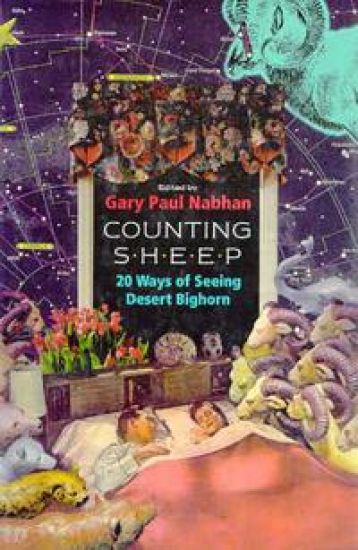
Counting Sheep

Counting Sheep

Gary Paul Nabhan

University of Arizona Press
1993
nidottu
Imagine sending a number of nature writers out into the same unrelenting stretch of Sonoran Desert. Then consider telling them to focus their attention on just one animal vis canadensis, popularly called the desert bighorn or borrego cimarron&#151and have them write about it. Have them write from makeshift blinds or from behind a gun barrel. Have them write while walking across the Cabeza Prieta at night, or while flying over it trying to radio-collar the creatures. Have them write from actual sightings of the animals or simply from their tracks and droppings. What would result from such an exercise is Counting Sheep, an unusual anthology that demonstrates the range of possibilities in nature writing. While ostensibly a collection of writings about these desert sheep that live along the U. S.-Mexico border, it also represents an attempt to broaden the scope of the natural history essay. Writers trained in a wide range of disciplines spanning the natural and social sciences here offer a similarly diverse collection of writings, with women's, Hispanic, and Native American views complementing those in a genre long dominated by Anglo men. The four sections of the anthology comprise pre-Anglo-American tradition, examples of early nature writing, varied responses by modern writers to actually counting sheep, and a selection of essays that place bighorns in the context of the larger world. Counting Sheep celebrates the diversity of cultural responses to this single animal species in its Sonoran Desert habitat and invites readers to change the way in which they view their relationship to wild creatures everywhere. It also shows how nature writers can delight us all by the varied ways in which they practice their craft. Contributors:Charles BowdenDavid E. BrownBill BroylesJulian HaydenWilliam T. HornadayPaul KrausmanDanny LopezEric MellinkMauricio MixcoGale MonsonGary Paul NabhanDoug PeacockKermit RooseveltHarley G. ShawCharles SheldonPeter SteinhartAnita Alvarez de WilliamsTerry Tempest WilliamsAnn Zwinger