Kirjojen hintavertailu – 12 903 725 kirjaa ja 27 kauppaa

Kirjailija

Gary Schreckengost

Kirjat ja teokset yhdessä paikassa: 9 kirjaa, julkaisuja vuosilta 2016–2017, suosituimpiin kuuluu Defense of the Peach Orchard at Gettysburg: With Collis's Philadelphia Zouaves. Vertaile teosten hintoja ja tarkista saatavuus suomalaisista kirjakaupoista.

9 kirjaa

Kirjojen julkaisuvuodet: 2016–2017.

Defense of the Peach Orchard at Gettysburg: With Collis's Philadelphia Zouaves

Defense of the Peach Orchard at Gettysburg: With Collis's Philadelphia Zouaves

Gary Schreckengost

Createspace Independent Publishing Platform
2016
nidottu
The battle of Gettysburg was considered to be the turning point of the War of the Southern Rebellion not necessarily because the Federal Army of the Potomac won, but because it did not lose. One of the most important phases of the battle was fought on July 2, 1863, at a place they called "the Peach Orchard." Here elements of Maj. Gen. Daniel Sickes's III U. S. Corps fought to deprive the rebels of high ground which would have allowed the rebels to shoot enfilading artillery fire into the left flank of Maj. Gen. Winfield Hancock's II U. S. Corps on Cemetery Ridge, unhinging the entire line. Brig. Gen. Charles Graham's brigade of Sickles's corps was placed in the center of this salient and the 114th Pennsylvania, (Collis's Philadelphia Zouaves), was in the center of Graham's brigade. This is the historically accurate yet fictitious story about John Tricker and his brother, Alfred, who were actual members of Company B, 114th Pennsylvania. Read about how and why they joined Collis's Zouaves and what the fighting was like for them on that fateful day at Gettysburg, July 2, 1863.
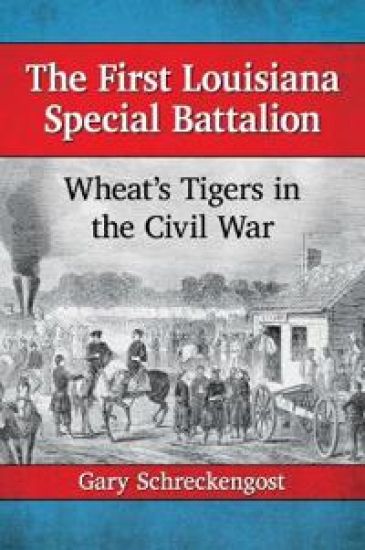
The First Louisiana Special Battalion

The First Louisiana Special Battalion

Gary Schreckengost

McFarland Co Inc
2017
pokkari
From the little-known Filibuster Wars to the Civil War battlefield of Gaines' Mill, this volume details the fascinating story of one of the South's most colorful military units, the 1st Louisiana Special Battalion, aka Wheat's Tigers. Beginning with a brief look at the Filibuster Wars (a set of military attempts to annex Latin American countries into the United States as slave states), the work takes a close look at the men who comprised Wheat's Tigers: Irish immigrant ship hands, New Orleans dock workers and Filibuster veterans. Commanded by one of the greatest antebellum filibusterers, Chatham Roberdeau Wheat, the Tigers quickly distinguished themselves in battle through their almost reckless bravery, proving instrumental in Southern victories at the battles of Front Royal, Winchester and Port Republic. An in-depth look at Battle of Gaines' Mill, in which Wheat's Tigers suffered heavy casualties, including their commander, completes the story. Appendices provide a compiled roster of the Wheat's Tigers, a look at the 1st Louisiana's uniforms and a copy of Wheat's report about the Battle of Manassas. Never-before-published photographs are also included.
Before Bull Run: The Army of Pennsylvania and Its Forgotten Campaign 1861

Before Bull Run: The Army of Pennsylvania and Its Forgotten Campaign 1861

Gary Schreckengost

Createspace Independent Publishing Platform
2017
nidottu
Little if anything is written about the "Three Month Men" that answered President Lincoln's clarion call for 75,000 loyal militia volunteers after the insurgent Confederate government attacked and took Fort Sumter on April 12, 1861. Few also appreciate how vulnerable Washington D. C., the nation's capital, was to rebel capture, especially after the Commonwealth of Virginia, which understandably refused to provide troops to smash the rebels, joined the Southern Confederacy. This is the story of the Army of Pennsylvania, part of that Three Month force, which was assembled not only to help defend Washington and keep Maryland in the Union, but to also act in concert with McDowell's Army of Northeastern Virginia that attacked the strong rebel lines along Bull Run Creek. To cover the McDowell's-and the administration's-loss at Bull Run, blame was shifted onto General Robert Patterson and his Army of Pennsylvania for political reasons. This book covers how the Lincoln administration operated during the first critical months of the war, how the Army of Pennsylvania was raised, trained, and equipped on such short notice, and how and why it operated in Maryland and western Virginia, including its action at Falling Waters.
McClellan Wins the War!: An Alternative History of the American Civil War

McClellan Wins the War!: An Alternative History of the American Civil War

Gary Schreckengost

Createspace Independent Publishing Platform
2017
nidottu
Much has been written about Maj. Gen. George Brinton McClellan's failure to take the Confederate capital of Richmond in 1862. In my opinion, too many people blame McClellan for this failure, and not his boss, Lincoln. What if McClellan would have been given the 300,000-man army he requested in 1862 instead of the 150,000 he actually received? What if Lincoln would have accepted McClellan's narrow front attack plan to send 300,000 Federal soldiers against Richmond in 1862, fighting the "Mother of All Battles?" What if Lincoln would have accepted risk in the West by staying on the defensive, giving McClellan the forces he requested? These "what if" scenarios are played out here.
Achtung Panzer, Marsch!: With the 1st German Panzer Division: Formation to the Fall of France, 1935-40
For most of World War II, 1939-45, Germany's armored forces or Panzerwaffe ruled the battlefields of Europe through superior tactics, training, and will power. Their primary function was to break through enemy lines along a narrow front "hitting with fist and not feeling with the fingers," encircle the enemy, cutting him off, and setting up their subsequent annihilation by regular infantry and artillery units. Speed and shock were the Panzerwaffe's friends. In 1935, the first four Panzer divisions were formed and developed under the watchful eyes of officers such as Heinz Guderian, Ewald von Kleist, Erich H pner, and Hermann Hoth. By 1939, on the eve of the war with Poland, Das Deutsches Panzerwaffe (German Armored Forces) had grown into ten divisions, spearheading the German assault into several surrounding countries. This is the historically accurate but fictional story of Gunter Prehm, a young Saxon who joined Panzer Division 1 in 1935. Read what training and life was like for him and his buddies in Kompanie 5, Panzer Reglement 1, about their uniforms and equipment, about the Panzerkampfwagons (armored fighting vehicles-tanks) that they operated and lived in, about the new Panzer tactics that they learned, practiced, and honed, and about their first campaigns in Poland in 1939 and in France in 1940, which proved to the world the decisive punch of revolutionary Panzer division concept, elevating the Panzerwaffe to become the undisputed champions of the battlefield.
I Was a Hessian Grenadier at the Battle of Trenton: Dec. 26, 1776

I Was a Hessian Grenadier at the Battle of Trenton: Dec. 26, 1776

Gary Schreckengost

Createspace Independent Publishing Platform
2016
nidottu
The Hessian soldiers who served as auxiliary troops for the British government during the American Revolution struck fear into the heart of American rebels even before they set foot on American shores. During the battle for New York in 1776, soon after the Declaration of Independence was signed, the Hessians proved further enhanced their vaunted reputation when they literally mauled the rebels, helping Crown forces capture New York City, Fort Washington, and, before the year was out, almost all of New Jersey. Trusted with guarding the Delaware River once winter set in, seven of these Hessian battalions were posted at Trenton, Bordentown, Black Horse, and Mount Holly, New Jersey, closest to what was left of Washington's rebel army. This is the historically accurate story of the fictitious character Grenadier Johann Schr der, a member of Grenadier Regiment Rall, one of the tough Hessian battalions that were surprisingly defeated by the rebels at Trenton on December 26, 1776. Read how and why Schr der joined the Hessian Army in the summer of 1775, what training was like in Hessia, his march north to Bremerhaven, his journey to America, and his campaigning in New York and New Jersey, culminating at the famous battle of Trenton, December 26, 1776, the "battle that saved America."