Kirjojen hintavertailu – 12 903 743 kirjaa ja 27 kauppaa

Kirjailija

Gary Teeple

Kirjat ja teokset yhdessä paikassa: 5 kirjaa, julkaisuja vuosilta 2000–2025, suosituimpiin kuuluu Globalization and the Decline of Social Reform. Vertaile teosten hintoja ja tarkista saatavuus suomalaisista kirjakaupoista.

5 kirjaa

Kirjojen julkaisuvuodet: 2000–2025.

The Democracy That Never Was

The Democracy That Never Was

Gary Teeple

Springer International Publishing AG
2025
sidottu
Liberal democracy is usually treated as an independent variable, as possessing the absolutes of democratic rule. Its variable forms, changing principles and practice, and conscious destruction by its own advocates, in particular the United States, however, suggest that it is not what it appears to be. This book argues that it is a dependent variable, the political form required by the changing configurations of national capital and their countervailing forces. The forms of liberal democracy have always shifted in concert with the mode of production as their premise. The absolutes of liberal democracy, the author contends, have never been anything but the abstracted principles of the marketplace. Their nature has now become especially visible for what they have been because the premise as national capital development has changed, leaving liberal democracy as a form without its original content, and its present content out of keeping with a national jurisdiction. As a political form, it persists, but its role has been transformed from the regulation of national capital accumulation to the enforcer of the demands of global configurations of capital. It is a role that its citizens implicitly understand, as revealed in widespread political cynicism, decreasing electoral participation, and declining legitimacy that require ever greater measures of deceit from political leaders and increased means of coercive social control, including militarized police forces and pervasive electronic surveillance. There can be no going back to the stage of national politics because the neoliberal content of liberal democratic policies represents the necessities of global capital. And it is the contradictions of global capital that define the character of early 21st century political conflict.
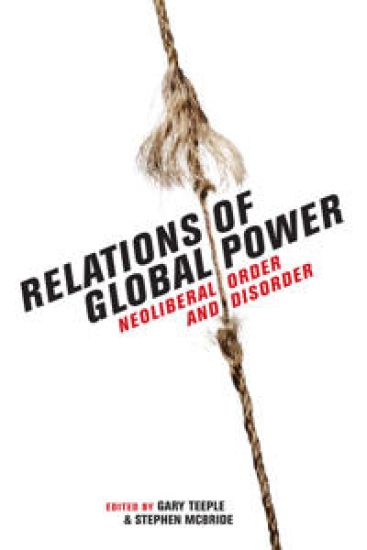
Relations of Global Power

Relations of Global Power

Gary Teeple; Stephen McBride

University of Toronto Press
2010
pokkari
This collection of original articles offers an up-to-date, critical review of the global political economy today, covering such topics as international finance, corporate governance, military power, international labour standards, global health, human rights, and more. Assembling a group of top scholars, the editors are able to provide a wide-ranging yet coherent survey of contemporary international institutions and how they are governed. In the process, they offer a useful basis for understanding the financial crisis of 2008. Relations of Global Power is the only book available that examines the many different dimensions of the international regulatory structure across a range of issues, placing them all within the context of neoliberal globalization. It will be of interest to scholars of political science, sociology, policy studies, public administration, and global studies, and will also appeal to activists and members of alter-globalization movements.
The Riddle of Human Rights

The Riddle of Human Rights

Gary Teeple

Garamond Press
2004
pokkari
Demands for "human rights" and resistance to their violation are rarely out of the news. Yet their definition is far from a settled matter, their legal status is quite varied, their uses and defence widely inconsistent between jurisdictions, and respect for them is blatantly limited. If it is held that all humans are abstractly equal in the possession of these rights, there is little agreement on anything else about them. The "human rights" of the United Nations' Charter and Universal Declaration contain a host of inconsis-tencies and a mixture of truths and untruths that contradict the assumptions of universality and timelessness. Gary Teeple makes the case that "human rights" are peculiar to an historically given mode of production; they comprise the public declaration of the principles of the prevailing property relations. In that they are proclaimed absolute and universal is no different than similar declarations and beliefs about the nature of principles arising in different social formations. Although the tenets underlying "human rights" are distinct from pre-capitalist rights in several ways, there is one very significant distinguishing characteristic: implicit within them are goals that are qualitatively different from any relations yet realized in existing social formations.