Kirjojen hintavertailu – 12 903 725 kirjaa ja 27 kauppaa

Kirjailija

Gaurav Saxena

Kirjat ja teokset yhdessä paikassa: 8 kirjaa, julkaisuja vuosilta 2020–2023, suosituimpiin kuuluu Lasers in Management of Oral Mucosal Lesions. Vertaile teosten hintoja ja tarkista saatavuus suomalaisista kirjakaupoista.

8 kirjaa

Kirjojen julkaisuvuodet: 2020–2023.

Laser bei der Behandlung oraler Schleimhautläsionen

Laser bei der Behandlung oraler Schleimhautläsionen

Shalu Rai; Deepankar Misra; Gaurav Saxena

Verlag Unser Wissen
2023
pokkari
Bei der Verwendung von Lasern in der Zahnmedizin geht es vor allem um die M glichkeit, die Akzeptanz der Patienten durch die Vermeidung von pr - und postoperativen Schmerzen und Beschwerden zu f rdern. Das breite Spektrum der Einsatzm glichkeiten von Lasern im Fachgebiet der oralen Medizin und Radiologie wurde bereits beschrieben, befindet sich aber noch in einem primitiven und begrenzten Stadium und bedarf einer umfassenden Ausarbeitung. In der Literatur wird der Laser in erster Linie f r die Behandlung gutartiger oraler L sionen wie Fibrome, H mangiome, Papillome bei der Behandlung von Gingivahyperplasien, aphth sen Geschw ren, Schleimhautb ndchen und Zungenb ndern (Ankyloglossie) empfohlen. Es wurde auch als Hilfsmittel f r die Behandlung potenziell b sartiger Erkrankungen wie orale Leukoplakien, Erythroplakie, Lichen planus und andere immunologische St rungen mit oralen Manifestationen postuliert. In der Literatur finden sich auch einige Berichte ber den Einsatz des Lasers bei der m glichen Behandlung b sartiger Erkrankungen im Fr hstadium mit Exzisionsbiopsien ohne das Risiko einer Metastasierung oder lokalen Ausbreitung.
Lasers no Tratamento de Lesões da Mucosa Oral

Lasers no Tratamento de Lesões da Mucosa Oral

Shalu Rai; Deepankar Misra; Gaurav Saxena

Edicoes Nosso Conhecimento
2023
pokkari
O uso do laser em odontologia tem se centrado na possibilidade de encorajar a aceita o do paciente por meio da preven o de dor e desconforto pr e p s-operat rios. A vasta gama de usos de lasers na especialidade de Medicina Oral e Radiologia j foi descrita, mas ainda est em seu est gio primitivo e limitado e precisa de extensa elabora o. Os lasers t m sido recomendados principalmente na literatura para o tratamento de les es orais benignas, como fibromas, hemangiomas e papilomas, no tratamento de hiperplasias gengivais, lceras aftosas, freios mucosos e l ngua presa (anquiloglossia). Tamb m foi postulado como adjuvante no tratamento de condi es potencialmente malignas, como leucoplasias orais, eritroplasia, l quen plano e outros dist rbios imunol gicos que produzem manifesta es orais. Alguns relatos tamb m foram documentados na literatura sobre o uso de Lasers no poss vel tratamento de malignidades em est gios iniciais com bi psias excisionais sem risco de met stase ou dissemina o local. Hoje, os lasers podem ser usados como uma vanguarda' ou um agente terap utico'.
Laser nella gestione delle lesioni della mucosa orale

Laser nella gestione delle lesioni della mucosa orale

Shalu Rai; Deepankar Misra; Gaurav Saxena

Edizioni Sapienza
2023
pokkari
L'uso del laser in odontoiatria si incentrato sulla possibilit di incoraggiare l'accettazione da parte del paziente evitando il dolore e il disagio pre e post-operatorio. L'ampia gamma di usi dei laser nella specialit della medicina orale e della radiologia stata precedentemente descritta, ma ancora nella sua fase primitiva e limitata e necessita di un'ampia elaborazione. I laser sono stati principalmente raccomandati in letteratura per il trattamento di lesioni orali benigne come fibromi, emangiomi e papillomi nel trattamento di iperplasie gengivali, ulcere aftose, frenuli della mucosa e legami della lingua (anchiloglossia). stato anche ipotizzato come coadiuvante per il trattamento di condizioni potenzialmente maligne come leucoplachia orale, eritroplachia, lichen planus e altri disturbi immunologici che producono manifestazioni orali. Sono stati documentati in letteratura anche alcuni report sull'utilizzo dei Laser nel possibile trattamento di tumori maligni in fase iniziale con biopsie escissionali senza rischio di metastasi o diffusione locale. Oggi i laser possono essere usati come "avanguardia" o "agente terapeutico".
Lasers dans la gestion des lésions de la muqueuse buccale

Lasers dans la gestion des lésions de la muqueuse buccale

Shalu Rai; Deepankar Misra; Gaurav Saxena

Editions Notre Savoir
2023
pokkari
L'utilisation du laser en dentisterie est centr e sur la possibilit d'encourager le patient accepter le traitement en vitant la douleur et l'inconfort pr et postop ratoires. Le large ventail d'utilisations des lasers dans la sp cialit de la m decine et de la radiologie buccales a d j t d crit, mais il n'en est encore qu' un stade primitif et limit et n cessite un d veloppement approfondi. Les lasers ont t principalement recommand s dans la litt rature pour le traitement des l sions buccales b nignes telles que les fibromes, les h mangiomes, les papillomes, les hyperplasies gingivales, les ulc res aphteux, les fr nules muqueuses et les attaches de la langue (ankyloglossie). Il a galement t propos comme adjuvant pour le traitement d'affections potentiellement malignes telles que les leucoplasies buccales, l' rythroplasie, le lichen plan et d'autres troubles immunologiques produisant des manifestations buccales. Certains rapports ont galement t publi s dans la litt rature sur l'utilisation des lasers dans le traitement possible des tumeurs malignes des stades pr coces avec des biopsies excisionnelles sans risque de m tastases ou de propagation locale.
Lasers in Management of Oral Mucosal Lesions

Lasers in Management of Oral Mucosal Lesions

Shalu Rai; Deepankar Misra; Gaurav Saxena

Lap Lambert Academic Publishing
2023
pokkari
Laser use in dentistry has centered on the possibility to encourage patient uptake through the avoidance of pre and post-operative pain and discomfort. The wide array of uses of lasers in the specialty of Oral Medicine and Radiology has been previously described but still is in its primitive and limited stage and needs extensive elaboration. Lasers have been primarily recommended in the literature for the treatment of benign oral lesions such as fibromas, hemangiomas, and papillomas in the treatment of gingival hyperplasias, aphthous ulcers, mucosal frenula and tongue ties (ankyloglossia). It has also been postulated as an adjunct for the treatment of potentially malignant conditions such as Oral leukoplakias, erythroplakia, lichen planus, and other immunological disorders producing oral manifestations. Some reports have also been documented in the literature on the use of Lasers in the possible treatment of malignancies in early stages with excisional biopsies without risk of metastasis or local spread. Today Lasers can be used as a Cutting edge' or a Therapeutic agent'.
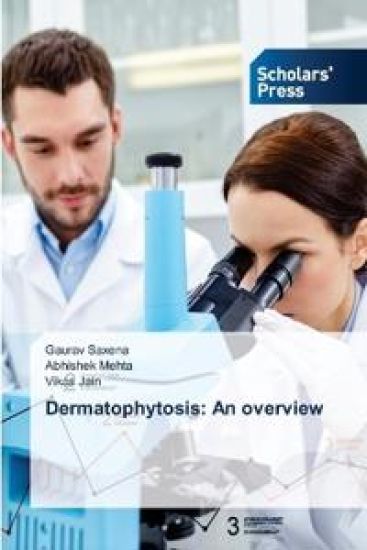
Dermatophytosis

Dermatophytosis

Gaurav Saxena; Abhishek Mehta; Vikas Jain

SCHOLARS' PRESS
2023
pokkari
In the current scenario, the topic of Dermatophytoses holds great relevance and is currently a burning issue throughout the world. Due to extensive experience in the field of Mycology and interest in this topic, I was motivated to write a book on Dermatophytosis by my clinician friends who felt that my knowledge and experience in this field will be of immense help to the medical fraternity in understanding the intricate concepts of Mycology and may help them in diagnosis and the treatment of such cases. The knowledge, particularly in the field of medical sciences, should not be restricted just to earning a University degree but should be disseminated in the entire scientific community so that the medical fraternity includes teachers, students, doctors, paramedics, and researchers. The entire efforts and time invested in this process will be deemed meaningful and fruitful only If the patients are benefitted directly or indirectly from this work.
Microbe-Assisted Phytoremediation of Environmental Pollutants
Microbe-Assisted Phytoremediation of Environmental Pollutants: Recent Advances and Challenges provides comprehensive information on the principles and practical knowledge of microbe-assisted phytoremediation of organic and inorganic pollutants for environmental safety. This book describes the physiological, biochemical, microbiological, and molecular basis of microbe-assisted phytoremediation and contains many relevant topics to fill the gaps in developing an understanding of microbe-assisted phytoremediation of environmental pollutants. The book provides state-of-the-art knowledge on fundamental, practical, and purposeful utilization of plant-associated bacteria (plant growth-promoting rhizobacteria [PGPR] and endophytes) and arbuscular mycorrhizal fungi for plant-growth promotion and enhanced phytoremediation of environmental pollutants in the contaminated matrix. Features: Provides a state-of-the-art overview of microbe-assisted phytoremediation Emphasizes the roles of PGPR, endophytes, and mycorrhizal fungi in assisted phytoremediation Elucidates biochemical and molecular mechanisms of microbe-assisted phytoremediation Details field studies and success stories of microbe-assisted phytoremediation Explores advances, challenges, and future directions in microbe-assisted phytoremediationThe book serves as a valuable resource for researchers, ecotoxicologists, environmental scientists and engineers, environmental microbiologists and biotechnologists, environmental health and risk scientists, environmental science managers and administrators, remediation practitioners, environmental policymakers, and students at the postgraduate and doctoral levels in the relevant fields who wish to work on microbe-assisted phytoremediation of pollutants for environmental safety and sustainability.