

Kirjailija
Geert Lovink
Kirjat ja teokset yhdessä paikassa: 17 kirjaa, julkaisuja vuosilta 2007–2025, suosituimpiin kuuluu Platform Brutality. Vertaile teosten hintoja ja tarkista saatavuus suomalaisista kirjakaupoista.
17 kirjaa
Kirjojen julkaisuvuodet: 2007–2025.

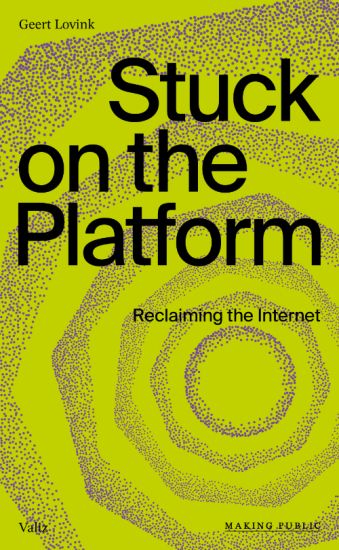
A plea to reclaim the internet from addictive platform capitalism, from the author of Sad by DesignHowever often you delete apps from your phone, the seduction of the platform draws you back. There is a rising disaffection with "platform" culture--with megacorporations such as Google and Facebook that provide the foundational software for others to use, and to which we are almost all addicted. What can be done against it? In Stuck on the Platform, Geert Lovink--whose work has been championed by Jodi Dean, Bernard Stiegler and Eva Illouz, among others--diagnoses this condition and suggests exit strategies. Analyzing the toxic symptoms of platform capitalism, Lovink proposes assembling a techno-social exodus movement; campaigns to break up monopoly platforms; the rebuilding of the internet as a public infrastructure; and the removal of certain corporations from internet governance bodies. Geert Lovink (born 1959) is a Dutch media theorist and author of Uncanny Networks (2002), My First Recession (2003), Social Media Abyss (2016) and Sad by Design (2019).

Made in China, Designed in California, Criticised in Europe
Mieke Gerritzen; Geert Lovink
BIS Publishers B.V.
2020
nidottu
When everything is destined to be designed, design disappears into the everyday. We simply do not see it anymore because it is everywhere. This is the vanishing act of design. At this moment, design registers its redundancy: our products, environments and services have been comprehensively improved. Everything has been designed to perfection and is under a permanent upgrade regime. Within such a paradigm, design is taken over by the capitalist logic of reproduction. But this does not come without conflicts, struggles and tensions. The most obvious of these, is that design is constantly being replaced. Our dispense culture prompts a yearning for longevity. The compulsion to delete brings alive a desire to retrieve objects, ideas and experiences that refuse to become obsolete. Society is growing more aware of sustainability and alert to the depletion of this world. For the ambitious designer, it is time to take the next step: designing the future with a more holistic consideration and approach. The book is a critical look at the design world with its various design disciplines and how these have developed in the past 10 years. Made in China, Designed in California, Criticised in Europe is for professional designers that care about design, the environment and how we live.

What is online video today, fifteen years into its exponential growth? What started with amateur work of YouTube prosumers has spread to virtually all communication apps: an explosion in the culture of mobile sound and vision. Now, in the age of the smart phone, video accompanies, informs, moves, and distracts us. Are you addicted yet? Look into that tiny camera, talk, move the phone, show us around - prove to others that you exist Founded in 2007, Video Vortex is a lively network of artists, activists, coders, curators, critics, and researchers linked by the exchange of ideas, materials, and discussions both online and offline. Video Vortex has produced two anthologies, a website, a mailing list, 12 international conferences, several art exhibitions, and more to come as the internet and video continue to merge and miniaturize. The first Video Vortex reader came out in 2008, followed by a second in 2011. This third anthology covers the turbulent period from Video Vortex #7 (2013) in Yogyakarta, across the meetings that followed in Zagreb, L neburg, Istanbul, Kochi, and finally Malta in 2019, where the foundations for this publication where laid before its production began in the midst of the corona crisis. The contributions herein respond to a broad range of emerging and urgent topics, from bias in YouTube's algorithms, to the use of video in messaging, image theory, the rise of deepfakes, a reconsideration of the history of video art, a reflection on the continuing role and influence of music video, indy servers, synthetic intimacies, love and sadness, artist videos, online video theory in the age of platform capitalism, video as online activism, and the rise of streaming. Click, browse, swipe, like, share, save, and enjoy Contributors: Annie Abrahams, Ina Blom, Natalie Bookchin, Pablo deSoto, Ben Grosser, Adnan Hadzi, Judit Kis, Patricia G. Lange, Hang Li, Patrick Lichty, Geert Lovink, Gabriel Menotti, Sabine Niederer, Dan Oki, Aras Ozgun, Daniel Pinheiro, Rahee Punyashloka, Oliver Lenore Schultz, Peter Snowdon, Andreas Treske, Colette Tron, Jack Wilson, Dino Ge Zhang.

No Internet, No Art
Geert Lovink; Kenneth Goldsmith; Karen Archey; Brad Troemel; Ben Vickers; Melanie Bühler
Onomatopee
2019
nidottu
Today it has become increasingly difficult to find a person or an object without some kind of connection to the internet. No Internet, No Art is dedicated to exploring what this situation entails with respect to one cultural field in particular: art. This anthology forms both the culmination and a continuation of a series of public events titled Lunch Bytes – Thinking about Art and Digital Culture, held in Washington, D. C. , which invited artists and experts from different fields to discuss their work in relation to this overarching theme. By opening up the often narrowly-defined discursive field of “post-internet,” artistic practices are examined thematically within the larger context of digital culture. As such, this anthology offers valuable new contributions to the fields of art history, media studies, philosophy, curatorial studies, and design. With contributions by: Philipp Albers, Kari Altmann, Karen Archey, Aram Bartholl, Michael Bell-Smith, David M. Berry, Natalie Bookchin, Andreas Broeckmann, Melanie Bühler, Harry Burke, Adam Cruces, Michel van Dartel, Annet Dekker, Niels van Doorn, Raffael Dörig, Claire L. Evans, Kenneth Goldsmith, Joel Holmberg, Paul Kneale, Katja Kwastek, Monica Lam, Geert Lovink, Pierre Lumineau, m-a-u-s-e-r, Greg Niemeyer, Nicolas Nova, Jaakko Pallasvuo, Christiane Paul, Daniel Pinkas, Domenico Quaranta, Jon Rafman, Rafaël Rozendaal, Cornelia Sollfrank, Jenna Sutela, Douglas Thomas, Mark Tribe, Brad Troemel, UBERMORGEN, Ben Vickers, Bernadette Wegenstein, Peter Weibel, Elvia Wilk.

Entrepreneur or precarious worker? These are the terms of a cognitive dissonance that turns everyone’s life into a shaky project in perennial start-up phase. Silvio Lorusso guides us through the entreprecariat, a world where change is natural and healthy, whatever it may bring. A world populated by motivational posters, productivity tools, mobile offices and self-help techniques. A world in which a mix of entrepreneurial ideology and widespread precarity is what regulates professional social media, online marketplaces for self-employment and crowdfunding platforms for personal needs. The result? A life in permanent beta, with sometimes tragic implications. With a foreword by Geert Lovink and an afterword by Raffaele Alberto Ventura. “A compelling and relentless j’accuse: debunking the social and political myths that push an increasing number of persons to perform in the entrepreneurship circus — with no safety nets. ” Antonio Casilli, author of En attendant les robots, 2019
Organize
Timon Beyes; Lisa Conrad; Reinhold Martin; Geert Lovink; Ned Rossiter
University of Minnesota Press
2019
pokkari
A pioneering systematic inquiry into-and mapping of-the field of media and organization Media organize things into patterns and relations. As intermediaries among people and between people and worlds, media shape sociotechnical orders. At the same time, media are organized: while they condition different organizational forms and processes, they, too, are formed and can be re-formed. This intimate relation of media and organizing is timeless. Yet arguably, digital media technologies repose the question of organization-and thus of power and domination, control and surveillance, disruption and emancipation. Bringing together leading media thinkers and organization theorists, this book interrogates organization as an effect and condition of media. How can we understand the recursive relation between media and organization? How can we think, explore, critique, and perhaps alter the organizational bodies and scripts that shape contemporary life? Organize will be of interest to scholars and students of new and old media, social organization, and technology. Moreover, the dialogical form of these essays provides a concise and path-breaking view on the recursive relation between technological media and social organization. The book therefore establishes and maps “media and organization” as a highly relevant field of inquiry, appealing to those with a critical interest in the technological conditioning of the social.

Sadness is now a design problem. The highs and lows of melancholy are coded into social media platforms. After all the clicking, browsing, swiping and liking, all we are left with is the flat and empty aftermath of time lost to the app. Sad by Design offers a critical analysis of the growing social media controversies such as fake news, toxic viral memes and online addiction. The failed search for a grand design has resulted in depoliticised internet studies unable to generate either radical critique or a search for alternatives. Geert Lovink calls for us to embrace the engineered intimacy of social media, messenger apps and selfies, because boredom is the first stage of overcoming 'platform nihilism'. Then, after the haze, we can organise to disrupt the data extraction industries at their core.
Sadness is now a design problem. The highs and lows of melancholy are coded into social media platforms. After all the clicking, browsing, swiping and liking, all we are left with is the flat and empty aftermath of time lost to the app. Sad by Design offers a critical analysis of the growing social media controversies such as fake news, toxic viral memes and online addiction. The failed search for a grand design has resulted in depoliticised internet studies unable to generate either radical critique or a search for alternatives. Geert Lovink calls for us to embrace the engineered intimacy of social media, messenger apps and selfies, because boredom is the first stage of overcoming 'platform nihilism'. Then, after the haze, we can organise to disrupt the data extraction industries at their core.
Social Media Abyss plunges into the paradoxical condition of the new digital normal versus a lived state of emergency. There is a heightened, post-Snowden awareness; we know we are under surveillance but we click, share, rank and remix with a perverse indifference to technologies of capture and cultures of fear. Despite the incursion into privacy by companies like Facebook, Google and Amazon, social media use continues to be a daily habit with shrinking gadgets now an integral part of our busy lives. We are thrown between addiction anxiety and subliminal, obsessive use. Where does art, culture and criticism venture when the digital vanishes into the background? Geert Lovink strides into the frenzied social media debate with Social Media Abyss - the fifth volume of his ongoing investigation into critical internet culture. He examines the symbiotic yet problematic relation between networks and social movements, and further develops the notion of organized networks. Lovink doesn't just submit to the empty soul of 24/7 communication but rather provides the reader with radical alternatives. Selfie culture is one of many Lovink's topics, along with the internet obsession of American writer Jonathan Franzen, the internet in Uganda, the aesthetics of Anonymous and an anatomy of the Bitcoin religion. Will monetization through cybercurrencies and crowdfunding contribute to a redistribution of wealth or further widen the gap between rich and poor? In this age of the free, how a revenue model of the 99% be collectively designed? Welcome back to the Social Question.
Social Media Abyss plunges into the paradoxical condition of the new digital normal versus a lived state of emergency. There is a heightened, post-Snowden awareness; we know we are under surveillance but we click, share, rank and remix with a perverse indifference to technologies of capture and cultures of fear. Despite the incursion into privacy by companies like Facebook, Google and Amazon, social media use continues to be a daily habit with shrinking gadgets now an integral part of our busy lives. We are thrown between addiction anxiety and subliminal, obsessive use. Where does art, culture and criticism venture when the digital vanishes into the background? Geert Lovink strides into the frenzied social media debate with Social Media Abyss - the fifth volume of his ongoing investigation into critical internet culture. He examines the symbiotic yet problematic relation between networks and social movements, and further develops the notion of organized networks. Lovink doesn't just submit to the empty soul of 24/7 communication but rather provides the reader with radical alternatives. Selfie culture is one of many Lovink's topics, along with the internet obsession of American writer Jonathan Franzen, the internet in Uganda, the aesthetics of Anonymous and an anatomy of the Bitcoin religion. Will monetization through cybercurrencies and crowdfunding contribute to a redistribution of wealth or further widen the gap between rich and poor? In this age of the free, how a revenue model of the 99% be collectively designed? Welcome back to the Social Question.
With the vast majority of Facebook users caught in a frenzy of ‘friending’, ‘liking’ and ‘commenting’, at what point do we pause to grasp the consequences of our info-saturated lives? What compels us to engage so diligently with social networking systems? Networks Without a Cause examines our collective obsession with identity and self-management coupled with the fragmentation and information overload endemic to contemporary online culture. With a dearth of theory on the social and cultural ramifications of hugely popular online services, Lovink provides a path-breaking critical analysis of our over-hyped, networked world with case studies on search engines, online video, blogging, digital radio, media activism and the Wikileaks saga. This book offers a powerful message to media practitioners and theorists: let us collectively unleash our critical capacities to influence technology design and workspaces, otherwise we will disappear into the cloud. Probing but never pessimistic, Lovink draws from his long history in media research to offer a critique of the political structures and conceptual powers embedded in the technologies that shape our daily lives.
With the vast majority of Facebook users caught in a frenzy of ‘friending’, ‘liking’ and ‘commenting’, at what point do we pause to grasp the consequences of our info-saturated lives? What compels us to engage so diligently with social networking systems? Networks Without a Cause examines our collective obsession with identity and self-management coupled with the fragmentation and information overload endemic to contemporary online culture. With a dearth of theory on the social and cultural ramifications of hugely popular online services, Lovink provides a path-breaking critical analysis of our over-hyped, networked world with case studies on search engines, online video, blogging, digital radio, media activism and the Wikileaks saga. This book offers a powerful message to media practitioners and theorists: let us collectively unleash our critical capacities to influence technology design and workspaces, otherwise we will disappear into the cloud. Probing but never pessimistic, Lovink draws from his long history in media research to offer a critique of the political structures and conceptual powers embedded in the technologies that shape our daily lives.
In Zero Comments, internationally renowned media theorist and 'net critic' Geert Lovink revitalizes worn out concepts about the Internet and interrogates the latest hype surrounding blogs and social network sites. In this third volume of his studies into critical Internet culture, following the influential Dark Fiber and My First Recession, Lovink develops a 'general theory of blogging.' He unpacks the ways that blogs exhibit a 'nihilist impulse' to empty out established meaning structures. Blogs, Lovink argues, are bringing about the decay of traditional broadcast media, and they are driven by an in-crowd dynamic in which social ranking is a primary concern. The lowest rung of the new Internet hierarchy are those blogs and sites that receive no user feedback or 'zero comments'. Zero Comments also explores other important changes to Internet culture, as well, including the silent globalization of the Net in which the West is no longer the main influence behind new media culture, as countries like India, China and Brazil expand their influence and looks forward to speculate on the Net impact of organized networks, free cooperation and distributed aesthetics.

In Zero Comments, internationally renowned media theorist and 'net critic' Geert Lovink revitalizes worn out concepts about the Internet and interrogates the latest hype surrounding blogs and social network sites. In this third volume of his studies into critical Internet culture, following the influential Dark Fiber and My First Recession, Lovink develops a 'general theory of blogging.' He unpacks the ways that blogs exhibit a 'nihilist impulse' to empty out established meaning structures. Blogs, Lovink argues, are bringing about the decay of traditional broadcast media, and they are driven by an in-crowd dynamic in which social ranking is a primary concern. The lowest rung of the new Internet hierarchy are those blogs and sites that receive no user feedback or 'zero comments'. Zero Comments also explores other important changes to Internet culture, as well, including the silent globalization of the Net in which the West is no longer the main influence behind new media culture, as countries like India, China and Brazil expand their influence and looks forward to speculate on the Net impact of organized networks, free cooperation and distributed aesthetics.