Kirjailija
Geoffrey Chaucer
Kirjat ja teokset yhdessä paikassa: 533 kirjaa, julkaisuja vuosilta 1883–2026, suosituimpiin kuuluu Alegato De Buena Prueba Presentado Por El Lic. Luis Velazquez Ante El C. Juez De Jilotepec. Lic. Cristobal Poulet Y Mier. Vertaile teosten hintoja ja tarkista saatavuus suomalaisista kirjakaupoista.
533 kirjaa
Kirjojen julkaisuvuodet: 1883–2026.
The Romaunt of the Rose translates in abridged form a long dream vision, part elegant romance, part rollicking satire, written in France during the thirteenth century. The French original, Le Roman de la Rose, had a profound influence on Chaucer, who says he translated the work. From the sixteenth century to the mid-nineteenth, scholars assumed that the Romaunt comprised large fragments of that translation. Subsequent debates have divided the Romaunt into two or three segments, and proffered arguments that Chaucer was responsible for one or more of them, or for none. The current consensus is that he almost certainly wrote the first 1,705 lines. Charles Dahlberg's edition of the Romaunt provides a full summary of scholarship on the question of authorship as well as other important topics, including a useful survey of the influence of the French poem on Chaucer.
The complete Chaucer text is read in the original Middle English, which complements any study of Chaucer. The CD can be listened to alongside the relevant text in the Selected Tales from Chaucer series. It can also be used in conjunction with the new Cambridge University Press series entitled Cambridge School Chaucer. Notes and glossaries accompany both series.
This new addition to the Longman Critical Readers Series provides an overview of the various ways in which modern critical theory has influenced Chaucer Studies over the last fifteen years. There is still a sense in the academic world, and in the wider literary community, that Medieval Studies are generally impervious to many of the questions that modern theory asks, and that it concerns itself only with traditional philological and historical issues. On the contrary, this book shows how Chaucer, specifically the Canterbury Tales, has been radically and excitingly 'opened up' by feminist, Lacanian, Bakhtinian, deconstructive, semiotic and anthropological theories to name but a few. The book provides an introduction to these new developments by anthologising some of the most important work in the field, including excerpts from book-length works, as well as articles from leading and innovative journals. The introduction to the volume examines in some detail the relation between the individual strengths of each of the above approaches and the ways in which a 'postmodernist' Chaucer is seen as reflecting them all. This convenient single volume collection of key critical analyses of Chaucer, which includes work from some journals and studies that are not always easily available, will be indispensable to students of Medieval Studies, Medieval Literature and Chaucer, as well as to general readers who seek to widen their understanding of the forces behind Chaucer's writing.
The Canterbury Tales
Geoffrey Chaucer; Geraldine McCaughrean
Puffin Classics
1997
pokkari
Halvin toimitettuna 13,70 €
A lively, humorous retelling for children of Geoffrey Chaucer's Canterbury Tales, by award-winning author Geraldine McCaughrean.
The most complete of all remaining surviving fragments sections of The Canterbury Tales, the First Fragment contains some of Chaucer's most widely enjoyed work. In The General Prologue, Chaucer introduces his pilgrims through a set of speaking portraits, drawn with a clarity that makes no attempt to conceal their peculiarities. The four tales that follow - those of the Knight, Miller, Reeve and Cook - reveal a wide variety of human preoccupations: whether chivalrous, romantic or simply sexual. Brilliantly bawdy and subtly complex, each of these tales is alive with Chaucer's skills as a poet, storyteller and creator of comedy.
Part SevenOnce reviled as an example of Chaucer at his most tasteless and omitted from some editions of The Canterbury Tales, this scatological anecdote has over time been accorded genuine admiration, first grudging and finally unabashed. As in The Miller's Tale, Chaucer has elaborated a simple fart joke into pungent satire against human foibles. Here too, through subtle references to religious lore, Chaucer transforms mere vulgarity into a truly clever jest and, in the opinion of some critics, a serious commentary on important issues. The particular target of the tale's satire is a friar who is so blinded by greed, hypocrisy, and anger that he cannot see how others perceive him.
Part OneThis monumental edition, in two volumes, presents a full record of commentary, both textual and interpretive, on the best known and most widely studied part of Chaucer's work, The General Prologue of The Canterbury Tales. Part One A contains a critical commentary, a textual commentary, text, collations, textual notes, an appendix of sources for the first eighteen lines of The General Prologue, and a bibliographical index. Because most explication of The General Prologue is directed to particular points, details, and passages, the present edition has devoted Part One B to the record of such commentary. This volume, compiled by Malcolm Andrew, also includes overviews of commentary on coherent passages such as the portraits of the pilgrims.
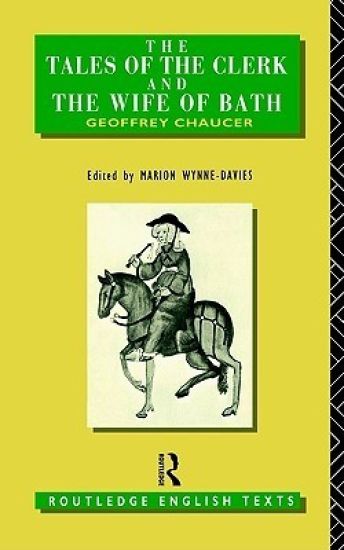
The first feminist edition of these two tales. Wynne-Davies addresses the social and cultural context of the poems' production in a critical commentary to the texts. Also includes a line by line gloss and a historical introduction.
These tales bring together a band of pilgrims who represented most of the occupations and social groups of the time. The diversity of the narrators in turn made possible a varied collection of tales including chivalric romance, spiritual allegory, courtly lay, beast fable and literary satire.
The first edition of "The Canterbury Tales" that presents Chaucer's poem word for word in modern spelling. It is intended to remove the obstacle of archaic spelling while making the poem, with all the charm of its original language and style, accessible to a wider readership.
This is the first edition of "The Canterbury Tales" that presents Chaucer's poem word for word in modern spelling. It retains the charm of Chaucer's language while eliminating the obstacle of archaic spelling. This text is eminently more readable and accessible, and should encourage rather than deter students to read and appreciate Chaucer.
This new reprint of the existing Everyman CANTERBURY TALES retains the essential ingredients of A C Cawley's highly respected edition, but adds a new prefactory introduction by Professor Malcolm Andrews of The Queen's University Belfast; a new suggested reading list; and a new chronology of Chaucer's life and times. Whether read for study or purely pleasure, the CANTERBURY TALES remains as fresh and enjoyable today as when it was written.
Part TwelveIn the list of scholarly problems it presents, The Squire's Tale ranks among the highest in The Canterbury Tales. Being incomplete and coming to a halt on a baffling note-was it in fact evolving into a tale of incest?-the tale has undergone the most remarkable shift in critic acceptance of any of Chaucer's works. This tale of oriental wonder, with its strong base in magic, excited the admiration of Chaucer's contemporaries and inspired Spenser's imitative speculation and Milton's famous desire that the old poet be summoned up to finish his task. It retained for the eighteenth and most of the nineteenth centuries its Gothic fascination, being ranked with the very best of Chaucer's work. In the second half of the twentieth century, it has been seen from a number of provocative perspectives. Is it a parody of the long Eastern romance? Is it a satire on the values of an aristocracy whose time is past? Is it a rhetorical joke on Chaucer's part, extending the character of the young Squire into an earnest and somewhat naïve competition with his father, the Knight? The concerns of contemporary scholarship reveal as much about the critical temper of the time as about the work itself. On its own merits The Squire's Tale compels our attention as an example of Chaucer's wide-ranging and sometimes inscrutable genius. It provides us with an exotic literary type not otherwise represented in the Tales. It reverberates, in its discussion of 'gentilesse' with other such discussions in Chaucer's poetry; it demonstrates, in its use of the love-vision and the complaint, the experimental ways in which Chaucer handles the conventions of French poetry. Perhaps most fascinating is the range of Chaucer's mind revealed by the casual uses of the science of his time: its knowledge of meteorology, optics, glass and metal work, astrology, and astronomy. The tale offers yet one more example of Chaucer's genius at work, speaking to us in a voice that is at once suggestive, provocative, and mystifying as always.

Enriched Classics offer readers accessible editions of great works of literature enhanced by helpful notes and commentary. Each book includes educational tools alongside the text, enabling students and readers alike to gain a deeper and more developed understanding of the writer and their work. The procession that crosses Chaucer's pages is as full of life and as richly textured as a medieval tapestry. The Knight, the Miller, the Friar, the Squire, the Prioress, the Wife of Bath, and others who make up the cast of characters—including Chaucer himself—are real people, with human emotions and weaknesses. When it is remembered that Chaucer wrote in English at a time when Latin was the standard literary language across western Europe, the magnitude of his achievement is even more remarkable. But Chaucer's genius needs no historical introduction; it bursts forth from every page of The Canterbury Tales.
Six of Chaucer's best known Canterbury Tales - the Knight's, the Wife of Bath's, the Pardoner's, the Franklin's, the Nun's Priest's and the Miller's - are here freely adapted for the stage. Original and adapted music to suit the period has been added. The style of the play is that of a spontaneous telling of a story by a group of strolling players, with all the Company taking various parts in enacting the different tales.7 women or men
Part TwentyOf all Chaucer's tales in the Canterbury Group, The Prioress's Tale of the Virgin Mary and the murdered child ranks among the most popular and surely the most admired for its artistry. Nonetheless, it has encountered its fair share of somewhat hostile criticism on purely social and cultural grounds, owing in part to a negative evaluation of the Prioress herself (she is seen by some as a shallow person who does not recognize the harmful implications of her utterances), in part to the anti-Semitic cast of the tale. Beverly Boyd's tough-minded, crisp approach to the tale enables her to present an overview of the great diversity of scholarship in both the sympathetic and hostile approaches to the work; to examine its strongest ingredients, the liturgical borrowings that form a kind of subtext; and thus to offer a balanced view of one of Chaucer's most carefully crafted poems. Her examination of the sources and analogues, of Miracles of the Virgin, of considerations of style and structure, along with a full treatment of the textual tradition of the Prioress's Sequence and an unusually full corpus of explanatory notes, taken together, provide a rich and complete edition of the tale, one that will prove to be of exceptional value for the teacher and the scholar.