Kirjojen hintavertailu – 12 903 725 kirjaa ja 27 kauppaa

Kirjailija

Geoffrey Meen

Kirjat ja teokset yhdessä paikassa: 7 kirjaa, julkaisuja vuosilta 1992–2020, suosituimpiin kuuluu Economic segregation in England. Vertaile teosten hintoja ja tarkista saatavuus suomalaisista kirjakaupoista.

7 kirjaa

Kirjojen julkaisuvuodet: 1992–2020.

Understanding Affordability

Understanding Affordability

Geoffrey Meen; Christine Whitehead

Bristol University Press
2020
nidottu
For many younger and lower-income people, housing affordability continues to worsen. Based on the academic research of two distinguished housing economists – and stimulated by working with governments across the world - this wide-ranging book sets out clear theoretical and empirical frameworks to tackle one of today’s most important socio-economic issues. Housing unaffordability arises from complex forces and a prerequisite to effective policy is understanding the causes of rising house prices and rents and the interactions between housing, housing finance and the macroeconomy. The authors challenge many of the conventional wisdoms in housing policy and offer innovative recommendations to improve affordability.
Understanding Affordability

Understanding Affordability

Geoffrey Meen; Christine Whitehead

Bristol University Press
2020
sidottu
For many younger and lower-income people, housing affordability continues to worsen. Based on the academic research of two distinguished housing economists – and stimulated by working with governments across the world - this wide-ranging book sets out clear theoretical and empirical frameworks to tackle one of today’s most important socio-economic issues. Housing unaffordability arises from complex forces and a prerequisite to effective policy is understanding the causes of rising house prices and rents and the interactions between housing, housing finance and the macroeconomy. The authors challenge many of the conventional wisdoms in housing policy and offer innovative recommendations to improve affordability.
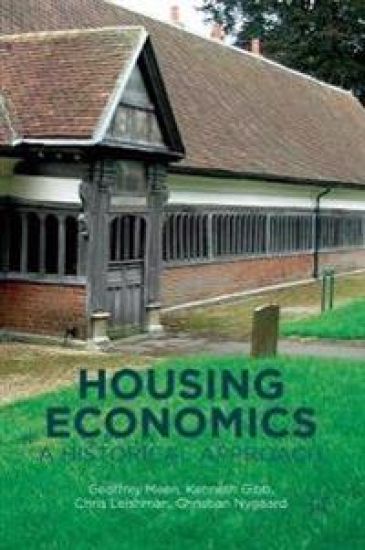
Housing Economics

Housing Economics

Geoffrey Meen; Kenneth Gibb; Chris Leishman; Christian Nygaard

Palgrave Macmillan
2016
sidottu
The world has still to emerge fully from the housing-triggered Global Financial Crisis, but housing crises are not new. The history of housing shows long-run social progress, littered with major disasters; nevertheless the progress is often forgotten, whilst the difficulties hit the headlines. Housing Economics provides a long-term economic perspective on macro and urban housing issues, from the Victorian era onwards. A historical perspective sheds light on modern problems and the constraints on what can be achieved; it concentrates on the key policy issues of housing supply, affordability, tenure, the distribution of migrant communities, mortgage markets and household mobility. Local case studies are interwoven with city-wide aggregate analysis. Three sets of issues are addressed: the underlying reasons for the initial establishment of residential neighbourhoods, the processes that generate growth, decline and patterns of integration/segregation, and the impact of historical development on current problems and the implications for policy.
Modelling Spatial Housing Markets

Modelling Spatial Housing Markets

Geoffrey Meen

Springer-Verlag New York Inc.
2012
nidottu
Spatial fixity is one of the characteristics that distinguishes housing from most other goods and services in the economy. In general, housing cannot be moved from one part of the country to another in response to shortages or excesses in particular areas. The modelling of housing markets and the interlinkages between markets at different spatial levels - international, national, regional and urban - are the main themes of this book. A second major theme is disaggregation, not only in terms of space, but also between households. The book argues that aggregate time-series models of housing markets of the type widely used in Britain and also in other countries in the past have become less relevant in a world of increasing income dispersion. Typically, aggregate relationships will break down, except under special conditions. We can no longer assume that traditional location or tenure patterns, for example, will continue in the future. The book has four main components. First, it discusses trends in housing markets both internationally and within nations. Second, the book develops theoretical housing models at each spatial scale, starting with national models, moving down to the regional level and, then, to urban models. Third, the book provides empirical estimates of the models and, finally, the models are used for policy analysis. Analysis ranges over a wide variety of topics, including explanations for differing international house price trends, the causes of housing cycles, the role of credit markets, regional housing market interactions and the role of housing in urban/suburban population drift.
Economic segregation in England

Economic segregation in England

Geoffrey Meen; Kenneth Gibb; Jennifer Goody; Thomas McGrath; Jane Mackinnon

Policy Press
2005
nidottu
One of the key objectives of government neighbourhood policy is to encourage a sustainable mix of tenures and incomes. This report addresses questions of why integration has been so difficult to achieve in practice and draws conclusions for future policy. The report analyses data from three related empirical studies. The first models, locally, the links between housing, labour markets, migration, deprivation and segregation. The second examines the factors behind the individual moving decisions that lie at the heart of segregation and how policy can influence choices. The third presents three case studies. These are the first empirical studies of their kind to show how segregation and deprivation arise. Economic segregation in Britain is aimed at policy practitioners, economists and academics working in the fields of housing and neighbourhood revitalisation. Although the report deals with technical modelling issues, it is written in a style accessible to the non-specialist.
Modelling Spatial Housing Markets
Spatial fixity is one of the characteristics that distinguishes housing from most other goods and services in the economy. In general, housing cannot be moved from one part of the country to another in response to shortages or excesses in particular areas. The modelling of housing markets and the interlinkages between markets at different spatial levels - international, national, regional and urban - are the main themes of this book. A second major theme is disaggregation, not only in terms of space, but also between households. The book argues that aggregate time-series models of housing markets of the type widely used in Britain and also in other countries in the past have become less relevant in a world of increasing income dispersion. Typically, aggregate relationships will break down, except under special conditions. We can no longer assume that traditional location or tenure patterns, for example, will continue in the future. The book has four main components. First, it discusses trends in housing markets both internationally and within nations. Second, the book develops theoretical housing models at each spatial scale, starting with national models, moving down to the regional level and, then, to urban models. Third, the book provides empirical estimates of the models and, finally, the models are used for policy analysis. Analysis ranges over a wide variety of topics, including explanations for differing international house price trends, the causes of housing cycles, the role of credit markets, regional housing market interactions and the role of housing in urban/suburban population drift.
The Mid-Tudor Crisis, 1545-1565

The Mid-Tudor Crisis, 1545-1565

Geoffrey Meen

Red Globe Press
1992
nidottu
Historians, like politicians, thrive in crises. Was there really a crisis in England between 1545 and 1565, or is this just a way of describing a period in history when a lot of interesting things where happening? In reality the twenty years from 1545 to 1565 contained no more elements of crisis than other comparable periods. There were crises: a brief, but serious collapse of the overseas cloth trade in 1551-52, and a confused royal succession in 1553. Inflation began to be a problem in about 1545, and remained so for the remainder of the century. The Church had already undergone a major revolution in the 1530s, and the mid-century period could be described as the 'search for a stable settlement', a search had succeeded by 1565. Indeed, the machinery of central and local government worked throughout this period, with only minor fluctuations in its efficiency and effectiveness. Although, therefore, there were crises within in the mid-Tudor period, there was no fundamental threat to the state or societyMary and Northumberland's achievements in particular have been much underrated as governors in order, originally, to magnify those of Elizabeth propaganda. DAVID LOADES rights the record and argues for the surprising stability of government during this period