Kirjojen hintavertailu – 12 903 735 kirjaa ja 27 kauppaa
Kirjailija
Geoffrey R. Grimmett
Kirjat ja teokset yhdessä paikassa: 6 kirjaa, julkaisuja vuosilta 1997–2012, suosituimpiin kuuluu Percolation. Vertaile teosten hintoja ja tarkista saatavuus suomalaisista kirjakaupoista.
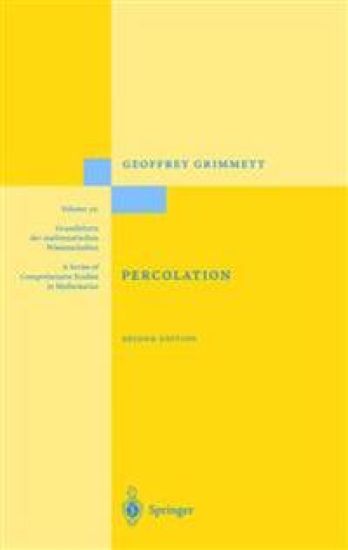
Percolation theory is the study of an idealized random medium in two or more dimensions. The mathematical theory is mature, and continues to give rise to problems of special beauty and difficulty. Percolation is pivotal for studying more complex physical systems exhibiting phase transitions. The emphasis of this book is upon core mathematical material and the presentation of the shortest and most accessible proofs. The book is intended for graduate students and researchers in probability and mathematical physics. Almost no specialist knowledge is assumed. Much new material appears in this second edition, including: dynamic and static renormalization, strict inequalities between critical points, a sketch of the lace expansion, and several essays on related fields and applications.
Therandom-clustermodelwasinventedbyCees[Kees]FortuinandPietKasteleyn around 1969 as a uni?cation of percolation, Ising, and Potts models, and as an extrapolation of electrical networks. Their original motivation was to harmonize the series and parallel laws satis?ed by such systems. In so doing, they initiated a study in stochastic geometry which has exhibited beautiful structure in its own right, and which has become a central tool in the pursuit of one of the oldest challenges of classical statistical mechanics, namely to model and analyse the ferromagnet and especially its phase transition. The importance of the model for probability and statistical mechanics was not fully recognized until the late 1980s. There are two reasons for this period of dormancy. Although the early publications of 1969–1972 contained many of the basic properties of the model, the emphasis placed there upon combinatorial aspects may have obscured its potential for applications. In addition, many of the geometrical arguments necessary for studying the model were not known prior to 1980, but were developed during the ‘decade of percolation’ that began 1 then. In 1980 was published the proof that p = for bond percolation on the c 2 square lattice, and this was followed soon by Harry Kesten’s monograph on t- dimensionalpercolation. Percolationmovedintohigherdimensionsaround1986, and many of the mathematical issues of the day were resolved by 1989. Interest in the random-cluster model as a tool for studying the Ising/Potts models was rekindled around 1987.
Therandom-clustermodelwasinventedbyCees[Kees]FortuinandPietKasteleyn around 1969 as a uni?cation of percolation, Ising, and Potts models, and as an extrapolation of electrical networks. Their original motivation was to harmonize the series and parallel laws satis?ed by such systems. In so doing, they initiated a study in stochastic geometry which has exhibited beautiful structure in its own right, and which has become a central tool in the pursuit of one of the oldest challenges of classical statistical mechanics, namely to model and analyse the ferromagnet and especially its phase transition. The importance of the model for probability and statistical mechanics was not fully recognized until the late 1980s. There are two reasons for this period of dormancy. Although the early publications of 1969–1972 contained many of the basic properties of the model, the emphasis placed there upon combinatorial aspects may have obscured its potential for applications. In addition, many of the geometrical arguments necessary for studying the model were not known prior to 1980, but were developed during the ‘decade of percolation’ that began 1 then. In 1980 was published the proof that p = for bond percolation on the c 2 square lattice, and this was followed soon by Harry Kesten’s monograph on t- dimensionalpercolation. Percolationmovedintohigherdimensionsaround1986, and many of the mathematical issues of the day were resolved by 1989. Interest in the random-cluster model as a tool for studying the Ising/Potts models was rekindled around 1987.
This text focuses on percolation theory - the study of an idealized random medium in two or more dimensions. Percolation is pivotal for studying more complex physical systems exhibiting phase transitions. The emphasis of this book is upon core mathematical material.