Kirjojen hintavertailu – 12 903 725 kirjaa ja 27 kauppaa

Kirjailija

Geoffrey R. Stone

Kirjat ja teokset yhdessä paikassa: 7 kirjaa, julkaisuja vuosilta 2007–2023, suosituimpiin kuuluu A Legacy of Discrimination. Vertaile teosten hintoja ja tarkista saatavuus suomalaisista kirjakaupoista.

7 kirjaa

Kirjojen julkaisuvuodet: 2007–2023.

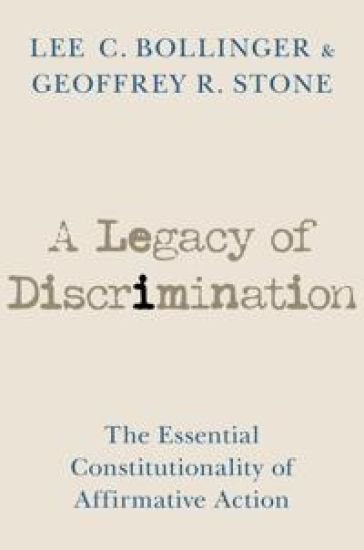
A Legacy of Discrimination

A Legacy of Discrimination

Lee C. Bollinger; Geoffrey R. Stone

OXFORD UNIVERSITY PRESS INC
2023
sidottu

Halvin toimitettuna 39,20 €

A timely defense of affirmative action policies that offers a more nuanced understanding of how centuries of invidious racism, discrimination, and segregation in the United States led to and justifies such policies from both a moral and constitutional perspective. Since 1961, the issue of "affirmative action" has been a hotly contested legal and political issue. Intended to address our nation's often horrifying discrimination against Black Americans and other minorities, affirmative action has led over the past sixty years to far greater minority representation across a vast range of industries, government positions, and academic institutions. Nonetheless, affirmative action policies in the United States continue to fall under assault. In A Legacy of Discrimination, Lee C. Bollinger and Geoffrey R. Stone, two of America's leading constitutional scholars, trace the policy's history and the legal challenges it has faced over the decades. They argue that in order to fully comprehend affirmative action's original intent and impact, we must re-acquaint ourselves with the era in which it arose, beginning with the most important Supreme Court decision of the 20th century, 1954's Brown v. Board of Education of Topeka, Kansas. Assessing this history, Bollinger and Stone introduce subsequent, and evolving, affirmative-action case law that had the intent and effect of constraining social, educational, and economic progress for Black people and other minority groups. They demonstrate how and why affirmative action policies stand on firm legal ground and must remain protected. Further, they explain why Americans must view affirmative action as a long-term moral commitment to secure justice, especially for Black Americans, after three and a half centuries of grave injustice that violates the most essential aspirations of our nation. A timely and robust overview of the history of our nation's historical and continuing racial discrimination and of the advent of affirmative action as a critical means to address this history, this book will serve as a powerful defense of a policy that has accomplished more than most people realize in making America a fairer and more inclusive country.
Constitutional Law: [Connected eBook with Study Center]

Constitutional Law: [Connected eBook with Study Center]

Geoffrey R. Stone; Louis Michael Seidman; Cass R. Sunstein

Aspen Publishing
2023
sidottu
Buy a new version of this textbook and receive access to the Connected eBook with Study Center on Casebook Connect, including lifetime access to the online ebook with highlight, annotation, and search capabilities. Access also includes practice questions, an outline tool, and other helpful resources. Connected eBooks provide what you need most to be successful in your law school classes. Constitutional Law, Ninth Editionby Geoffrey R. Stone, Louis M. Seidman, Cass R. Sunstein, Mark V. Tushnet, Pamela S. Karlan, Aziz Z. Huq, and Leah M. Litman guides students through all facets of constitutional law, exploring traditional constitutional doctrine through the lens of varying critical and social perspectives informed by political theory, philosophy, sociology, ethics, history, and economics. Constitutional Law, Ninth Editiontakes a comprehensive approach to the way in which constitutional law arises. It offers instructors carefully edited cases and rich, interdisciplinary material for classroom discussion. Logically organized for a two-semester course, the first part of Constitutional Law tackles issues concerning separation of powers and federalism; the second part addresses all facets of individual rights and liberties. Constitutional Law, Ninth Edition, also provides thoughtfully selected content on the First Amendment, to give students a well-rounded understanding of religion and free speech issues. New to the Ninth Edition: Extensively revised treatment of the Religion Clauses. Revamped material on abortion rights given Dobbs v. Jackson Women's Health Organization. More focused and tightened presentation of judicial review, federalism, and other areas. Professors and students will benefit from: The text's attention to policy, including discussion of competing critical and social perspectives. An interdisciplinary approach that draws on political theory, philosophy, sociology, ethics, history, and economics. Thoughtful editing, including both lightly and more tightly edited cases, that balances close textual analysis with comprehensive converge of important opinions and pivotal cases. Streamlined treatment of First Amendment law, so that it efficiently provides the necessary fundamentals in free speech and religious liberties jurisprudence. A comprehensive coverage that is ideal for a two-semester course.
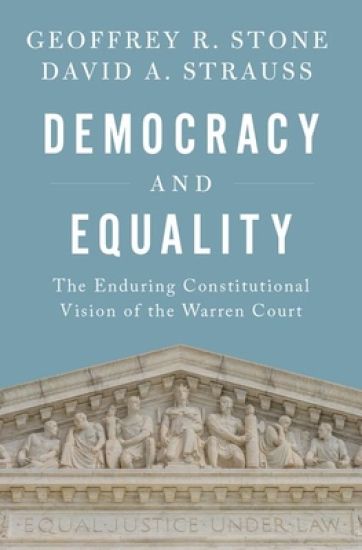
Democracy and Equality

Democracy and Equality

Geoffrey R. Stone; David A. Strauss

Oxford University Press Inc
2020
sidottu
From 1953 to 1969, the Supreme Court under Chief Justice Earl Warren brought about many of the proudest achievements of American constitutional law. The Warren declared racial segregation and laws forbidding interracial marriage to be unconstitutional; it expanded the right of citizens to criticize public officials; it held school prayer unconstitutional; and it ruled that people accused of a crime must be given a lawyer even if they can't afford one. Yet, despite those and other achievements, conservative critics have fiercely accused the justices of the Warren Court of abusing their authority by supposedly imposing their own opinions on the nation. As the eminent legal scholars Geoffrey R. Stone and David A. Strauss demonstrate in Democracy and Equality, the Warren Court's approach to the Constitution was consistent with the most basic values of our Constitution and with the most fundamental responsibilities of our judiciary. Stone and Strauss describer the Warren Court's extraordinary achievements by reviewing its jurisprudence across a range of issues addressing our nation's commitment to the values of democracy and equality. In each chapter, they tell the story of a critical decision, exploring the historical and legal context of each case, the Court's reasoning, and how the justices of the Warren Court fulfilled the Court's most important responsibilities. This powerfully argued evaluation of the Warren Court's legacy, in commemoration of the 50th anniversary of the end of the Warren Court, both celebrates and defends the Warren Court's achievements against almost sixty-five years of unrelenting and unwarranted attacks by conservatives. It demonstrates not only why the Warren Court's approach to constitutional interpretation was correct and admirable, but also why the approach of the Warren Court was far superior to that of the increasingly conservative justices who have dominated the Supreme Court over the past half-century.
Sex and the Constitution

Sex and the Constitution

Geoffrey R. Stone

Liveright Publishing Corporation
2018
nidottu
Lauded for "bringing a bracing and much-needed dose of reality about the Founders' views of sexuality" (New York Review of Books), Geoffrey R. Stone's Sex and the Constitution traces the evolution of legal and moral codes that have legislated sexual behavior from America's earliest days to today's fractious political climate. This "fascinating and maddening" (Pittsburgh Post-Gazette) narrative shows how agitators, moralists, and, especially, the justices of the Supreme Court have navigated issues as divisive as abortion, homosexuality, pornography, and contraception. Overturning a raft of contemporary shibboleths, Stone reveals that at the time the Constitution was adopted there were no laws against obscenity or abortion before the midpoint of pregnancy. A pageant of historical characters, including Voltaire, Thomas Jefferson, Anthony Comstock, Margaret Sanger, and Justice Anthony Kennedy, enliven this "commanding synthesis of scholarship" (Publishers Weekly) that dramatically reveals how our laws about sex, religion, and morality reflect the cultural schisms that have cleaved our nation from its founding.
Sex and the Constitution: Sex, Religion, and Law from America's Origins to the Twenty-First Century
Beginning his volume in the ancient and medieval worlds, Geoffrey R. Stone demonstrates how the Founding Fathers, deeply influenced by their philosophical forebears, saw traditional Christianity as an impediment to the pursuit of happiness and to the quest for human progress. Acutely aware of the need to separate politics from the divisive forces of religion, the Founding Fathers crafted a constitution that expressed the fundamental values of the Enlightenment. Although the Second Great Awakening later came to define America through the lens of evangelical Christianity, nineteenth-century Americans continued to view sex as a matter of private concern, so much so that sexual expression and information about contraception circulated freely, abortions before "quickening" remained legal, and prosecutions for sodomy were almost nonexistent. The late nineteenth and early twentieth centuries reversed such tolerance, however, as charismatic spiritual leaders and barnstorming politicians rejected the values of our nation's founders. Spurred on by Anthony Comstock, America's most feared enforcer of morality, new laws were enacted banning pornography, contraception, and abortion, with Comstock proposing that the word "unclean" be branded on the foreheads of homosexuals. Women increasingly lost control of their bodies, and birth control advocates, like Margaret Sanger, were imprisoned for advocating their beliefs. In this new world, abortions were for the first time relegated to dank and dangerous back rooms. The twentieth century gradually saw the emergence of bitter divisions over issues of sexual "morality" and sexual freedom. Fiercely determined organizations and individuals on both the right and the left wrestled in the domains of politics, religion, public opinion, and the courts to win over the soul of the nation. With its stirring portrayals of Supreme Court justices, Sex and the Constitution reads like a dramatic gazette of the critical cases they decided, ranging from Griswold v. Connecticut (contraception), to Roe v. Wade (abortion), to Obergefell v. Hodges (gay marriage), with Stone providing vivid historical context to the decisions that have come to define who we are as a nation. Now, though, after the 2016 presidential election, we seem to have taken a huge step backward, with the progress of the last half century suddenly imperiled. No one can predict the extent to which constitutional decisions safeguarding our personal freedoms might soon be eroded, but Sex and the Constitution is more vital now than ever before.
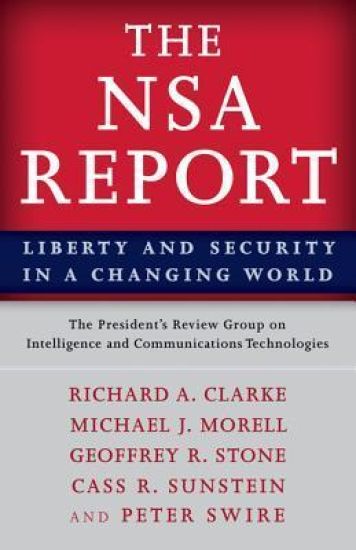
The NSA Report

The NSA Report

Richard A. Clarke; Michael J. Morell; Geoffrey R. Stone; Cass R. Sunstein; Peter Swire

Princeton University Press
2014
pokkari
"We cannot discount the risk, in light of the lessons of our own history, that at some point in the future, high-level government officials will decide that this massive database of extraordinarily sensitive private information is there for the plucking. Americans must never make the mistake of wholly 'trusting' our public officials."--The NSA Report This is the official report that is helping shape the international debate about the unprecedented surveillance activities of the National Security Agency. Commissioned by President Obama following disclosures by former NSA contractor Edward J. Snowden, and written by a preeminent group of intelligence and legal experts, the report examines the extent of NSA programs and calls for dozens of urgent and practical reforms. The result is a blueprint showing how the government can reaffirm its commitment to privacy and civil liberties--without compromising national security.
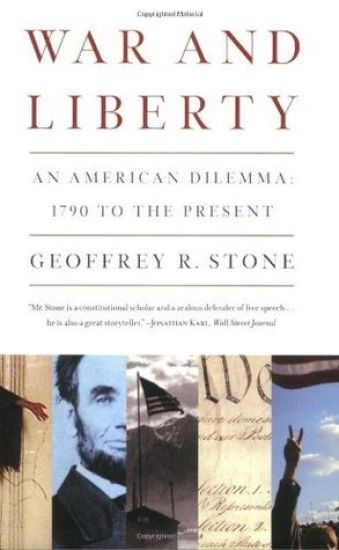
War and Liberty

War and Liberty

Geoffrey R. Stone

WW Norton Co
2007
pokkari
An analysis of the challenges of preserving civil liberties in wartime by the national award-winning author of Perilous Times provides in-depth coverage of how constitutional rights have changed during the presidency of George W. Bush, in an account that also describes similar repressions of American civil liberties in times of war throughout history. Original.