Kirjojen hintavertailu – 12 903 725 kirjaa ja 27 kauppaa

Kirjailija

George Anastaplo

Kirjat ja teokset yhdessä paikassa: 16 kirjaa, julkaisuja vuosilta 1989–2015, suosituimpiin kuuluu Reflections on Constitutional Law. Vertaile teosten hintoja ja tarkista saatavuus suomalaisista kirjakaupoista.

16 kirjaa

Kirjojen julkaisuvuodet: 1989–2015.

Reflections on Religion, the Divine, and the Constitution
In Part One, the uses of divine revelation in the Western world are reviewed by recalling authors that include Euripides, Sophocles, Aristophanes, Plato, Maimonides, Cervantes, Hobbes, and Milton. The challenges posed by such monstrosities as Aztec human sacrifices and the Second World War Holocaust are recalled. In Part Two, the challenges of religion for and by Americans are examined. Documents such as the Declaration of Independence, the Constitution of 1787, and Presidential Farewell Addresses are recalled. The lives and thought of eminent Americans are also recalled (including George Washington, Benjamin Franklin, Thomas Jefferson, and Abraham Lincoln). Recalled as well are such movements as that of the Mormons and that of the “I Am” sect. The implications both for religious developments and for religious orthodox of modern science are investigated. The Appendices reinforce these inquiries by providing reminders of how distinguished commentators and others have tried to deal with critical questions noticed in the Essays of this book.
Reflections on War and Peace and the Constitution
The attitudes and assumptions of different cultures and historical periods toward war and the maintenance of peace are reviewed by recalling authors who include Euripides, Sophocles, Plato, Cervantes, Shakespeare, Hobbes, and Zola. The challenges of war, peace, and national security for and by Americans are examined, and documents such as the Declaration of Independence and the Constitution of 1787. The lives and thought of eminent Americans are also recalled (including George Washington, Thomas Jefferson, Abraham Lincoln, and Franklin Roosevelt), as well as the challenges posed by incidents such as the Dreyfus Affair and monstrosities such as the Second World War Holocaust. The Appendixes reinforce these inquiries by providing critical documents in American history and interviews with a Holocaust survivor.
Reflections on Religion, the Divine, and the Constitution
In Part One, the uses of divine revelation in the Western world are reviewed by recalling authors that include Euripides, Sophocles, Aristophanes, Plato, Maimonides, Cervantes, Hobbes, and Milton. The challenges posed by such monstrosities as Aztec human sacrifices and the Second World War Holocaust are recalled. In Part Two, the challenges of religion for and by Americans are examined. Documents such as the Declaration of Independence, the Constitution of 1787, and Presidential Farewell Addresses are recalled. The lives and thought of eminent Americans are also recalled (including George Washington, Benjamin Franklin, Thomas Jefferson, and Abraham Lincoln). Recalled as well are such movements as that of the Mormons and that of the “I Am” sect. The implications both for religious developments and for religious orthodox of modern science are investigated. The Appendices reinforce these inquiries by providing reminders of how distinguished commentators and others have tried to deal with critical questions noticed in the Essays of this book.
Reflections on Slavery and the Constitution

Reflections on Slavery and the Constitution

George Anastaplo

Lexington Books
2013
nidottu
In this insightful book about constitutional law and slavery, George Anastaplo illuminates both how the history of race relations in the United States should be approached and how seemingly hopeless social and political challenges can be usefully considered through the lens of the U. S. Constitution. He examines the outbreak of the American Civil War, its prosecution, and its aftermath, tracing the concept of slavery and law from its earliest beginnings and slavery’s fraught legal history within the United States. Anastaplo offers discussions that bring into focus discussions of slavery in Ancient Greece and within the Bible, showing their influence on the Constitution and the subsequent political struggles that led to the Civil War.
The Christian Heritage

The Christian Heritage

George Anastaplo; Martin E. Marty

Lexington Books
2010
sidottu
The Christian Heritage: Problems and Prospects delves into the history of the western Christian heritage. Challenges to the Christian heritage, a heritage nourished both by Judaism and by the western classics, have been stimulated by the very success of the way of life that is promoted, a way of life that is somehow responsible for the emergence of modern science with its revolutionary technology. The reader is encouraged to reconsider authors prominent in the religious tradition of the West. Guidance is provided for examinations of the fundamental assumptions and the enduring questions by which Western Civilization has been guided and challenged for millennia. The enduring texts that we in the West repeatedly encounter, especially the most challenging of them, are apt to draw upon, and to illuminate the fundamental assumptions and the enduring questions by which Western Civilization has been guided and challenged for millennia. Vital to Western Civilization has long been the Christian Heritage. That Heritage has been taken for granted in our general education, in something as prosaic as the everyday operations of our legal system, and perhaps even in our economic and other social arrangements.
The Christian Heritage

The Christian Heritage

George Anastaplo; Martin E. Marty

Lexington Books
2010
nidottu
The Christian Heritage: Problems and Prospects delves into the history of the western Christian heritage. Challenges to the Christian heritage, a heritage nourished both by Judaism and by the western classics, have been stimulated by the very success of the way of life that is promoted, a way of life that is somehow responsible for the emergence of modern science with its revolutionary technology. The reader is encouraged to reconsider authors prominent in the religious tradition of the West. Guidance is provided for examinations of the fundamental assumptions and the enduring questions by which Western Civilization has been guided and challenged for millenniums. The enduring texts that we in the West repeatedly encounter, especially the most challenging of them, are apt to draw upon, and to illuminate the fundamental assumptions and the enduring questions by which Western Civilization has been guided and challenged for millenniums. Vital to Western Civilization has long been the Christian Heritage. That Heritage has been taken for granted in our general education, in something as prosaic as the everyday operations of our legal system, and perhaps even in our economic and other social arrangements.
The Bible

The Bible

George Anastaplo

Lexington Books
2008
nidottu
The Biblical heritage is generally recognized as vital to the development and guidance of Western Civilization as we know it. It is also recognized that it is in the interest of both believers and skeptics that the Bible be read with care. Among the things to be noticed is the status of the virtue of prudence in various circumstances described in the Bible. Particularly revealing in George Anastaplo's essays and appendices is what is shown about how intrinsically interesting the Biblical accounts are_accounts which not only offer guidance for everyday life but also instruction about the enduring questions that people everywhere have been asking for centuries. Thus, The Bible: Respectful Readings provides instruction for analyzing Biblical texts with care. It makes readers aware of both the questions addressed and the relevant evidence that should be assessed within The Bible. Winston Churchill counselled responsible thinkers today to address 'not only those . . . who enjoy the blessings and consolidation of revealed religion, but also . . . those who face the mystery of the human destiny alone.' In keeping with this spirit, Respectful Readings accommodates to the wide range of prospective students of the sacred texts of Western Civilization.
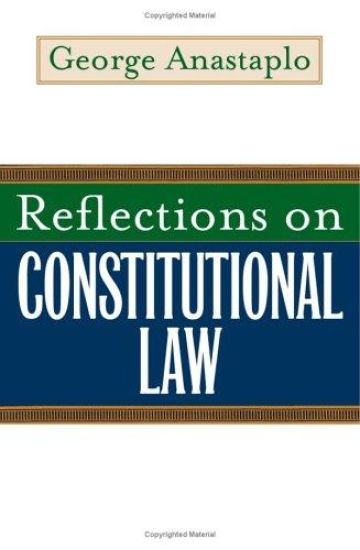
Reflections on Constitutional Law

Reflections on Constitutional Law

George Anastaplo

The University Press of Kentucky
2006
nidottu
In a trend that disturbs nationally known constitutional scholar George Anastaplo, law schools now place very little emphasis on the study of the United States Constitution as a document. Today, many constitutional law professors spend less than a week teaching the history, philosophical tenets, and legal origins of the Constitution itself and more time on Supreme Court cases. In Reflections on Constitutional Law, Anastaplo emphasizes the continuing significance and importance of the Constitution by examining the most important influences on the American constitutional system, including the Magna Carta and the Declaration of Independence. According to Anastaplo, a rigorous understanding of the Constitution is crucial to comprehending the true meaning of Supreme Court decisions.
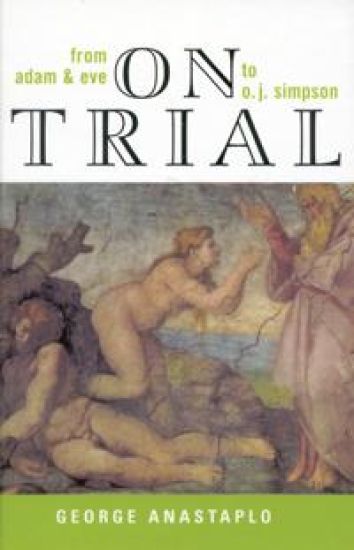
On Trial

On Trial

George Anastaplo

Lexington Books
2004
sidottu
On Trial is an exegesis on legal reason, moral judgment, political life, and the events that give them meaning. Beginning with the serpent in the Garden of Eden and ending with O. J. Simpson, esteemed thinker George Anastaplo offers students, scholars, and informed readers an exploration of justice and the rule of law through well-known trials ancient and modern, real and fictional. Anastaplo starts with an interrogation of the good common sense on which most of us draw to make successful judgments. He examines the nurturing of this faculty against rationality, moral obligation, and the contingencies of history and culture. Using classic literary sources as well as real trial histories, On Trial puts legal and moral reason squarely beneath the critical lens.
On Trial

On Trial

George Anastaplo

Lexington Books
2004
nidottu
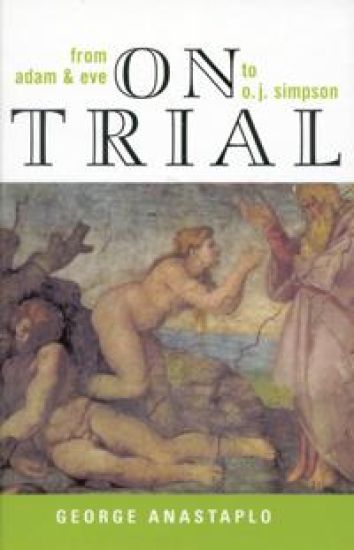
On Trial is an exegesis on legal reason, moral judgment, political life, and the events that give them meaning. Beginning with the serpent in the Garden of Eden and ending with O. J. Simpson, esteemed thinker George Anastaplo offers students, scholars, and informed readers an exploration of justice and the rule of law through well-known trials ancient and modern, real and fictional. Anastaplo starts with an interrogation of the good common sense on which most of us draw to make successful judgments. He examines the nurturing of this faculty against rationality, moral obligation, and the contingencies of history and culture. Using classic literary sources as well as real trial histories, On Trial puts legal and moral reason squarely beneath the critical lens.
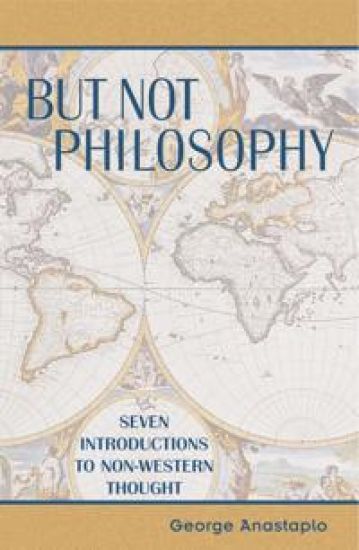
But Not Philosophy

But Not Philosophy

George Anastaplo; John Van Doren

Lexington Books
2001
nidottu
George Anastaplo has written brilliantly and persuasively about ancient and modern Western political philosophy and literature and about American Constitutional history and law. With his latest book Anastaplo turns away from his areas of admitted expertise to offer, in his own words, "the explorations of a determined amateur with some practice in reading." The essays contained in this volume were originally conceived as a set of seminars, each culminating in a public lecture, which in turn formed the basis for contributions to Encyclopedia Brittanica's 1961-1998 series The Great Ideas Today. Gathered in this one volume, But Not Philosophy provides useful and thought-provoking introductions to seven major "schools" of non-Western thought: Mesopotamian, ancient African, Hindu, Confucian, Buddhist, Islamic, and North American Indian. Anastaplo studies ancient literary epics and legal codes and examines religious traditions and systems of thought, providing detailed references to authoritative histories and commentators. Movingly and thoughtfully written, the essays encourage readers to bring their own Western traditions under similar scrutiny, to study our own grasp of the divine, reliance upon nature and causality, and dependence on philosophy-to learn about what we are from what we are not.
The Thinker As Artist

The Thinker As Artist

George Anastaplo

Ohio University Press
1997
pokkari
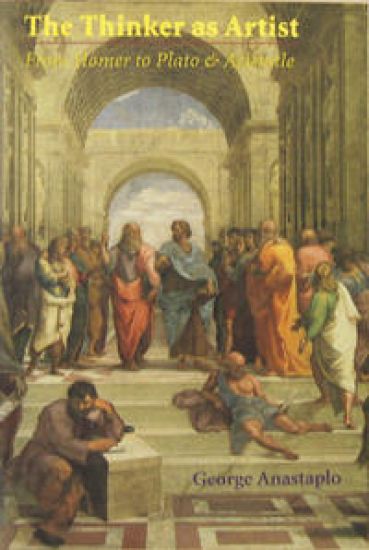
In an attempt to subject representative texts of a dozen ancient authors to a more or less Socratic inquiry, the noted scholar George Anastaplo suggests in The Thinker as Artist how one might usefully read as well as enjoy such texts, which illustrate the thinking done by the greatest artists and how they "talk" among themselves across the centuries. In doing so, he does not presume to repeat the many fine things said about these and like authors, but rather he discusses what he himself has noticed about them, text by text. Drawing upon a series of classical authors ranging from Homer and Sappho to Plato and Aristotle, Anastaplo examines issues relating to chance, art, nature, and divinity present in the artful works of philosophers and other thinkers. As he has done in his earlier work, Anastaplo mines the great texts to help us discover who we are and what we should be. Some of the works used are familiar, while others were once better known than they are now. The approach to all of them is fresh and provocative, demonstrating the value of such texts in showing the reader what to look for and how to talk about matters that have always engaged thoughtful human beings. These imaginative yet disciplined discussions of important texts of ancient Greek thought and of Raphael's The School of Athens should appeal to both the specialist and the general reader.
The American Moralist

The American Moralist

George Anastaplo

Ohio University Press
1994
pokkari
The essays collected here, somewhat autobiographical in their effect, range from a discussion of the despair of the Cold War and Vietnam in 1966 to reflections on the euphoria over the ending of the Cold War in Eastern Europe in 1990. The opening essays are general in nature: exploring the foundation and limitation of sound morality; examining what is "American" about American morality; measuring all by the yardsticks provided by classical and modern philosophers. Anastaplo's overriding concern here is to show how one can be moral without being either cranky or moralistic. He then turns his attention to the issues of the day: the first amendment, religious liberty, women and the law, gun control, medicine, capital punishment, local politics, civil disobedience.
The American Moralist

The American Moralist

George Anastaplo

Ohio University Press
1994
sidottu
The essays collected here, somewhat autobiographical in their effect, range from a discussion of the despair of the Cold War and Vietnam in 1966 to reflections on the euphoria over the ending of the Cold War in Eastern Europe in 1990. The opening essays are general in nature: exploring the foundation and limitation of sound morality; examining what is "American" about American morality; measuring all by the yardsticks provided by classical and modern philosophers. Anastaplo's overriding concern here is to show how one can be moral without being either cranky or moralistic. He then turns his attention to the issues of the day: the first amendment, religious liberty, women and the law, gun control, medicine, capital punishment, local politics, civil disobedience.
The Constitution of 1787

The Constitution of 1787

George Anastaplo

Johns Hopkins University Press
1989
pokkari
"A marvelous instrument for introducing citizens to their Constitution" (Mortimer J. Adler), "this is exactly the kind of book that former Chief Justice Burger, as Chairman of the Bicentennial Commission, has been pleading with scholars and scholarly presses to produce" (Thomas L. Pangle, University of Toronto).