Kirjojen hintavertailu – 12 859 828 kirjaa ja 27 kauppaa

Kirjailija

George Em Karniadakis

Kirjat ja teokset yhdessä paikassa: 4 kirjaa, julkaisuja vuosilta 2003–2024, suosituimpiin kuuluu Spectral and Spectral Element Methods for Fractional Ordinary and Partial Differential Equations. Vertaile teosten hintoja ja tarkista saatavuus suomalaisista kirjakaupoista.

4 kirjaa

Kirjojen julkaisuvuodet: 2003–2024.

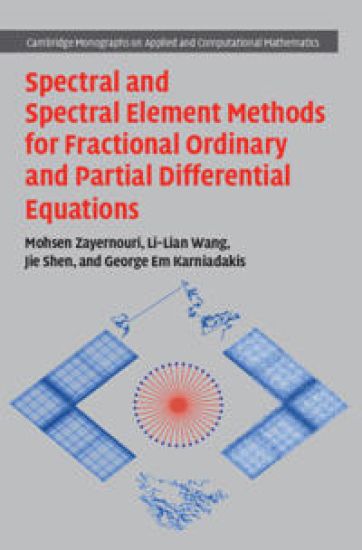
Spectral and Spectral Element Methods for Fractional Ordinary and Partial Differential Equations

Spectral and Spectral Element Methods for Fractional Ordinary and Partial Differential Equations

Mohsen Zayernouri; Li-Lian Wang; Jie Shen; George Em Karniadakis

Cambridge University Press
2024
sidottu
This comprehensive introduction to global spectral methods for fractional differential equations from leaders of this emerging field is designed to be accessible to graduate students and researchers across math, science, and engineering. The book begins by covering the foundational fractional calculus concepts needed to understand and model anomalous transport phenomena. The authors proceed to introduce a series of new spectral theories and new families of orthogonal and log orthogonal functions, then present corresponding spectral and spectral element methods for fractional differential equations. The book also covers the fractional Laplacian in unbounded and bounded domains and major developments in time-integration of fractional models. It ends by sampling the wide variety of real-world applications of fractional modeling, including concentration transport in surface/subsurface dynamics, complex rheology and material damage, and fluid turbulence and geostrophic transport.
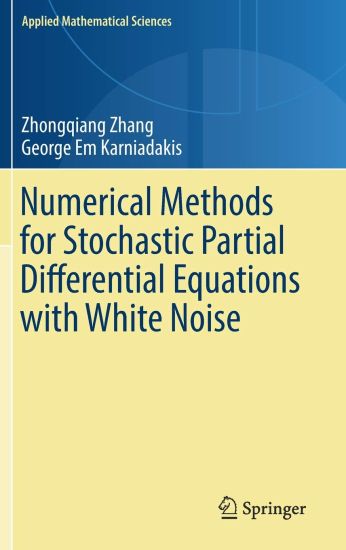
Numerical Methods for Stochastic Partial Differential Equations with White Noise

Numerical Methods for Stochastic Partial Differential Equations with White Noise

Zhongqiang Zhang; George Em Karniadakis

Springer International Publishing AG
2018
nidottu
This book covers numerical methods for stochastic partial differential equations with white noise using the framework of Wong-Zakai approximation. The book begins with some motivational and background material in the introductory chapters and is divided into three parts. Part I covers numerical stochastic ordinary differential equations. Here the authors start with numerical methods for SDEs with delay using the Wong-Zakai approximation and finite difference in time. Part II covers temporal white noise. Here the authors consider SPDEs as PDEs driven by white noise, where discretization of white noise (Brownian motion) leads to PDEs with smooth noise, which can then be treated by numerical methods for PDEs. In this part, recursive algorithms based on Wiener chaos expansion and stochastic collocation methods are presented for linear stochastic advection-diffusion-reaction equations. In addition, stochastic Euler equations are exploited as an application of stochastic collocation methods, where a numerical comparison with other integration methods in random space is made. Part III covers spatial white noise. Here the authors discuss numerical methods for nonlinear elliptic equations as well as other equations with additive noise. Numerical methods for SPDEs with multiplicative noise are also discussed using the Wiener chaos expansion method. In addition, some SPDEs driven by non-Gaussian white noise are discussed and some model reduction methods (based on Wick-Malliavin calculus) are presented for generalized polynomial chaos expansion methods. Powerful techniques are provided for solving stochastic partial differential equations. This book can be considered as self-contained. Necessary background knowledge is presented in the appendices. Basic knowledge of probability theory and stochastic calculus is presented in Appendix A. In Appendix B some semi-analytical methods for SPDEs are presented. In Appendix C an introduction to Gauss quadrature is provided. In Appendix D, all the conclusions which are needed for proofs are presented, and in Appendix E a method to compute the convergence rate empirically is included. In addition, the authors provide a thorough review of the topics, both theoretical and computational exercises in the book with practical discussion of the effectiveness of the methods. Supporting Matlab files are made available to help illustrate some of the concepts further. Bibliographic notes are included at the end of each chapter. This book serves as a reference for graduate students and researchers in the mathematical sciences who would like to understand state-of-the-art numerical methods for stochastic partial differential equations with white noise.
Numerical Methods for Stochastic Partial Differential Equations with White Noise

Numerical Methods for Stochastic Partial Differential Equations with White Noise

Zhongqiang Zhang; George Em Karniadakis

Springer International Publishing AG
2017
sidottu
This book covers numerical methods for stochastic partial differential equations with white noise using the framework of Wong-Zakai approximation. The book begins with some motivational and background material in the introductory chapters and is divided into three parts. Part I covers numerical stochastic ordinary differential equations. Here the authors start with numerical methods for SDEs with delay using the Wong-Zakai approximation and finite difference in time. Part II covers temporal white noise. Here the authors consider SPDEs as PDEs driven by white noise, where discretization of white noise (Brownian motion) leads to PDEs with smooth noise, which can then be treated by numerical methods for PDEs. In this part, recursive algorithms based on Wiener chaos expansion and stochastic collocation methods are presented for linear stochastic advection-diffusion-reaction equations. In addition, stochastic Euler equations are exploited as an application of stochastic collocation methods, where a numerical comparison with other integration methods in random space is made. Part III covers spatial white noise. Here the authors discuss numerical methods for nonlinear elliptic equations as well as other equations with additive noise. Numerical methods for SPDEs with multiplicative noise are also discussed using the Wiener chaos expansion method. In addition, some SPDEs driven by non-Gaussian white noise are discussed and some model reduction methods (based on Wick-Malliavin calculus) are presented for generalized polynomial chaos expansion methods. Powerful techniques are provided for solving stochastic partial differential equations. This book can be considered as self-contained. Necessary background knowledge is presented in the appendices. Basic knowledge of probability theory and stochastic calculus is presented in Appendix A. In Appendix B some semi-analytical methods for SPDEs are presented. In Appendix C an introduction to Gauss quadrature is provided. In Appendix D, all the conclusions which are needed for proofs are presented, and in Appendix E a method to compute the convergence rate empirically is included. In addition, the authors provide a thorough review of the topics, both theoretical and computational exercises in the book with practical discussion of the effectiveness of the methods. Supporting Matlab files are made available to help illustrate some of the concepts further. Bibliographic notes are included at the end of each chapter. This book serves as a reference for graduate students and researchers in the mathematical sciences who would like to understand state-of-the-art numerical methods for stochastic partial differential equations with white noise.
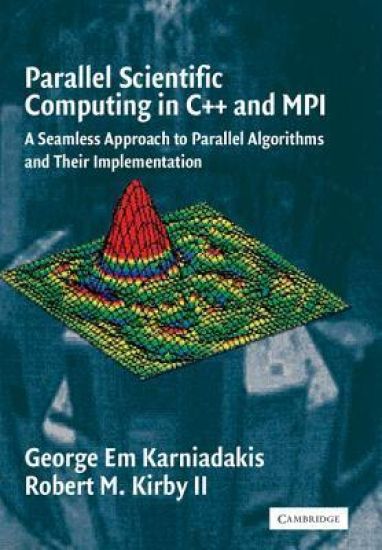
Parallel Scientific Computing in C++ and MPI

Parallel Scientific Computing in C++ and MPI

George Em Karniadakis; Robert M. Kirby II

Cambridge University Press
2003
pokkari
Numerical algorithms, modern programming techniques, and parallel computing are often taught serially across different courses and different textbooks. The need to integrate concepts and tools usually comes only in employment or in research - after the courses are concluded - forcing the student to synthesise what is perceived to be three independent subfields into one. This book provides a seamless approach to stimulate the student simultaneously through the eyes of multiple disciplines, leading to enhanced understanding of scientific computing as a whole. The book includes both basic as well as advanced topics and places equal emphasis on the discretization of partial differential equations and on solvers. Some of the advanced topics include wavelets, high-order methods, non-symmetric systems, and parallelization of sparse systems. The material covered is suited to students from engineering, computer science, physics and mathematics.