

Kirjailija
George Holmes
Kirjat ja teokset yhdessä paikassa: 18 kirjaa, julkaisuja vuosilta 1966–2025, suosituimpiin kuuluu Farmer John. Vertaile teosten hintoja ja tarkista saatavuus suomalaisista kirjakaupoista.
18 kirjaa
Kirjojen julkaisuvuodet: 1966–2025.


Foedera, Conventiones, Literae, Et Cujuscunque Generis Acta Publica, Inter Reges Angliae, Et Alios Quosvis Imperatores, Reges, Pontifices, Principes, Vel Communitates, Ab Ineunte Saeculo Duodecimo ... Ad Nostra Usque Tempora, Habita Aut Tractata
Thomas Rymer; George Holmes; Robert Sanderson
Hutson Street Press
2025
sidottu

Foedera, Conventiones, Literae, Et Cujuscunque Generis Acta Publica, Inter Reges Angliae, Et Alios Quosvis Imperatores, Reges, Pontifices, Principes, Vel Communitates, Ab Ineunte Saeculo Duodecimo ... Ad Nostra Usque Tempora, Habita Aut Tractata
Thomas Rymer; George Holmes; Robert Sanderson
Hutson Street Press
2025
pokkari




Reprint of the original, first published in 1883.

Reprint of the original, first published in 1883.


Sketches Of Some Of The Southern Counties Of Ireland, Collected During A Tour In The Autumn, 1797, In A Series Of Letters
George Holmes
Alpha Edition
2021
pokkari
Sketches Of Some Of The Southern Counties Of Ireland, Collected During A Tour In The Autumn, 1797, In A Series Of Letters has been considered by academicians and scholars of great significance and value to literature. This forms a part of the knowledge base for future generations. So that the book is never forgotten we have represented this book in a print format as the same form as it was originally first published. Hence any marks or annotations seen are left intentionally to preserve its true nature.
Sketches Of Some Of The Southern Counties Of Ireland
George Holmes
KESSINGER PUBLISHING, LLC
2009
pokkari
The Oxford Illustrated History of Medieval Europe
George Holmes
Oxford University Press
2001
nidottu
Halvin toimitettuna 33,80 €
This richly illustrated book is the most authoritative account of life in medieval Europe between the fall of the Roman Empire and the coming of the Renaissance. Full coverage is given to all aspects of life in a thousand-year period which saw the creation of western civilization: from the empires and kingdoms of Charlemagne, the Byzantines, and the Hundred Years War, to the ideas of the Crusades; the building of great cathedrals and the social catastrophe of the Black Death; the cultural worlds of chivalric knights, popular festivals, and new art forms. The chapters show the movement of hte centre of gravity in European life from the Mediterranean to the north; and the authors explore the contrast between Byzantine and Renaissance cultures in the south and the new, complex political and social structures of north-west Europe, which by 1300 had the most advanced civilization the world had ever seen. Over 200 illustrations, including 24 colour plates, amplify the text; and the picture is completed with comprehensive reference material including maps, genealogies, and a full chronology.

This book provides a classic introduction to a key period in the history of Europe - the transition from medieval to Renaissance Europe. In this updated edition, Professor Holmes traces the main political events as well as describing broader changes in social structure and culture. He reveals the interactions between politics, society and ideas that contributed to the problems and changes of this period. The book addresses the crises of the medieval world. At the start of the period, Europe was dominated by the institutions of the church, monarchy, armies of knightly cavalry and Gothic art. By the end, the Papacy had been drastically weakened, the Hussite movement was heralding the social and religious changes to come in the next century, the armoured knight was no longer a formidable force, and the cultural movement of the Italian Renaissance was beginning to unfold. The author shows how economic forces, including the Black Death and the fall in population threatened the power of the landowners, church and monarchy and how such changes prompted interaction not only between political powers but between different communities and divergent ways of life and thought. Throughout the book, Professor Holmes relates his strong political narrative to the social and ideological movements of the period and explains the legacy of this period for the centuries that followed. For this edition, he has included updates to the text and bibliography.
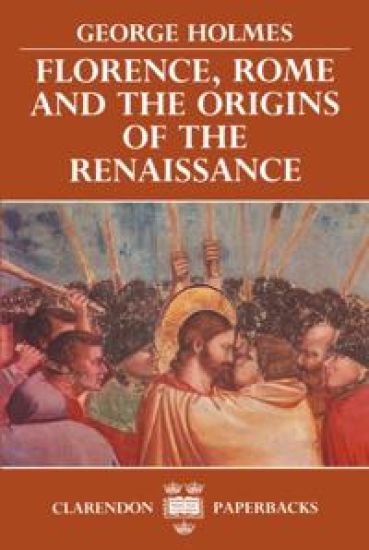
This study sets out to place the remarkable cultural events of the early Renaissance in a full historical perspective. Dealing with both literary and visual art, it describes the world of Dante and Giotto and explains the circumstances in which their innovations became possible. The political, economical, cultural, and religious life of Tuscany between 1260 and 1320 is explored, and the importance of the relationship with the papal court emphasized. Papal patronage encouraged classical influence on the visual arts; but the Papacy also played a leading role in the political and economic life of the 'Guelf League', in which it was linked with Florence, Siena, Naples, and France. Papal intervention in Florence in 1301, leading to Dante's exile, and the Papacy's removal to France in 1305, created new conditions in which the masterpieces of Dante and Giotto were created. This is the first paperback edition of Florence, Rome and the Origins of the Renaissance, which was published in hardback in 1986.

Professor Holmes also examines the politics of these years--the relations of the kings of England with neighboring rules and with their own subjects. This period includes the successful conquest of Scotland, the series of wars with France known as the Hundred Years' War, and the War of the Roses, which brought Henry VII, the first Tudor, to the throne in 1485. Here also is an exploration of the heretical movement initiated by Wycliffe in the thirteen-seventies, which began a tendency toward loosening the power of the Church, and a study of the beginnings of parliamentary government in the later fourteenth century, its collapse in the following century, and the emergence of a strong self-sufficient monarchy.