Kirjojen hintavertailu – 12 903 725 kirjaa ja 27 kauppaa

Kirjailija

George Hutchinson

Kirjat ja teokset yhdessä paikassa: 9 kirjaa, julkaisuja vuosilta 1996–2026, suosituimpiin kuuluu Jean Toomer: Writer for a New America. Vertaile teosten hintoja ja tarkista saatavuus suomalaisista kirjakaupoista.

9 kirjaa

Kirjojen julkaisuvuodet: 1996–2026.

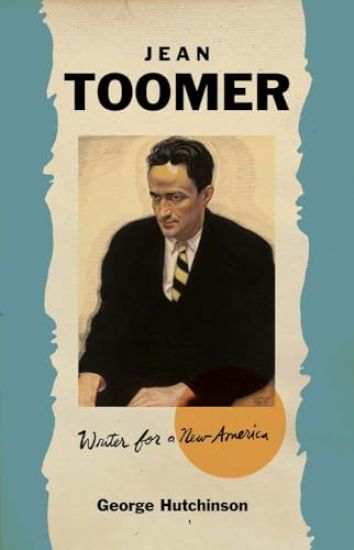
Jean Toomer: Writer for a New America

Jean Toomer: Writer for a New America

George Hutchinson; George Hutchinson

YALE UNIVERSITY PRESS
2026
sidottu
A critical biography of Harlem Renaissance writer Jean Toomer and his lifelong struggle to transcend race, by an award-winning author The poet and novelist Jean Toomer (1894-1967) was among the most influential figures of the Harlem Renaissance, inspiring generations of Black writers with his 1923 modernist masterwork Cane. Yet his mission was to awaken Americans to the formation of a new "American" race that would supersede the "old" racial categories. Award-winning biographer George Hutchinson reveals how Toomer's racial theory shaped both his literary genius and his personal struggles. Born into the Black elite in Washington, D. C., Toomer was highly sensitive to the color line and able to move across it. Toomer engaged in a lifelong struggle to be released from this system, reinventing himself racially, spiritually, and artistically not as a Black man but as a "superman." From his early attraction to physical culture through his search for Cosmic Consciousness, Toomer aspired to shape a new modern sensibility alongside his bohemian contemporaries Georgia O'Keeffe, Alfred Stieglitz, Langston Hughes, and Nella Larsen. Yet his refusal to identify as Black, in tandem with his messianic calling, came at the cost of his literary career and the women who loved him. Hutchinson shows how the tortures of American racism shaped Toomer's life--and how the struggle to birth a new "American" identity marks his art.

The celibates' club; being the united stories of The Bachelors' Club and The Old Maids' Club.: By: I. Zangwill, Illustrated By: George (Wylie) Hutchin
George Wylie Hutchinson (1852-1942) was a painter and leading illustrator in Britain and was from Great Village, Nova Scotia, Canada. He illustrated the works of Arthur Conan Doyle, Rudyard Kipling, Hall Caine, Robert Louis Stevenson and Israel Zangwill. His paintings inspired the poem "Large Bad Picture" and "Poem," both by Elizabeth Bishop, his great grand niece. Hutchinson was a contributor to and subject of the novel The Master (1895) by Israel Zangwill, with whom he was a close friend. Hutchinson left Nova Scotia at age 14, as a cabin boy. He studied painting in London at the Royal Academy (1880-1885) and later painted portraits and created illustrations and cartoons for numerous publications such as the Illustrated London News. At the age of 44, he returned to Nova Scotia for a year in 1896 and taught painting. By the 1910s and 1920s, Hutchinson appears to have been living in retirement in Clacton-on-Sea, Essex............................... Israel Zangwill (21 January 1864 - 1 August 1926) was a British author at the forefront of cultural Zionism during the 19th century, and was a close associate of Theodor Herzl. He later rejected the search for a Jewish homeland and became the prime thinker behind the territorial movement. Early life and education: Zangwill was born in London on 21 January 1864, in a family of Jewish immigrants from the Russian Empire. His father, Moses Zangwill, was from what is now Latvia, and his mother, Ellen Hannah Marks Zangwill, was from what is now Poland. He dedicated his life to championing the cause of people he considered oppressed, becoming involved with topics such as Jewish emancipation, Jewish assimilation, territorialism, Zionism, and women's suffrage. His brother was novelist Louis Zangwill. Zangwill received his early schooling in Plymouth and Bristol. When he was nine years old, Zangwill was enrolled in the Jews' Free School in Spitalfields in east London, a school for Jewish immigrant children. The school offered a strict course of both secular and religious studies while supplying clothing, food, and health care for the scholars; presently one of its four houses is named Zangwill in his honour. At this school he excelled and even taught part-time, eventually becoming a full-fledged teacher. While teaching, he studied for his degree from the University of London, earning a BA with triple honours in 1884. Writings: He had already written a tale entitled The Premier and the Painter in collaboration with Louis Cowen, when he resigned his position as a teacher owing to differences with the school managers and ventured into journalism. He initiated and edited Ariel, The London Puck, and did miscellaneous work for the London press. Zangwill's work earned him the nickname "the Dickens of the Ghetto." He wrote a very influential novel Children of the Ghetto: A Study of a Peculiar People (1892). The use of the metaphorical phrase "melting pot" to describe American absorption of immigrants was popularised by Zangwill's play The Melting Pot, 4] a success in the United States in 1909-10. When The Melting Pot opened in Washington D. C. on 5 October 1909, former President Theodore Roosevelt leaned over the edge of his box and shouted, "That's a great play, Mr. Zangwill, that's a great play." In 1912 Zangwill received a letter from Roosevelt in which Roosevelt wrote of the Melting Pot "That particular play I shall always count among the very strong and real influences upon my thought and my life..."....................
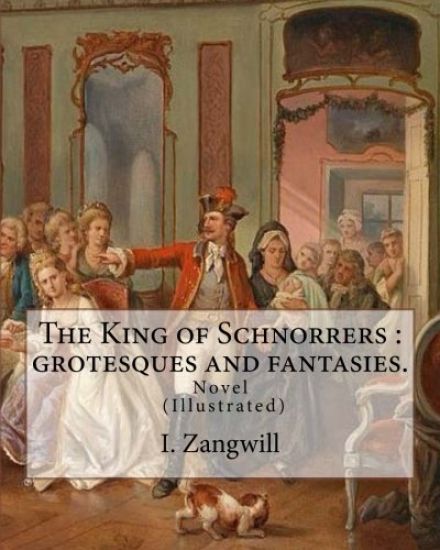
The King of Schnorrers: grotesques and fantasies. By: I. Zangwill: Novel Illustrated By: Mark Zangwill (1869 - 1945), By: F. H. Townsend (1868
Mark Zangwill Born 1869 in Plymouth, Devon, Englandmap Son of Moses Zangwill and mother unknown] Brother of Leah Zangwill, Israel Zangwill, Louis Zangwill and Dinah (Zangwill) Horn..... Frederick Henry Townsend (1868-1920) was a British illustrator and cartoonist. He illustrated the second edition of Charlotte Bront 's 1847 novel Jane Eyre, A Child's History of England and Gryll Grange, and Nathaniel Hawthorne's House of the Seven Gables in 1902. Also an edition (1907) of Kipling's The Brushwood Boy and the 1913 edition of Arthur Conan Doyle's The Sign of Four. Townsend also contributed cartoons to Punch.... George Wylie Hutchinson (1852-1942) was a painter and leading illustrator in Britain and was from Great Village, Nova Scotia, Canada.......... Israel Zangwill (21 January 1864 - 1 August 1926) was a British author at the forefront of cultural Zionism during the 19th century, and was a close associate of Theodor Herzl. He later rejected the search for a Jewish homeland and became the prime thinker behind the territorial movement. Early life and education: Zangwill was born in London on 21 January 1864, in a family of Jewish immigrants from the Russian Empire. His father, Moses Zangwill, was from what is now Latvia, and his mother, Ellen Hannah Marks Zangwill, was from what is now Poland. He dedicated his life to championing the cause of people he considered oppressed, becoming involved with topics such as Jewish emancipation, Jewish assimilation, territorialism, Zionism, and women's suffrage. His brother was novelist Louis Zangwill. Zangwill received his early schooling in Plymouth and Bristol. When he was nine years old, Zangwill was enrolled in the Jews' Free School in Spitalfields in east London, a school for Jewish immigrant children. The school offered a strict course of both secular and religious studies while supplying clothing, food, and health care for the scholars; presently one of its four houses is named Zangwill in his honour. At this school he excelled and even taught part-time, eventually becoming a full-fledged teacher. While teaching, he studied for his degree from the University of London, earning a BA with triple honours in 1884...................
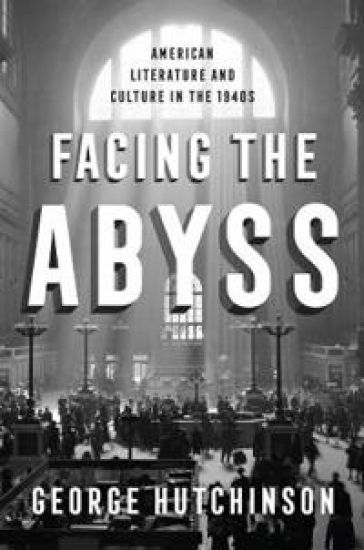
Facing the Abyss

Facing the Abyss

George Hutchinson

Columbia University Press
2018
sidottu
Mythologized as the era of the "good war" and the "Greatest Generation," the 1940s are frequently understood as a more heroic, uncomplicated time in American history. Yet just below the surface, a sense of dread, alienation, and the haunting specter of radical evil permeated American art and literature. Writers returned home from World War II and gave form to their disorienting experiences of violence and cruelty. They probed the darkness that the war opened up and confronted bigotry, existential guilt, ecological concerns, and fear about the nature and survival of the human race. In Facing the Abyss, George Hutchinson offers readings of individual works and the larger intellectual and cultural scene to reveal the 1940s as a period of profound and influential accomplishment. Facing the Abyss examines the relation of aesthetics to politics, the idea of universalism, and the connections among authors across racial, ethnic, and gender divisions. Modernist and avant-garde styles were absorbed into popular culture as writers and artists turned away from social realism to emphasize the process of artistic creation. Hutchinson explores a range of important writers, from Saul Bellow and Mary McCarthy to Richard Wright and James Baldwin. African American and Jewish novelists critiqued racism and anti-Semitism, women writers pushed back on the misogyny unleashed during the war, and authors such as Gore Vidal and Tennessee Williams reflected a new openness in the depiction of homosexuality. The decade also witnessed an awakening of American environmental and ecological consciousness. Hutchinson argues that despite the individualized experiences depicted in these works, a common belief in art's ability to communicate the universal in particulars united the most important works of literature and art during the 1940s. Hutchinson's capacious view of American literary and cultural history masterfully weaves together a wide range of creative and intellectual expression into a sweeping new narrative of this pivotal decade.
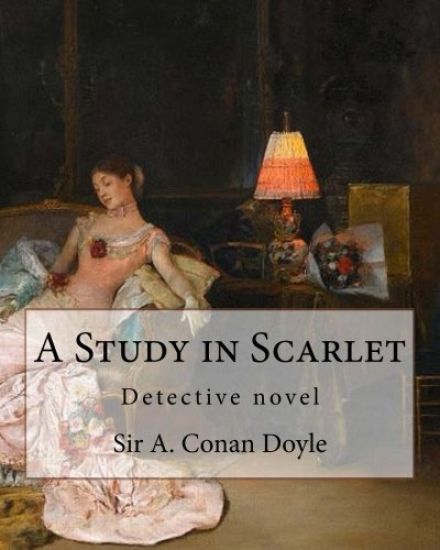
A Study in Scarlet, By Sir A. Conan Doyle with a note on sherlock holmes: By Dr. Joseph Bell(2 December 1837 - 4 October 1911), illustrated By George
A Study in Scarlet is an 1887 detective novel by British author Arthur Conan Doyle. Written in 1886, the story marks the first appearance of Sherlock Holmes and Dr. Watson, who would become two of the most famous characters in popular fiction. The book's title derives from a speech given by Holmes, an amateur detective, to his friend and chronicler Watson on the nature of his work, in which he describes the story's murder investigation as his "study in scarlet": "There's the scarlet thread of murder running through the colourless skein of life, and our duty is to unravel it, and isolate it, and expose every inch of it."(A "study" is a preliminary drawing, sketch or painting done in preparation for a finished piece.) The story, and its main characters, attracted little public interest when it first appeared. Only 11 complete copies of the magazine in which the story first appeared, Beeton's Christmas Annual for 1887, are known to exist now and they have considerable value. Although Conan Doyle wrote 56 short stories featuring Holmes, A Study in Scarlet is one of only four full-length novels in the original canon. The novel was followed by The Sign of the Four, published in 1890. A Study in Scarlet was the first work of detective fiction to incorporate the magnifying glass as an investigative tool. Sir Arthur Ignatius Conan Doyle (22 May 1859 - 7 July 1930) was an Irish-Scots writer and physician, most noted for creating the fictional detective Sherlock Holmes and writing stories about him which are generally considered milestones in the field of crime fiction. He is also known for writing the fictional adventures of a second character he invented, Professor Challenger, and for popularising the mystery of the Mary Celeste. He was a prolific writer whose other works include fantasy and science fiction stories, plays, romances, poetry, non-fiction and historical novels..... Joseph Bell, FRCSE (2 December 1837 - 4 October 1911) was a Scottish lecturer at the medical school of the University of Edinburgh in the 19th century. He is perhaps best known as an inspiration for the literary character Sherlock Holmes., ........ illustrator George Hutchinson (1891-1893
Publishing Blackness

Publishing Blackness

George Hutchinson; John Young

The University of Michigan Press
2013
sidottu
From the white editorial authentication of slave narratives, to the cultural hybridity of the Harlem Renaissance, to the overtly independent publications of the Black Arts Movement, to the commercial power of Oprah's Book Club, African American textuality has been uniquely shaped by the contests for cultural power inherent in literary production and distribution. Always haunted by the commodification of blackness, African American literary production interfaces with the processes of publication and distribution in particularly charged ways. An energetic exploration of the struggles and complexities of African American print culture, this collection ranges across the history of African American literature, and the authors have much to contribute on such issues as editorial and archival preservation, canonization, and the "packaging" and repackaging of black-authored texts. Publishing Blackness aims to project African Americanist scholarship into the discourse of textual scholarship, provoking further work in a vital area of literary study.
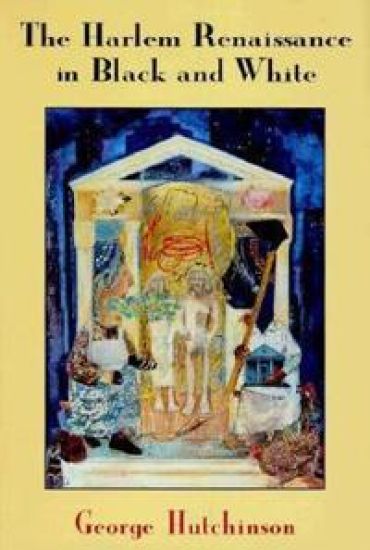
The Harlem Renaissance in Black and White

The Harlem Renaissance in Black and White

George Hutchinson

The Belknap Press
1996
sidottu
It wasn’t all black or white. It wasn’t a vogue. It wasn’t a failure. By restoring interracial dimensions left out of accounts of the Harlem Renaissance—or blamed for corrupting it—George Hutchinson transforms our understanding of black (and white) literary modernism, interracial literary relations, and twentieth-century cultural nationalism in the United States. What has been missing from literary histories of the time is a broader sense of the intellectual context of the Harlem Renaissance, and Hutchinson supplies that here: Boas’s anthropology, Park’s sociology, various strands of pragmatism and cultural nationalism—ideas that shaped the New Negro movement and the literary field, where the movement flourished. Hutchinson tracks the resulting transformation of literary institutions and organizations in the 1920s, offering a detailed account of the journals and presses, black and white, that published the work of the “New Negroes.” This cultural excavation discredits bedrock assumptions about the motives of white interest in the renaissance, and about black relationships to white intellectuals of the period. It also allows a more careful investigation than ever before of the tensions among black intellectuals of the 1920s. Hutchinson’s analysis shows that the general expansion of literature and the vogue of writing cannot be divorced from the explosion of black literature often attributed to the vogue of the New Negro—any more than the growing sense of “Negro” national consciousness can be divorced from expanding articulations and permutations of American nationality. The book concludes with the first full-scale interpretation of the landmark anthology The New Negro. A courageous work that exposes the oversimplifications and misrepresentations of popular readings of the Harlem Renaissance, this book reveals the truly composite nature of American literary culture.