Kirjojen hintavertailu – 12 903 724 kirjaa ja 27 kauppaa

Kirjailija

George J. Klir

Kirjat ja teokset yhdessä paikassa: 15 kirjaa, julkaisuja vuosilta 1991–2017, suosituimpiin kuuluu Architecture of Systems Problem Solving. Vertaile teosten hintoja ja tarkista saatavuus suomalaisista kirjakaupoista.

15 kirjaa

Kirjojen julkaisuvuodet: 1991–2017.

Fuzzy Logic and Mathematics

Fuzzy Logic and Mathematics

Radim Belohlavek; Joseph Warren Dauben; George J. Klir

Oxford University Press Inc
2017
sidottu
The term "fuzzy logic" (FL), as it is understood in this book, stands for all aspects of representing and manipulating knowledge based on the rejection of the most fundamental principle of classical logic: the principle of bivalence. According to this principle, each declarative sentence is required to be either true or false. In fuzzy logic, these classical truth values are not abandoned. However, additional, intermediary truth values between true and false are allowed, which are interpreted as degrees of truth. This opens a new way of thinking--thinking in terms of degrees rather than absolutes. For example, it led to the definition of a new category of sets, referred to as fuzzy sets, in which membership is a matter of degree. The book examines the genesis and development of fuzzy logic. It surveys the prehistory of fuzzy logic and inspects circumstances that eventually lead to the emergence of fuzzy logic. The book explores in detail the development of propositional, predicate, and other calculi that admit degrees of truth, which are known as fuzzy logic in the narrow sense. Fuzzy logic in the broad sense, whose primary aim is to utilize degrees of truth for emulating common-sense human reasoning in natural language, is scrutinized as well. The book also examines principles for developing mathematics based on fuzzy logic and provides overviews of areas in which this has been done most effectively. It also presents a detailed survey of established and prospective applications of fuzzy logic in various areas of human affairs, and provides an assessment of the significance of fuzzy logic as a new paradigm.
Architecture of Systems Problem Solving

Architecture of Systems Problem Solving

George J. Klir

Springer-Verlag New York Inc.
2012
nidottu
One criterion for classifying books is whether they are written for a single purpose or for multiple purposes. This book belongs to the category of multipurpose books, but one of its roles is predominant-it is primarily a textbook. As such, it can be used for a variety of courses at the first-year graduate or upper-division undergraduate level. A common characteristic of these courses is that they cover fundamental systems concepts, major categories of systems problems, and some selected methods for dealing with these problems at a rather general level. A unique feature of the book is that the concepts, problems, and methods are introduced in the context of an architectural formulation of an expert system­ referred to as the general systems problem solver or GSPS-whose aim is to provide users of all kinds with computer-based systems knowledge and methodology. The GSPS architecture, which is developed throughout the book, facilitates a framework that is conducive to a coherent, comprehensive, and pragmatic coverage of systems fundamentals--concepts, problems, and methods. A course that covers systems fundamentals is now offered not only in systems ~cience, information science, or systems engineering programs, but in many programs in other disciplines as well. Although the level of coverage for systems science or engineering students is surely different from that used for students in other disciplines, this book is designed to serve both of these needs.
Facets of Systems Science

Facets of Systems Science

George J. Klir

Springer-Verlag New York Inc.
2012
nidottu
This book has a rather strange history. It began in spring 1989, thirteen years after our Systems Science Department at SUNY-Binghamton was established, when I was asked by a group of students in our doctoral program to have a meeting with them. The spokesman of the group, Cliff Joslyn, opened our meeting by stating its purpose. I can closely paraphrase what he said: "We called this meeting to discuss with you, as Chairman of the Department, a fundamental problem with our systems science curriculum. In general, we consider it a good curriculum: we learn a lot of concepts, principles, and methodological tools, mathematical, computational, heu­ ristic, which are fundamental to understanding and dealing with systems. And, yet, we learn virtually nothing about systems science itself. What is systems science? What are its historical roots? What are its aims? Where does it stand and where is it likely to go? These are pressing questions to us. After all, aren't we supposed to carry the systems science flag after we graduate from this program? We feel that a broad introductory course to systems science is urgently needed in the curriculum. Do you agree with this assessment?" The answer was obvious and, yet, not easy to give: "I agree, of course, but I do not see how the situation could be alleviated in the foreseeable future.
Architecture of Systems Problem Solving

Architecture of Systems Problem Solving

George J. Klir; Doug Elias

Springer-Verlag New York Inc.
2012
nidottu
One criterion for classifying books is whether they are written for a single pur­ pose or for multiple purposes. This book belongs to the category of multipurpose books, but one of its roles is predominant-it is primarily a textbook. As such, it can be used for a variety ofcourses at the first-year graduate or upper-division undergraduate level. A common characteristic of these courses is that they cover fundamental systems concepts, major categories of systems problems, and some selected methods for dealing with these problems at a rather general level. A unique feature of the book is that the concepts, problems, and methods are introduced in the context of an architectural formulation of an expert system­ referred to as the general systems problem solver or aSPS-whose aim is to provide users ofall kinds with computer-based systems knowledge and methodo­ logy. Theasps architecture,which is developed throughout the book, facilitates a framework that is conducive to acoherent, comprehensive, and pragmaticcoverage ofsystems fundamentals-concepts, problems, and methods. A course that covers systems fundamentals is now offered not only in sys­ tems science, information science, or systems engineering programs, but in many programs in other disciplines as well. Although the level ofcoverage for systems science or engineering students is surely different from that used for students in other disciplines, this book is designed to serve both of these needs.
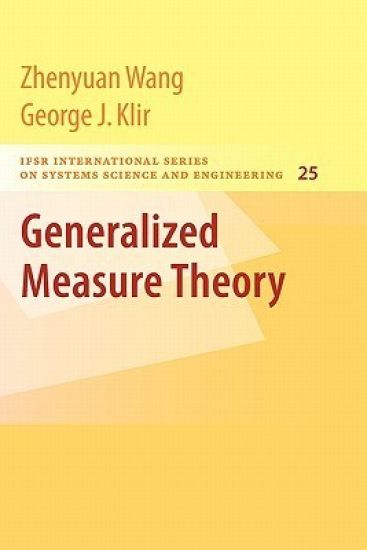
Generalized Measure Theory

Generalized Measure Theory

Zhenyuan Wang; George J. Klir

Springer-Verlag New York Inc.
2010
nidottu
In 1992 we published a book entitled Fuzzy Measure Theory (Plenum Press, New York), in which the term ‘‘fuzzy measure’’ was used for set functions obtained by replacing the additivity requirement of classical measures with weaker requirements of monotonicity with respect to set inclusion and con- nuity. That is, the book dealt with nonnegative set functions that were mo- tone, vanished at the empty set, and possessed appropriate continuity properties when defined on infinite sets. It seems that Fuzzy Measure Theory was the only book available on the market at that time devoted to this emerging new mathematical theory. Some ten years after its publication we began to see that the subject had expanded so much that a second edition of the book, or even a new book on the subject, was needed. We eventually decided to write a new book because the new material we wished to include was too extensive for—and far beyond the usual scope—of a second edition. More importantly, we felt that some fundamental changes regarding this topic’s scope and terminology would be desirable and timely.
Fuzzy Measure Theory

Fuzzy Measure Theory

Zhenyuan Wang; George J. Klir

Springer-Verlag New York Inc.
2010
nidottu
Providing the first comprehensive treatment of the subject, this groundbreaking work is solidly founded on a decade of concentrated research, some of which is published here for the first time, as well as practical, ''hands on'' classroom experience. The clarity of presentation and abundance of examples and exercises make it suitable as a graduate level text in mathematics, decision making, artificial intelligence, and engineering courses.
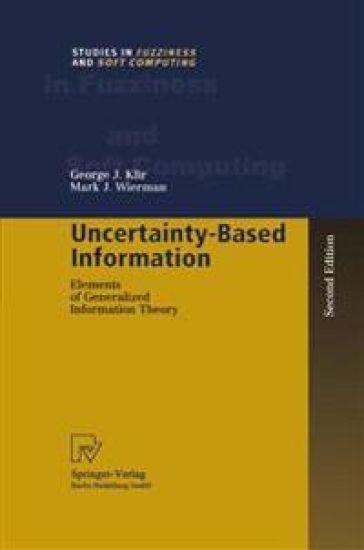
Uncertainty-Based Information

Uncertainty-Based Information

George J. Klir; Mark J. Wierman

Physica-Verlag GmbH Co
2010
nidottu
Information is precious. It reduces our uncertainty in making decisions. Knowledge about the outcome of an uncertain event gives the possessor an advantage. It changes the course of lives, nations, and history itself. Information is the food of Maxwell's demon. His power comes from know­ ing which particles are hot and which particles are cold. His existence was paradoxical to classical physics and only the realization that information too was a source of power led to his taming. Information has recently become a commodity, traded and sold like or­ ange juice or hog bellies. Colleges give degrees in information science and information management. Technology of the computer age has provided access to information in overwhelming quantity. Information has become something worth studying in its own right. The purpose of this volume is to introduce key developments and results in the area of generalized information theory, a theory that deals with uncertainty-based information within mathematical frameworks that are broader than classical set theory and probability theory. The volume is organized as follows.
Generalized Measure Theory

Generalized Measure Theory

Zhenyuan Wang; George J. Klir

Springer-Verlag New York Inc.
2008
sidottu
In 1992 we published a book entitled Fuzzy Measure Theory (Plenum Press, New York), in which the term ‘‘fuzzy measure’’ was used for set functions obtained by replacing the additivity requirement of classical measures with weaker requirements of monotonicity with respect to set inclusion and con- nuity. That is, the book dealt with nonnegative set functions that were mo- tone, vanished at the empty set, and possessed appropriate continuity properties when defined on infinite sets. It seems that Fuzzy Measure Theory was the only book available on the market at that time devoted to this emerging new mathematical theory. Some ten years after its publication we began to see that the subject had expanded so much that a second edition of the book, or even a new book on the subject, was needed. We eventually decided to write a new book because the new material we wished to include was too extensive for—and far beyond the usual scope—of a second edition. More importantly, we felt that some fundamental changes regarding this topic’s scope and terminology would be desirable and timely.
Uncertainty Modeling and Analysis in Engineering and the Sciences

Uncertainty Modeling and Analysis in Engineering and the Sciences

Bilal M. Ayyub; George J. Klir

Chapman Hall/CRC
2006
sidottu
Engineers and scientists often need to solve complex problems with incomplete information resources, necessitating a proper treatment of uncertainty and a reliance on expert opinions. Uncertainty Modeling and Analysis in Engineering and the Sciences prepares current and future analysts and practitioners to understand the fundamentals of knowledge and ignorance, how to model and analyze uncertainty, and how to select appropriate analytical tools for particular problems. This volume covers primary components of ignorance and their impact on practice and decision making. It provides an overview of the current state of uncertainty modeling and analysis, and reviews emerging theories while emphasizing practical applications in science and engineering. The book introduces fundamental concepts of classical, fuzzy, and rough sets, probability, Bayesian methods, interval analysis, fuzzy arithmetic, interval probabilities, evidence theory, open-world models, sequences, and possibility theory. The authors present these methods to meet the needs of practitioners in many fields, emphasizing the practical use, limitations, advantages, and disadvantages of the methods.
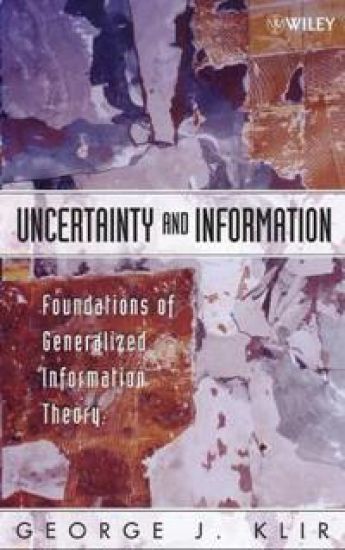
Uncertainty and Information

Uncertainty and Information

George J. Klir

John Wiley Sons Inc
2005
sidottu
Deal with information and uncertainty properly and efficiently using tools emerging from generalized information theory Uncertainty and Information: Foundations of Generalized Information Theory contains comprehensive and up-to-date coverage of results that have emerged from a research program begun by the author in the early 1990s under the name "generalized information theory" (GIT). This ongoing research program aims to develop a formal mathematical treatment of the interrelated concepts of uncertainty and information in all their varieties. In GIT, as in classical information theory, uncertainty (predictive, retrodictive, diagnostic, prescriptive, and the like) is viewed as a manifestation of information deficiency, while information is viewed as anything capable of reducing the uncertainty. A broad conceptual framework for GIT is obtained by expanding the formalized language of classical set theory to include more expressive formalized languages based on fuzzy sets of various types, and by expanding classical theory of additive measures to include more expressive non-additive measures of various types. This landmark book examines each of several theories for dealing with particular types of uncertainty at the following four levels: * Mathematical formalization of the conceived type of uncertainty * Calculus for manipulating this particular type of uncertainty * Justifiable ways of measuring the amount of uncertainty in any situation formalizable in the theory * Methodological aspects of the theory With extensive use of examples and illustrations to clarify complex material and demonstrate practical applications, generous historical and bibliographical notes, end-of-chapter exercises to test readers' newfound knowledge, glossaries, and an Instructor's Manual, this is an excellent graduate-level textbook, as well as an outstanding reference for researchers and practitioners who deal with the various problems involving uncertainty and information. An Instructor's Manual presenting detailed solutions to all the problems in the book is available from the Wiley editorial department.
Architecture of Systems Problem Solving

Architecture of Systems Problem Solving

George J. Klir; Doug Elias

Kluwer Academic/Plenum Publishers
2003
sidottu
One criterion for classifying books is whether they are written for a single pur­ pose or for multiple purposes. This book belongs to the category of multipurpose books, but one of its roles is predominant-it is primarily a textbook. As such, it can be used for a variety ofcourses at the first-year graduate or upper-division undergraduate level. A common characteristic of these courses is that they cover fundamental systems concepts, major categories of systems problems, and some selected methods for dealing with these problems at a rather general level. A unique feature of the book is that the concepts, problems, and methods are introduced in the context of an architectural formulation of an expert system­ referred to as the general systems problem solver or aSPS-whose aim is to provide users ofall kinds with computer-based systems knowledge and methodo­ logy. Theasps architecture,which is developed throughout the book, facilitates a framework that is conducive to acoherent, comprehensive, and pragmaticcoverage ofsystems fundamentals-concepts, problems, and methods. A course that covers systems fundamentals is now offered not only in sys­ tems science, information science, or systems engineering programs, but in many programs in other disciplines as well. Although the level ofcoverage for systems science or engineering students is surely different from that used for students in other disciplines, this book is designed to serve both of these needs.
Facets of Systems Science

Facets of Systems Science

George J. Klir

Kluwer Academic/Plenum Publishers
2001
sidottu
This book has a rather strange history. It began in spring 1989, thirteen years after our Systems Science Department at SUNY-Binghamton was established, when I was asked by a group of students in our doctoral program to have a meeting with them. The spokesman of the group, Cliff Joslyn, opened our meeting by stating its purpose. I can closely paraphrase what he said: "We called this meeting to discuss with you, as Chairman of the Department, a fundamental problem with our systems science curriculum. In general, we consider it a good curriculum: we learn a lot of concepts, principles, and methodological tools, mathematical, computational, heu­ ristic, which are fundamental to understanding and dealing with systems. And, yet, we learn virtually nothing about systems science itself. What is systems science? What are its historical roots? What are its aims? Where does it stand and where is it likely to go? These are pressing questions to us. After all, aren't we supposed to carry the systems science flag after we graduate from this program? We feel that a broad introductory course to systems science is urgently needed in the curriculum. Do you agree with this assessment?" The answer was obvious and, yet, not easy to give: "I agree, of course, but I do not see how the situation could be alleviated in the foreseeable future.
Uncertainty-Based Information

Uncertainty-Based Information

George J. Klir; Mark J. Wierman

Physica-Verlag GmbH Co
1999
sidottu
Information is precious. It reduces our uncertainty in making decisions. Knowledge about the outcome of an uncertain event gives the possessor an advantage. It changes the course of lives, nations, and history itself. Information is the food of Maxwell's demon. His power comes from know­ ing which particles are hot and which particles are cold. His existence was paradoxical to classical physics and only the realization that information too was a source of power led to his taming. Information has recently become a commodity, traded and sold like or­ ange juice or hog bellies. Colleges give degrees in information science and information management. Technology of the computer age has provided access to information in overwhelming quantity. Information has become something worth studying in its own right. The purpose of this volume is to introduce key developments and results in the area of generalized information theory, a theory that deals with uncertainty-based information within mathematical frameworks that are broader than classical set theory and probability theory. The volume is organized as follows.
Fuzzy Measure Theory

Fuzzy Measure Theory

Zhenyuan Wang; George J. Klir

Kluwer Academic/Plenum Publishers
1993
sidottu
Providing the first comprehensive treatment of the subject, this groundbreaking work is solidly founded on a decade of concentrated research, some of which is published here for the first time, as well as practical, ''hands on'' classroom experience. The clarity of presentation and abundance of examples and exercises make it suitable as a graduate level text in mathematics, decision making, artificial intelligence, and engineering courses.
Facets of Systems Science

Facets of Systems Science

George J. Klir

Kluwer Academic/Plenum Publishers
1991
sidottu
This book has a rather strange history. It began in Spring 1989, thirteen years after our Systems Science Department at SUNY -Binghamton was established, when I was asked by a group of students in our doctoral program to have a meeting with them. The spokesman of the group, Cliff Joslyn, opened our meeting by stating its purpose. I can closely paraphrase what he said: "We called this meeting to discuss with you, as Chairman of the Department, a fundamental problem with our systems science curriculum. In general, we consider it a good curriculum: we learn a lot of concepts, principles, and methodological tools, mathematical, computational, heuristic, which are fundamental to understanding and dealing with systems. And, yet, we learn virtually nothing about systems science itself. What is systems science? What are its historical roots? What are its aims? Where does it stand and where is it likely to go? These are pressing questions to us. After all, aren't we supposed to carry the systems science flag after we graduate from this program? We feel that a broad introductory course to systems science is urgently needed in the curriculum. Do you agree with this assessment?" The answer was obvious and, yet, not easy to give: "I agree, of course, but I do not see how the situation could be alleviated in the foreseeable future.