Kirjojen hintavertailu – 12 859 827 kirjaa ja 27 kauppaa

Kirjailija

George Kozmetsky

Kirjat ja teokset yhdessä paikassa: 5 kirjaa, julkaisuja vuosilta 1990–2012, suosituimpiin kuuluu The Economic Transformation of the United States,1950-2000. Vertaile teosten hintoja ja tarkista saatavuus suomalaisista kirjakaupoista.

5 kirjaa

Kirjojen julkaisuvuodet: 1990–2012.

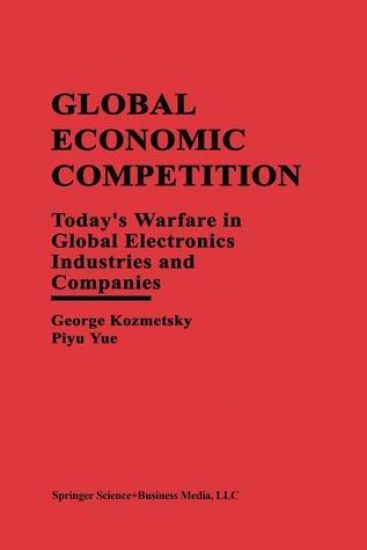
Global Economic Competition

Global Economic Competition

George Kozmetsky

Springer-Verlag New York Inc.
2012
nidottu
Global competitiveness has always been a hotly debated issue, promoting differing opinions among economists, management strategists, business leaders, and policy analysts and consultants. Global Economic Competition provides a broad framework to compare the United States economy with 23 other global economies. This is done by presenting empirical evidence in a series of comparative analyses of economic competition using data pertaining to specific countries, industries and companies. In this volume, the electronics industries are used to illustrate an ongoing economic warfare among competing regions, nations, and cluster companies across the electronic technology chain. Employing the latest empirical data to evaluate the competitiveness of the US economy and its electronic industries and companies in the 1980s and early 1990s, Global Economic Competition will be of interest not only to those who study economics, management science and international trade, but also to policy makers and business leaders.
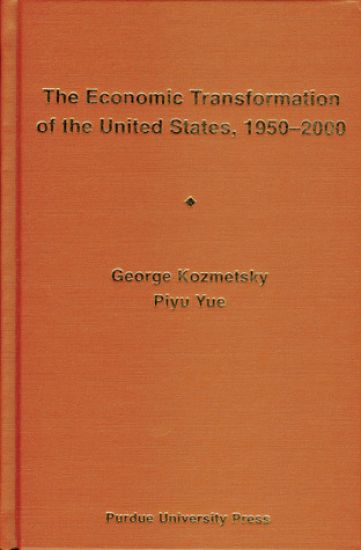
The Economic Transformation of the United States,1950-2000

The Economic Transformation of the United States,1950-2000

George Kozmetsky; Piyu Yue

Purdue University Press
2005
sidottu
This book provides a detailed analysis of U. S. economic transformation in the last 50 years, including the principal drivers for economic growth, U. S. demographic transformation, and the changing sector structure of the U. S. economy. Economic Transformation of the United States, 1950-2000, provides contemporary and historical contexts to illustrate how technological innovation and the changing American ideology play a role in the process of U. S. economic transformation. It describes the services sector in which one set of service industries is indentified as ""wealth providers"" and another set as ""job providers.
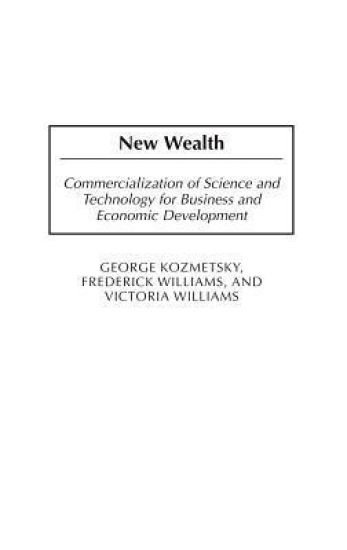
New Wealth

New Wealth

George Kozmetsky; Frederick Williams; Victoria Williams

Praeger Publishers Inc
2004
sidottu
Drawing from more than 25 years of research and project development, the authors describe how accelerated commercialization strategies building on advances in science and technology offer a sustainable source of wealth. They show how collaboration among business, government, entrepreneurial, and academic partners—all focusing to leverage local resources to compete in the global marketplace—is an established and powerful strategy for 21st century business creation and economic development. This collaborative success strategy of thinking globally and acting locally, along with supportive activities such as technology incubators, research methods, entrepreneurship training, and use of networks for resource sharing is what has come to be called the Technopolis paradigm. Because a maturing Technopolis evolves as an integral component of a city, state, or larger sociopolitical unit, it promotes attention to sustainability and quality of life. Further, Kozmetsky and Williams consider the Technopolis paradigm as a process of constructive capitalism in that it utilizes private or corporate commercialization of science and technology to create wealth and shared prosperity, the value of which is set by competition in a free market.
Global Economic Competition

Global Economic Competition

George Kozmetsky

Springer
1997
sidottu
Global competitiveness has always been a hotly debated issue, promoting differing opinions among economists, management strategists, business leaders, and policy analysts and consultants. Global Economic Competition provides a broad framework to compare the United States economy with 23 other global economies. This is done by presenting empirical evidence in a series of comparative analyses of economic competition using data pertaining to specific countries, industries and companies. In this volume, the electronics industries are used to illustrate an ongoing economic warfare among competing regions, nations, and cluster companies across the electronic technology chain. Employing the latest empirical data to evaluate the competitiveness of the US economy and its electronic industries and companies in the 1980s and early 1990s, Global Economic Competition will be of interest not only to those who study economics, management science and international trade, but also to policy makers and business leaders.
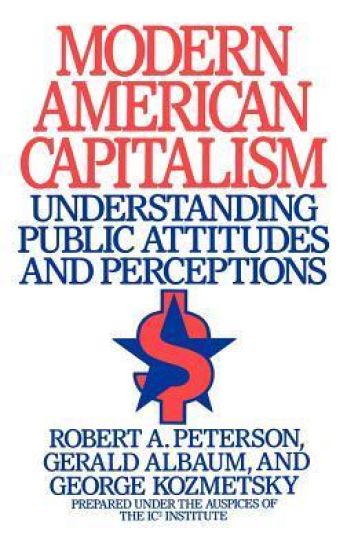
Modern American Capitalism

Modern American Capitalism

Robert A. Peterson; Gerald Albaum; George Kozmetsky

Praeger Publishers Inc
1990
sidottu
Peterson, Albaum, and Kozmetsky have systematically and formally documented here the American public's understanding of, attitudes toward, and perceptions regarding capitalism in the 1980s, and in so doing, have provided the first book to focus expressly on capitalism through empirical survey research. This work is based on a decade of empirical investigations and attempts to provide an accurate perspective that is devoid of the authors' personal views. The data for the studies reported in the book were derived from questionnaires administered to more than 10,000 individuals--comprising national samples of the general public, newspaper editors, and college students. Information was collected by telephone or mail interviews, and participants were queried about various facets of capitalism. In analyzing the data, the authors have integrated disparate research to provide a comprehensive portrait of the public's view of capitalism at the beginning and the end of the 1980s. Following an introductory chapter, the presentation of their findings falls into four primary subject areas: defining capitalism, attitudes toward capitalism, perceptions of capitalism and business, and changes in attitudes toward capitalism. A final chapter summarizes the conclusions. In identifying a heretofore unknown public mind-set, this study will be a valuable reference tool for courses and professionals in corporate communications, management, and business and government, as well as an important addition to public and academic libraries.