Kirjojen hintavertailu – 12 903 735 kirjaa ja 27 kauppaa

Kirjailija

George Lakoff

Kirjat ja teokset yhdessä paikassa: 14 kirjaa, julkaisuja vuosilta 1989–2025, suosituimpiin kuuluu Philosophy In The Flesh. Vertaile teosten hintoja ja tarkista saatavuus suomalaisista kirjakaupoista.

14 kirjaa

Kirjojen julkaisuvuodet: 1989–2025.

The Neural Mind

The Neural Mind

George Lakoff; Srini Narayanan

THE UNIVERSITY OF CHICAGO PRESS
2025
sidottu

Halvin toimitettuna 32,00 €

Offers an expansive, unified theory of thought that brings together the vast resources of neuroscience, computation, and cognitive linguistics. What is an idea, and where does it come from? We experience thought as if it were abstract, but every thought is actually a physical thing, carried out by the neural systems of our brains. Thought does not occur neuron-by-neuron; it happens when neurons come together to form circuits and when simple circuits combine to form complex ones. Thoughts, then, derive their structures from the circuitry we also use for vision, touch, and hearing. This circuitry is what allows simple thoughts to come together into complex concepts, making meaning, creating metaphors, and framing our social and political ideas. With The Neural Mind, George Lakoff, a pioneering cognitive linguist, and computer scientist Srini Narayanan deftly combine insights from cognitive science, computational modeling, and linguistics to show how thoughts arise from the neural circuitry that runs throughout our bodies. They answer key questions about the ways we make meaning: How does neural circuitry create the conceptual “frames” through which we understand our social lives? What kind of neural circuitry characterizes metaphorical thought, in which ideas are understood in terms of other ideas with similar structures? Lively and accessible, the book shows convincingly that the “metaphors we live by”—to use Lakoff’s famous phrase—aren’t abstractions but deeply embodied neural constructs. The Neural Mind is the first book of its kind, bringing together the ideas of multiple disciplines to offer a unified, accessible theory of thought. A field-defining work, Lakoff and Narayanan’s book will be of interest not just to linguists and cognitive scientists but also to psychologists, philosophers, anthropologists, journalists, sociologists, and political scientists—and anyone who wants to understand how we really think.

Your Brain's Politics

Your Brain's Politics

George Lakoff; Elisabeth Wehling

Societas
2016
pokkari
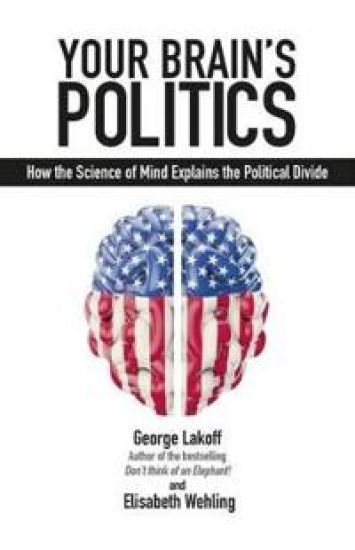
At first glance, issues like economic inequality, healthcare, climate change, and abortion seem unrelated. However, when thinking and talking about them, people reliably fall into two camps: conservative and liberal. What explains this divide? Why do conservatives and liberals hold the positions they do? And what is the conceptual nature of those who decide elections, commonly called the "political middle"? The answers are profound. They have to do with how our minds and brains work. Political attitudes are the product of what cognitive scientists call Embodied Cognition — the grounding of abstract thought in everyday world experience. Clashing beliefs about how to run nations largely arise from conflicting beliefs about family life: conservatives endorse a strict father and liberals a nurturant parent model. So-called “middle” voters are not in the middle at all. They are morally biconceptual, divided between both models, and as a result highly susceptible to moral political persuasion. In this brief introduction, Lakoff and Wehling reveal how cognitive science research has advanced our understanding of political thought and language, forcing us to revise common folk theories about the rational voter.
Moral Politics

Moral Politics

George Lakoff

University of Chicago Press
2016
nidottu

Halvin toimitettuna 33,30 €

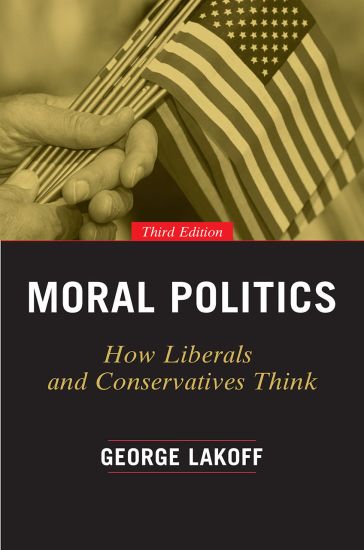
When Moral Politics was first published two decades ago, it redefined how Americans think and talk about politics through the lens of cognitive political psychology. Today, George Lakoff's classic text has become all the more relevant, as liberals and conservatives have come to hold even more vigorously opposed views of the world, with the underlying assumptions of their respective worldviews at the level of basic morality. Even more so than when Lakoff wrote, liberals and conservatives simply have very different, deeply held beliefs about what is right and wrong. Lakoff reveals radically different but remarkably consistent conceptions of morality on both the left and right. Moral worldviews, like most deep ways of understanding the world, are unconscious part of our "hard-wired" brain circuitry. When confronted with facts that don't fit our moral worldview, our brains work automatically and unconsciously to ignore or reject these facts, and it takes extraordinary openness and awareness of this phenomenon to pay critical attention to the vast number of facts we are presented with each day. For this new edition, Lakoff has added a new preface and afterword, extending his observations to major ideological conflicts since the book's original publication, from the Affordable Care Act to the wars in Iraq and Afghanistan, the recent financial crisis, and the effects of global warming. One might have hoped such massive changes would bring people together, but the reverse has actually happened; the divide between liberals and conservatives has become stronger and more virulent. To have any hope of bringing mutual respect to the current social and political divide, we need to clearly understand the problem and make it part of our contemporary public discourse. Moral Politics offers a much-needed wake-up call to both the left and the right.
The ALL NEW Don't Think of an Elephant!

The ALL NEW Don't Think of an Elephant!

George Lakoff

Chelsea Green Publishing Co
2014
nidottu

Halvin toimitettuna 17,90 €

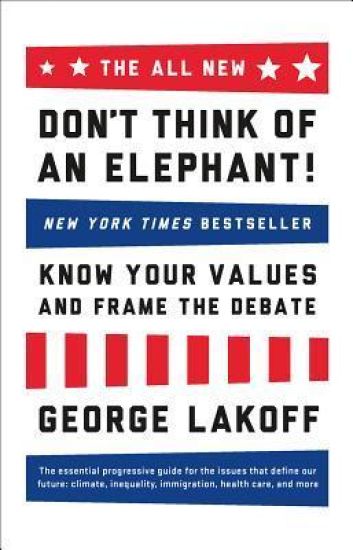
Lakoff researches how framing influences reasoning, or how the way we say something often matters much more than what we say. the GuardianOver a quarter of a million copies sold worldwide! Ten years after writing the definitive, international bestselling book on political debate and messaging, George Lakoff returns with new strategies about how to frame today's essential issues. Called the "father of framing" by The New York Times, Lakoff explains how framing is about ideas - ideas that come before policy, ideas that make sense of facts, ideas that are proactive not reactive, positive not negative, ideas that need to be communicated out loud every day in public. The revised edition picks up where the original book left off - delving deeper into how framing works, how framing has evolved in the past decade, how to speak to people who harbor elements of both progressive and conservative worldviews, how to counter propaganda and slogans, and more. The ALL NEW Don't Think of an Elephant! will make you reconsider everything you think you know about framing:Do you think facts alone can win a debate? Do you know what makes a Tea Party follower tick? Do you understand how to communicate on key issues that can improve people's lives? Whether you answer yes or no, the insights in The ALL NEW Don't Think of an Elephant! will not only surprise you, but also give you the tools you need to develop frames that work, and eradicate frames that backfire.
The Little Blue Book: The Essential Guide to Thinking and Talking Democratic
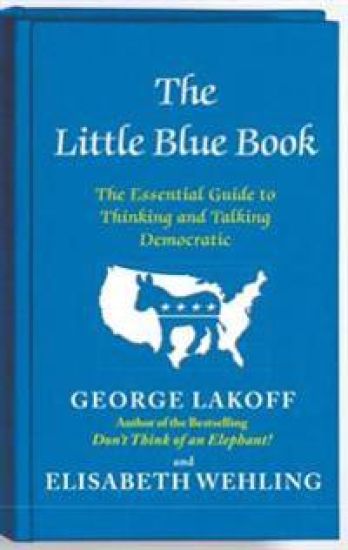
"The essential handbook for thinking and talking Democratic--must reading not only for every Democrat but for every responsible citizen" (Robert B. Reich, former Secretary of Labor and author of Beyond Outrage). "The essential handbook for thinking and talking Democratic--must reading not only for every Democrat but for every responsible citizen" (Robert B. Reich, former Secretary of Labor and author of Beyond Outrage). Voters cast their ballots for what they believe is right, for the things that make moral sense. Yet Democrats have too often failed to use language linking their moral values with their policies. The Little Blue Book demonstrates how to make that connection clearly and forcefully, with hands-on advice for discussing the most pressing issues of our time: the economy, health care, women's issues, energy and environmental policy, education, food policy, and more. Dissecting the ways that extreme conservative positions have permeated political discourse, Lakoff and Wehling show how to fight back on moral grounds and in concrete terms. Revelatory, passionate, and deeply practical, The Little Blue Book will forever alter the way Democrats and progressives think and talk about politics.
The Political Mind: A Cognitive Scientist's Guide to Your Brain and Its Politics

The Political Mind: A Cognitive Scientist's Guide to Your Brain and Its Politics

George Lakoff

PENGUIN BOOKS
2009
nidottu

Halvin toimitettuna 25,60 €

A groundbreaking scientific examination of the way our brains understand politics from a New York Times bestselling author One of the world 's best-known linguists and cognitive scientists, George Lakoff has a knack for making science make sense for general readers. In his new book, Lakoff spells out what cognitive science has discovered about reason, and reveals that human reason is far more interesting than we thought it was. Reason is physical, mostly unconscious, metaphorical, emotion-laden, and tied to empathy-and there are biological explanations behind our moral and political thought processes. His call for a New Enlightenment is a bold and striking challenge to the cherished beliefs not only of philosophers, but of pundits, pollsters, and political leaders. The Political Mind is a passionate, erudite, and groundbreaking book that will appeal to anyone interested in how the mind works and how we function socially and politically.
Hverdagens metaforer

Hverdagens metaforer

George Lakoff; Mark Johnson

Gyldendal
2005
nidottu
Denne bog vil få læseren til at tænke over sproget på en helt ny måde. For metaforer er ikke forbeholdt poesien eller retorikken, hævder Lakoff og Johnson, de er en del af hverdagens sprog, og de påvirker måden vi tænker, opfatter og handler på. Tag den begrebsmæssige metafor DISKUSSION ER KRIG. Vi siger: ”Jeg slog hårdt ned på alle svage punkter i hans oplæg”, ”Hendes kritik ramte plet”, ”Han skød min teori i sænk”. Men som forfatterne skriver, ”Det er vigtigt at forstå, at vi ikke bare taler om diskussioner vha. udtryk, der har med krig at gøre. Vi kan faktisk vinde eller tabe diskussioner. Vi betragter den person vi diskuterer med, som vores modstander. Vi angriber hans holdninger, og vi forsvarer vores egne ... I den forstand er metaforen DISKUSSION ER KRIG en vi lever med i vores kultur; den strukturerer de handlinger vi udfører, når vi diskuterer.” Lakoff og Johnson hævder dermed, at metaforen er selve grundlaget for vores måde at opfatte verden på. Hverdagens metaforer er fra 1980, men er allerede blevet en sprogvidenskabelig klassiker. Bogen, der nu for første gang foreligger på dansk, er et vigtigt bidrag til hvad der i dag anses for at være den mest produktive metaforteori. George Lakoff er professor i lingvistik ved University of California i Berkeley og forfatter til Women, Fire, and Dangerous Things. Mark Johnson er professor i filosofi ved University of Oregon og forfatter til The Body in the Mind. Sammen har de desuden skrevet Philosophy in the Flesh. Oversat fra amerikansk efter Metaphors We Live By af Ulrik Hvilshøj og Hanne Salomonsen.
Metaphors We Live By

Metaphors We Live By

George Lakoff; Mark Johnson

University of Chicago Press
2003
nidottu

Halvin toimitettuna 21,40 €

People use metaphors every time they speak. Some of those metaphors are literary - devices for making thoughts more vivid or entertaining. But most are much more basic than that - they're "metaphors we live by", metaphors we use without even realizing we're using them. In this book, George Lakoff and Mark Johnson suggest that these basic metaphors not only affect the way we communicate ideas, but actually structure our perceptions and understandings from the beginning. Bringing together the perspectives of linguistics and philosophy, Lakoff and Johnson offer an intriguing and surprising guide to some of the most common metaphors and what they can tell us about the human mind. And for this new edition, they supply an afterword both extending their arguments and offering a fascinating overview of the current state of thinking on the subject of the metaphor.
Where Mathematics Come From

Where Mathematics Come From

George Lakoff; Rafael Nunez

Basic Books
2001
pokkari

Halvin toimitettuna 37,10 €

This book is about mathematical ideas, about what mathematics means-and why. Abstract ideas, for the most part, arise via conceptual metaphor-metaphorical ideas projecting from the way we function in the everyday physical world. Where Mathematics Comes From argues that conceptual metaphor plays a central role in mathematical ideas within the cognitive unconscious-from arithmetic and algebra to sets and logic to infinity in all of its forms.
Philosophy In The Flesh

Philosophy In The Flesh

George Lakoff

Basic Books
1999
pokkari

Halvin toimitettuna 37,10 €

What are human beings like? How is knowledge possible? What is truth? Where do moral values come from? Questions like these have stood at the centre of Western philosophy for centuries. In addressing them, philosophers have made certain fundamental assumptions,that we can know our own minds by introspection, that most of our thinking about the world is literal, and that reason is disembodied and universal,that are now called into question by well-established results of cognitive science. It has been shown empirically that:Most thought is unconscious. We have no direct conscious access to the mechanisms of thought and language. Our ideas go by too quickly and at too deep a level for us to observe them in any simple way. Abstract concepts are mostly metaphorical. Much of the subject matter of philosopy, such as the nature of time, morality, causation, the mind, and the self, relies heavily on basic metaphors derived from bodily experience. What is literal in our reasoning about such concepts is minimal and conceptually impoverished. All the richness comes from metaphor. For instance, we have two mutually incompatible metaphors for time, both of which represent it as movement through space: in one it is a flow past us and in the other a spatial dimension we move along. Mind is embodied. Thought requires a body,not in the trivial sense that you need a physical brain to think with, but in the profound sense that the very structure of our thoughts comes from the nature of the body. Nearly all of our unconscious metaphors are based on common bodily experiences. Most of the central themes of the Western philosophical tradition are called into question by these findings. The Cartesian person, with a mind wholly separate from the body, does not exist. The Kantian person, capable of moral action according to the dictates of a universal reason, does not exist. The phenomenological person, capable of knowing his or her mind entirely through introspection alone, does not exist. The utilitarian person, the Chomskian person, the poststructuralist person, the computational person, and the person defined by analytic philosopy all do not exist. Then what does? Lakoff and Johnson show that a philosopy responsible to the science of mind offers radically new and detailed understandings of what a person is. After first describing the philosophical stance that must follow from taking cognitive science seriously, they re-examine the basic concepts of the mind, time, causation, morality, and the self: then they rethink a host of philosophical traditions, from the classical Greeks through Kantian morality through modern analytic philosopy. They reveal the metaphorical structure underlying each mode of thought and show how the metaphysics of each theory flows from its metaphors. Finally, they take on two major issues of twentieth-century philosopy: how we conceive rationality, and how we conceive language. Philosopy in the Flesh reveals a radically new understanding of what it means to be human and calls for a thorough rethinking of the Western philosophical tradition. This is philosopy as it has never been seen before.
Women, Fire, and Dangerous Things

Women, Fire, and Dangerous Things

George Lakoff

University of Chicago Press
1990
nidottu

Halvin toimitettuna 33,30 €

"Its publication should be a major event for cognitive linguistics and should pose a major challenge for cognitive science. In addition, it should have repercussions in a variety of disciplines, ranging from anthropology and psychology to epistemology and the philosophy of science. . . . Lakoff asks: What do categories of language and thought reveal about the human mind? Offering both general theory and minute details, Lakoff shows that categories reveal a great deal."—David E. Leary, American Scientist
More than Cool Reason

More than Cool Reason

George Lakoff; Mark Turner

University of Chicago Press
1989
nidottu

Halvin toimitettuna 33,30 €

"The authors restore metaphor to our lives by showing us that it's never gone away. We've merely been taught to talk as if it had: as though weather maps were more 'real' than the breath of autumn; as though, for that matter, Reason was really 'cool.' What we're saying whenever we say is a theme this book illumines for anyone attentive." — Hugh Kenner, Johns Hopkins University "In this bold and powerful book, Lakoff and Turner continue their use of metaphor to show how our minds get hold of the world. They have achieved nothing less than a postmodern Understanding Poetry, a new way of reading and teaching that makes poetry again important." — Norman Holland, University of Florida