Kirjojen hintavertailu – 12 859 826 kirjaa ja 27 kauppaa

Kirjailija

George Levy

Kirjat ja teokset yhdessä paikassa: 6 kirjaa, julkaisuja vuosilta 2003–2026, suosituimpiin kuuluu Motorsports Mavericks. Vertaile teosten hintoja ja tarkista saatavuus suomalaisista kirjakaupoista.

6 kirjaa

Kirjojen julkaisuvuodet: 2003–2026.

Motorsports Mavericks

Motorsports Mavericks

George Levy; Roger Penske

Quarto Publishing Group USA Inc
2026
sidottu
Motorsport’s most thrilling and perilous era, brought to life with expert narration, exclusive interviews, and rare photography. In the 1960s and ’70s, every form of racing demanded courage in the face of disproportionate risk. In Motorsports Mavericks, award-winning author and racing historian George Levy brings us the rise and fall of this “Golden Age” of motorsports through the insights and analysis of the participants themselves—putting us in the same room with history’s greatest racing legends. Pete Biro’s spectacular photography, much of it unpublished or long unseen, conveys the speed, danger, and glory in vivid detail. It was a time of: Extremes – Top speeds spiked, risk soared, and racing's popularity exploded. Legends – AJ Foyt, Dan Gurney, Don Garlits, Richard Petty, Mario Andretti, Jackie Stewart, Niki Lauda, Derek Bell, and more became household names piloting all manner of race cars in series including Formula 1, NASCAR, drag racing, Indy 500, and sports prototypes. Innovation – Bold experimentation prevailed, led by designers, engineers, and team owners like Enzo Ferrari, Colin Chapman, Jim Hall, and Robin Herd. Racers were as much test pilots as competitors. It was a window in time that would open and just as certainly close. Racing will never be—can never be—like that again. Featuring a foreword by auto racing icon Roger Penske, Motorsports Mavericks is an insightful, wistful, occasionally humorous look at that golden-and-simultaneously-fraught age when all race drivers courted danger with little in the way of a safety net. Whether you’re an F1 enthusiast, a NASCAR fan, or just love motorsport, this book offers an exhilarating ride.

Texas Legend

Texas Legend

George Levy

Evro Publishing
2024
sidottu

Halvin toimitettuna 91,00 €

One of the greatest drivers of his generation, Jim Hall is even better known as an innovator. From tiny Chaparral Cars in Midland, Texas emerged a series of vehicles that changed the face of racing. His high-winged Chaparral 2E Can-Am car and 2F World Sportscar Championship contender may be the most influential race vehicles of the 20th century. Today, every Formula 1 car uses net downforce, driver-adjustable wings, composite chassis, side-mounted radiators, semi-automatic gearboxes and advanced telemetry to optimize vehicle performance — all things Chaparral pioneered in the mid-1960s. Here he tells his story — his life, his cars, his relationship with Chevrolet, his partnership with Hap Sharp, his battles with sanctioning body bureaucracies — for the first time to award-winning author George Levy in this authorized biography.
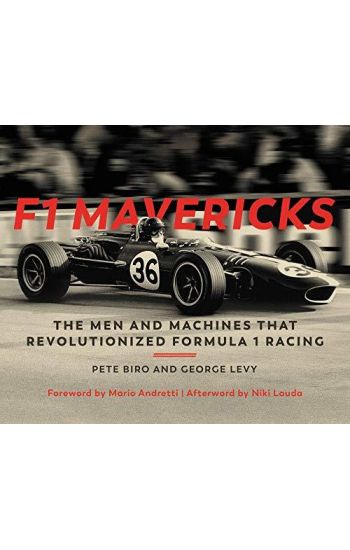
F1 Mavericks

F1 Mavericks

Pete Biro; George Levy; Mario Andretti; Niki Lauda

Motorbooks International
2019
sidottu

Halvin toimitettuna 34,30 €

F1 Mavericks is the story of the grandest, most influential, and most fondly remembered era in Formula 1 racing as seen through the lens of master motorsports photographer, Pete Biro. The period from 1960 to 1982 saw the greatest technological changes in the history of Formula 1 racing: the transition from front engines to rear engines, narrow-treaded tires, massive racing slicks, zero downforce, and neck-wrenching ground effects—and, of course, a staggering increase in performance and reduction in lap times. In short, the period saw the creation of the modern Formula 1 car. This is also the time when legendary names who defined F1 were out in full force: Jim Clark, Jack Brabham, Dan Gurney, Sir Jackie Stewart, Graham Hill, Niki Lauda, James Hunt, Bruce McLaren, Jody Scheckter. We’ll see and meet all of them. But F1 Mavericks also focuses on the designers and engineers behind the cars—men like Colin Chapman, Sir Patrick Head, Maurice Philippe, Franco Rochhi, Gordon Murray, and many others. We’ll hear directly from many of them, including a foreword from 1978 F1 World Champion, Mario Andretti. Every chapter is a photographic account of key races throughout the period, supplemented with sidebars featuring key designers and technologies, like wings, ground effects, slick tires, turbochargers, and the Brabham “fan” suction car. F1 Mavericks is an international story, and includes loads of information on designs from Japan (Honda), Britain (McLaren, Tyrrell, Cooper, BRM) Italy (Ferrari, Maserati, Alfa Romeo), France (Matra, Ligier, Renault), Germany (Porsche, BMW) and the United States (Eagle, Shadow, Penske, Parnelli). Strap yourself in for the story of the greatest era in Formula 1 racing—it's all here in F1 Mavericks.
Energy Power Risk

Energy Power Risk

George Levy

Emerald Publishing Limited
2018
sidottu
Energy Power Risk: Derivatives, Computation and Optimization is a comprehensive guide presenting the latest mathematical and computational tools required for the quantification and management of energy power risk. Written by a practitioner with many years’ experience in the field, it provides readers with valuable insights in to the latest practices and methodologies used in today’s markets, showing readers how to create innovative quantitative models for energy and power risk and derivative valuation. The book begins with an introduction to the mathematics of Brownian motion and stochastic processes, covering Geometric Brownian motion, Ito’s lemma, Ito’s Isometry, the Ornstein Uhlenbeck process and more. It then moves on to the simulation of power prices and the valuation of energy derivatives, before considering software engineering techniques for energy risk and portfolio optimization. The book also covers additional topics including wind and solar generation, intraday storage, generation and demand optionality. Written in a highly practical manner and with example C++ and VBA code provided throughout, Energy Power Risk: Derivatives, Computation and Optimization will be an essential reference for quantitative analysts, financial engineers and other practitioners in the field of energy risk management, as well as researchers and students interested in the industry and how it works.
Computational Finance Using C and C#

Computational Finance Using C and C#

George Levy

Academic Press Inc
2016
sidottu
Computational Finance Using C and C#: Derivatives and Valuation, Second Edition provides derivatives pricing information for equity derivatives, interest rate derivatives, foreign exchange derivatives, and credit derivatives. By providing free access to code from a variety of computer languages, such as Visual Basic/Excel, C++, C, and C#, it gives readers stand-alone examples that they can explore before delving into creating their own applications. It is written for readers with backgrounds in basic calculus, linear algebra, and probability. Strong on mathematical theory, this second edition helps empower readers to solve their own problems. *Features new programming problems, examples, and exercises for each chapter. *Includes freely-accessible source code in languages such as C, C++, VBA, C#, and Excel.. *Includes a new chapter on the history of finance which also covers the 2008 credit crisis and the use of mortgage backed securities, CDSs and CDOs. *Emphasizes mathematical theory.
Computational Finance

Computational Finance

George Levy

Butterworth-Heinemann Ltd
2003
sidottu
Computational Finance presents a modern computational approach to mathematical finance within the Windows environment, and contains financial algorithms, mathematical proofs and computer code in C/C++. The author illustrates how numeric components can be developed which allow financial routines to be easily called by the complete range of Windows applications, such as Excel, Borland Delphi, Visual Basic and Visual C++. These components permit software developers to call mathematical finance functions more easily than in corresponding packages. Although these packages may offer the advantage of interactive interfaces, it is not easy or computationally efficient to call them programmatically as a component of a larger system. The components are therefore well suited to software developers who want to include finance routines into a new application. Typical readers are expected to have a knowledge of calculus, differential equations, statistics, Microsoft Excel, Visual Basic, C++ and HTML.