Kirjojen hintavertailu – 12 870 887 kirjaa ja 27 kauppaa

Kirjailija

George Liska

Kirjat ja teokset yhdessä paikassa: 5 kirjaa, julkaisuja vuosilta 1957–2021, suosituimpiin kuuluu Expanding Realism. Vertaile teosten hintoja ja tarkista saatavuus suomalaisista kirjakaupoista.

5 kirjaa

Kirjojen julkaisuvuodet: 1957–2021.

Sdi And U.S. Foreign Policy

Sdi And U.S. Foreign Policy

Robert W. Tucker; George Liska; Robert E. Osgood; David P Calleo

Routledge
2021
nidottu
Showing how the development of space technology could affect the present system of deterrence, the authors consider the consequences for U. S. foreign policy, alliance relations, and strategic stability. In the first essay, Dr. Tucker argues that a greater commitment to defensive systems would not substantially affect deterrence or extended deterren
Sdi And U.s. Foreign Policy

Sdi And U.s. Foreign Policy

Robert W. Tucker; George Liska; Robert E. Osgood; David P Calleo

Routledge
2019
sidottu
Showing how the development of space technology could affect the present system of deterrence, the authors consider the consequences for U. S. foreign policy, alliance relations, and strategic stability. In the first essay, Dr. Tucker argues that a greater commitment to defensive systems would not substantially affect deterrence or extended deterren
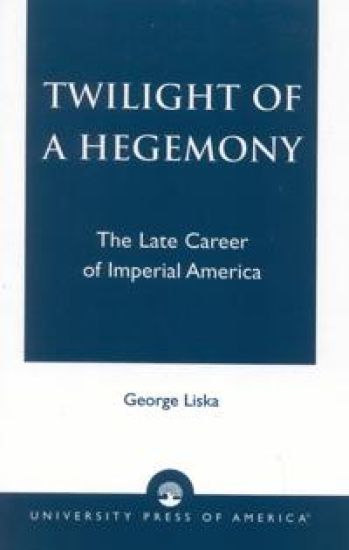
Twilight of a Hegemony

Twilight of a Hegemony

George Liska

University Press of America
2003
nidottu
Twilight of a Hegemony reflects on the self-defeating exercise of U. S. primacy after replacing the Soviet counter-empire with a post-nuclear balance of terror. The author proposes a devolutionary alternative.
Expanding Realism

Expanding Realism

George Liska

Rowman Littlefield
1998
nidottu
In this engaging book, eminent scholar George Liska demonstrates the intricate and complex relationship between world politics and world history, and he proposes a systematic, but fundamentally new method of thinking about world politics. Building on ideas developed in his earlier works, particularly the legacy of the Cold War, Liska expands his 'geopolitical' approach into a 'geohistorical' one. Rejecting the idea that periods and events should be viewed as static, fixed structures, Liska's analysis reveals the cyclical nature of world history and develops a new kind of realism that encompasses the problems of expansion and evolution. This innovative book by a world renowned political thinker has far reaching implications that will be valuable to all students and scholars of international relations, world history, and the philosophy of history.