Kirjojen hintavertailu – 12 903 735 kirjaa ja 27 kauppaa

Kirjailija

George Mavrotas

Kirjat ja teokset yhdessä paikassa: 7 kirjaa, julkaisuja vuosilta 1997–2014, suosituimpiin kuuluu Multicriteria Portfolio Management. Vertaile teosten hintoja ja tarkista saatavuus suomalaisista kirjakaupoista.

7 kirjaa

Kirjojen julkaisuvuodet: 1997–2014.

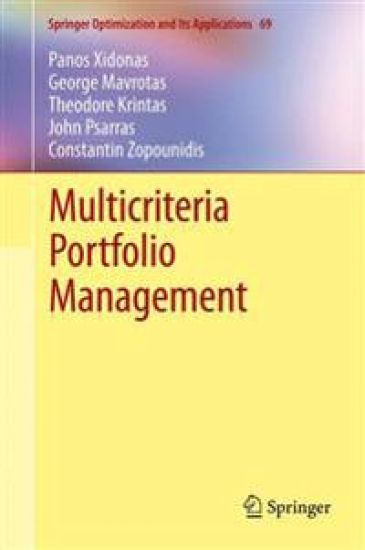
Multicriteria Portfolio Management

Multicriteria Portfolio Management

Panos Xidonas; George Mavrotas; Theodore Krintas; John Psarras; Constantin Zopounidis

Springer-Verlag New York Inc.
2014
nidottu
The primary purpose in this book is to present an integrated and innovative methodological approach for the construction and selection of equity portfolios. The approach takes into account the inherent multidimensional nature of the problem, while allowing the decision makers to incorporate specified preferences in the decision processes. A fundamental principle of modern portfolio theory is that comparisons between portfolios are generally made using two criteria; the expected return and portfolio variance. According to most of the portfolio models derived from the stochastic dominance approach, the group of portfolios open to comparisons is divided into two parts: the efficient portfolios, and the dominated. This work integrates the two approaches providing a unified model for decision making in portfolio management with multiple criteria.?
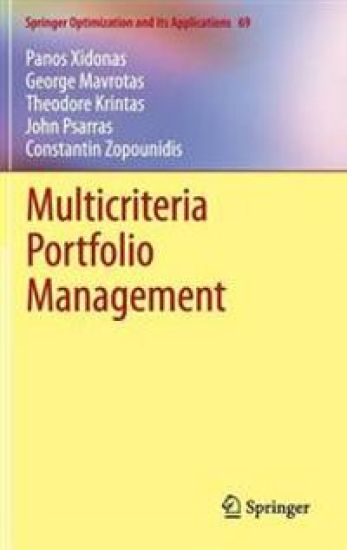
Multicriteria Portfolio Management

Multicriteria Portfolio Management

Panos Xidonas; George Mavrotas; Theodore Krintas; John Psarras; Constantin Zopounidis

Springer-Verlag New York Inc.
2012
sidottu
The primary purpose in this book is to present an integrated and innovative methodological approach for the construction and selection of equity portfolios. The approach takes into account the inherent multidimensional nature of the problem, while allowing the decision makers to incorporate specified preferences in the decision processes. A fundamental principle of modern portfolio theory is that comparisons between portfolios are generally made using two criteria; the expected return and portfolio variance. According to most of the portfolio models derived from the stochastic dominance approach, the group of portfolios open to comparisons is divided into two parts: the efficient portfolios, and the dominated. This work integrates the two approaches providing a unified model for decision making in portfolio management with multiple criteria.?
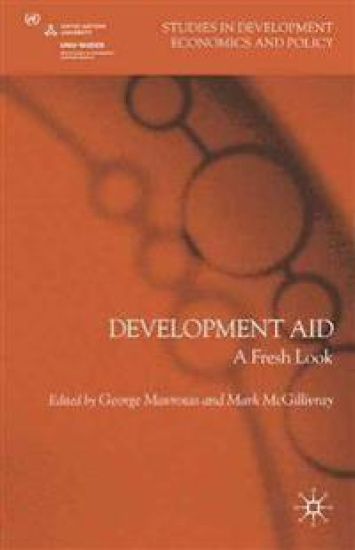
Development Aid

Development Aid

George Mavrotas; Mark McGillivray

Palgrave Macmillan
2009
sidottu
This book addresses several gaps in knowledge of aid allocation and effectiveness and provides new analytical insights. Topics covered include the interface between aid allocation and perceptions of aid effectiveness, the year-on-year volatility of aid and evaluation of the country-level impacts of aid.
Financial Development, Institutions, Growth and Poverty Reduction

Financial Development, Institutions, Growth and Poverty Reduction

Basudeb Guha-Khasnobis; George Mavrotas

Palgrave Macmillan
2008
sidottu
This book explores country case studies and works that detail the exact transmission mechanisms through which financial development can enhance pro-poor development in order to derive best practices in this field. This is an important companion for professionals and policymakers, and also a vital reference source for students.
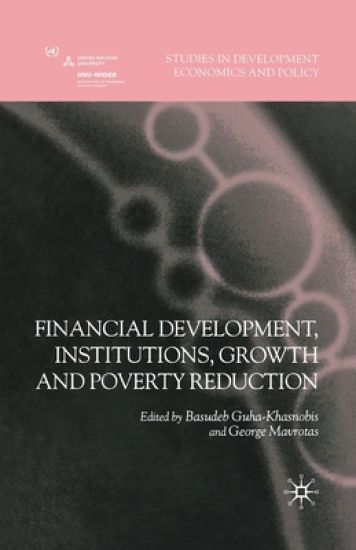
Financial Development, Institutions, Growth and Poverty Reduction

Financial Development, Institutions, Growth and Poverty Reduction

Basudeb Guha-Khasnobis; George Mavrotas

Palgrave Macmillan
2008
nidottu
This book explores country case studies and works that detail the exact transmission mechanisms through which financial development can enhance pro-poor development in order to derive best practices in this field. This is an important companion for professionals and policymakers, and also a vital reference source for students.
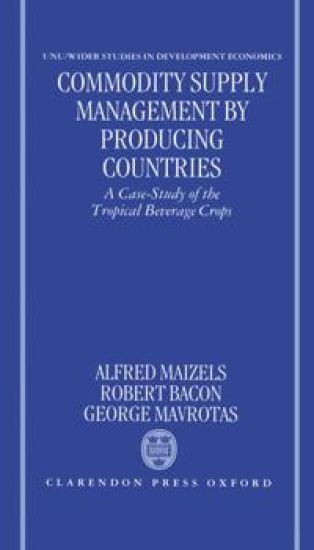
Commodity Supply Management by Producing Countries

Commodity Supply Management by Producing Countries

Alfred Maizels; Robert Bacon; George Mavrotas

Oxford University Press
1997
sidottu
The collapse in commodity prices since 1980 has been a major cause of the economic crisis in a large number of developing countries. This book investigates whether the commodity-producing countries, by joint action, could have prevented the price collapse by appropriate supply management. The analysis is focused on the markets for the tropical beverage crops: coffee, cocoa, and tea. Using new econometric models for each market, the impact of alternative supply management schemes on supply, consumption, prices, and export earnings is simulated for the later 1980s. The results indicate that supply management by producing countries would, indeed, have been a viable alternative to the `free market' approach favoured by the developed countries. This has important implications for current international commodity policy, and, in particular, for future joint action by producing countries to overcome persistent commodity surpluses as a complement to needed diversification.