Kirjojen hintavertailu – 12 903 725 kirjaa ja 27 kauppaa

Kirjailija

George Metcalfe

Kirjat ja teokset yhdessä paikassa: 4 kirjaa, julkaisuja vuosilta 2008–2023, suosituimpiin kuuluu Proof Theory for Fuzzy Logics. Vertaile teosten hintoja ja tarkista saatavuus suomalaisista kirjakaupoista.

4 kirjaa

Kirjojen julkaisuvuodet: 2008–2023.

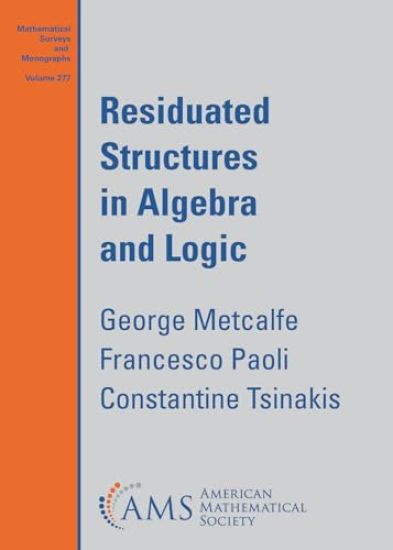
Residuated Structures in Algebra and Logic

Residuated Structures in Algebra and Logic

George Metcalfe; Francesco Paoli; Constantine Tsinakis

AMERICAN MATHEMATICAL SOCIETY
2023
nidottu
This book is an introduction to residuated structures, viewed as a common thread binding together algebra and logic. The framework includes well-studied structures from classical abstract algebra such as lattice-ordered groups and ideals of rings, as well as structures serving as algebraic semantics for substructural and other non-classical logics. Crucially, classes of these structures are studied both algebraically, yielding a rich structure theory along the lines of Conrad's program for lattice-ordered groups, and algorithmically, via analytic sequent or hypersequent calculi. These perspectives are related using a natural notion of equivalence for consequence relations that provides a bridge offering benefits to both sides. Algorithmic methods are used to establish properties like decidability, amalgamation, and generation by subclasses, while new insights into logical systems are obtained by studying associated classes of structures. The book is designed to serve the purposes of novices and experts alike. The first three chapters provide a gentle introduction to the subject, while subsequent chapters provide a state-of-the-art account of recent developments in the field.

Proof Theory for Fuzzy Logics

Proof Theory for Fuzzy Logics

George Metcalfe; Nicola Olivetti; Dov M. Gabbay

Springer
2010
nidottu
Fuzzy logics are many-valued logics that are well suited to reasoning in the context of vagueness. They provide the basis for the wider field of Fuzzy Logic, encompassing diverse areas such as fuzzy control, fuzzy databases, and fuzzy mathematics. This book provides an accessible and up-to-date introduction to this fast-growing and increasingly popular area. It focuses in particular on the development and applications of "proof-theoretic" presentations of fuzzy logics; the result of more than ten years of intensive work by researchers in the area, including the authors. In addition to providing alternative elegant presentations of fuzzy logics, proof-theoretic methods are useful for addressing theoretical problems (including key standard completeness results) and developing efficient deduction and decision algorithms. Proof-theoretic presentations also place fuzzy logics in the broader landscape of non-classical logics, revealing deep relations with other logics studied in Computer Science, Mathematics, and Philosophy. The book builds methodically from the semantic origins of fuzzy logics to proof-theoretic presentations such as Hilbert and Gentzen systems, introducing both theoretical and practical applications of these presentations.
Proof Theory for Fuzzy Logics

Proof Theory for Fuzzy Logics

George Metcalfe; Nicola Olivetti; Dov M. Gabbay

Springer-Verlag New York Inc.
2008
sidottu
Fuzzy logics are many-valued logics that are well suited to reasoning in the context of vagueness. They provide the basis for the wider field of Fuzzy Logic, encompassing diverse areas such as fuzzy control, fuzzy databases, and fuzzy mathematics. This book provides an accessible and up-to-date introduction to this fast-growing and increasingly popular area. It focuses in particular on the development and applications of "proof-theoretic" presentations of fuzzy logics; the result of more than ten years of intensive work by researchers in the area, including the authors. In addition to providing alternative elegant presentations of fuzzy logics, proof-theoretic methods are useful for addressing theoretical problems (including key standard completeness results) and developing efficient deduction and decision algorithms. Proof-theoretic presentations also place fuzzy logics in the broader landscape of non-classical logics, revealing deep relations with other logics studied in Computer Science, Mathematics, and Philosophy. The book builds methodically from the semantic origins of fuzzy logics to proof-theoretic presentations such as Hilbert and Gentzen systems, introducing both theoretical and practical applications of these presentations.