Kirjailija
George Saintsbury
Kirjat ja teokset yhdessä paikassa: 304 kirjaa, julkaisuja vuosilta 1968–2026, suosituimpiin kuuluu Corinne; Or, Italy. Vertaile teosten hintoja ja tarkista saatavuus suomalaisista kirjakaupoista.
304 kirjaa
Kirjojen julkaisuvuodet: 1968–2026.
Political Verse is an unchanged, high-quality reprint of the original edition of 1891. Hansebooks is editor of the literature on different topic areas such as research and science, travel and expeditions, cooking and nutrition, medicine, and other genres. As a publisher we focus on the preservation of historical literature. Many works of historical writers and scientists are available today as antiques only. Hansebooks newly publishes these books and contributes to the preservation of literature which has become rare and historical knowledge for the future.
Essays on French Novelists is an unchanged, high-quality reprint of the original edition of 1891. Hansebooks is editor of the literature on different topic areas such as research and science, travel and expeditions, cooking and nutrition, medicine, and other genres. As a publisher we focus on the preservation of historical literature. Many works of historical writers and scientists are available today as antiques only. Hansebooks newly publishes these books and contributes to the preservation of literature which has become rare and historical knowledge for the future.
French Lyrics is an unchanged, high-quality reprint of the original edition of 1887. Hansebooks is editor of the literature on different topic areas such as research and science, travel and expeditions, cooking and nutrition, medicine, and other genres. As a publisher we focus on the preservation of historical literature. Many works of historical writers and scientists are available today as antiques only. Hansebooks newly publishes these books and contributes to the preservation of literature which has become rare and historical knowledge for the future.

Selections from Defoe's Minor Novels is an unchanged, high-quality reprint of the original edition of 1892. Hansebooks is editor of the literature on different topic areas such as research and science, travel and expeditions, cooking and nutrition, medicine, and other genres. As a publisher we focus on the preservation of historical literature. Many works of historical writers and scientists are available today as antiques only. Hansebooks newly publishes these books and contributes to the preservation of literature which has become rare and historical knowledge for the future.
Catherine; A shabby genteel story; The second funeral of Napoleon; and Miscellanies, 1840-1 By: William Makepeace Thackeray and George Saintsbury ( wi
George Saintsbury; William Makepeace Thackeray
Createspace Independent Publishing Platform
2017
nidottu
William Makepeace Thackeray (18 July 1811 - 24 December 1863) was an English novelist of the 19th century. He is known for his satirical works, particularly Vanity Fair, a panoramic portrait of English society. BIOGRAPHY: Thackeray, an only child, was born in Calcutta, British India, where his father, Richmond Thackeray (1 September 1781 - 13 September 1815), was secretary to the Board of Revenue in the British East India Company. His mother, Anne Becher (1792-1864), was the second daughter of Harriet Becher and John Harman Becher, who was also a secretary (writer) for the East India Company. Richmond died in 1815, which caused Anne to send her son to England in 1816, while she remained in British India. The ship on which he travelled made a short stopover at St. Helena, where the imprisoned Napoleon was pointed out to him. Once in England he was educated at schools in Southampton and Chiswick, and then at Charterhouse School, where he became a close friend of John Leech. Thackeray disliked Charterhouse, and parodied it in his fiction as "Slaughterhouse". Nevertheless, Thackeray was honoured in the Charterhouse Chapel with a monument after his death. Illness in his last year there, during which he reportedly grew to his full height of six foot three, postponed his matriculation at Trinity College, Cambridge, until February 1829. citation needed]Never too keen on academic studies, Thackeray left Cambridge in 1830, but some of his earliest published writing appeared in two university periodicals, The Snob and The Gownsman. Thackeray then travelled for some time on the continent, visiting Paris and Weimar, where he met Goethe. He returned to England and began to study law at the Middle Temple, but soon gave that up. On reaching the age of 21 he came into his inheritance from his father, but he squandered much of it on gambling and on funding two unsuccessful newspapers, The National Standard and The Constitutional, for which he had hoped to write. He also lost a good part of his fortune in the collapse of two Indian banks. Forced to consider a profession to support himself, he turned first to art, which he studied in Paris, but did not pursue it, except in later years as the illustrator of some of his own novels and other writings. .... George Edward Bateman Saintsbury ( 23 October 1845 - 28 January 1933), was an English writer, literary historian, scholar, critic and wine connoisseur. Born in Lottery Hall, Southampton, he was educated at King's College School, London, and at Merton College, Oxford where he achieved a first class BA degree in Classical Mods, (1865), and a second class in literae humaniores (1867). He left Oxford in 1868 having failed to obtain a fellowship, and briefly became a master at the Manchester Grammar School, before spending six years in Guernsey as senior classical master of Elizabeth College, where he began his literary career by submitting his first reviews to The Academy. From 1874 until he returned to London in 1876 he was headmaster of the Elgin Educational Institute, with a brief period in 1877 on the Manchester Guardian. For ten years he was actively engaged in journalism, becoming an important member of the staff of the Saturday Review. Some of the critical essays contributed to the literary journals were afterwards collected in his Essays in English Literature, 1780-1860 (2 vols., 1890-1895), Essays on French Novelists (1891), Miscellaneous Essays (1892), and Corrected Impressions (1895). In 1895 he became professor of rhetoric and English literature at the University of Edinburgh, a position he held until 1915. He retired to 1A Royal Crescent, Bath, Somerset and died there in 1933...
Catherine; A shabby genteel story; The second funeral of Napoleon; and Miscellanies, 1840-1. By: William Makepeace Thackeray and George Saintsbury ( w
George Saintsbury; William Makepeace Thackeray
Createspace Independent Publishing Platform
2017
nidottu
William Makepeace Thackeray 18 July 1811 - 24 December 1863) was an English novelist of the 19th century. He is known for his satirical works, particularly Vanity Fair, a panoramic portrait of English society. Thackeray, an only child, was born in Calcutta, British India, where his father, Richmond Thackeray (1 September 1781 - 13 September 1815), was secretary to the Board of Revenue in the British East India Company. His mother, Anne Becher (1792-1864), was the second daughter of Harriet Becher and John Harman Becher, who was also a secretary (writer) for the East India Company. Richmond died in 1815, which caused Anne to send her son to England in 1816, while she remained in British India. The ship on which he travelled made a short stopover at St. Helena, where the imprisoned Napoleon was pointed out to him. Once in England he was educated at schools in Southampton and Chiswick, and then at Charterhouse School, where he became a close friend of John Leech. Thackeray disliked Charterhouse, and parodied it in his fiction as "Slaughterhouse". Nevertheless, Thackeray was honoured in the Charterhouse Chapel with a monument after his death. Illness in his last year there, during which he reportedly grew to his full height of six foot three, postponed his matriculation at Trinity College, Cambridge, until February 1829. Never too keen on academic studies, Thackeray left Cambridge in 1830, but some of his earliest published writing appeared in two university periodicals, The Snob and The Gownsman.
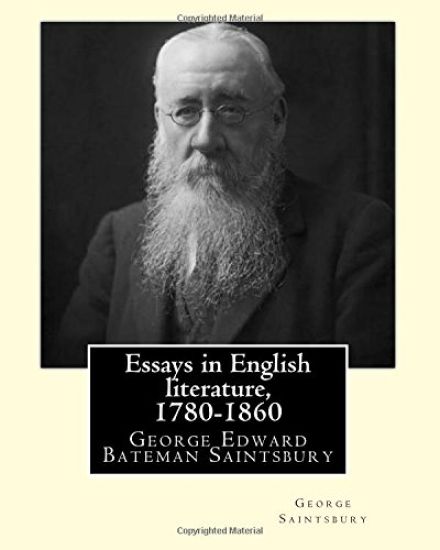
Essays in English literature, 1780-1860 By: George Saintsbury: George Edward Bateman Saintsbury ( 23 October 1845 - 28 January 1933), was an English w
George Saintsbury
Createspace Independent Publishing Platform
2017
nidottu
George Edward Bateman Saintsbury ( 23 October 1845 - 28 January 1933), was an English writer, literary historian, scholar, critic and wine connoisseur. BIOGRAPHY: Born in Lottery Hall, Southampton, he was educated at King's College School, London, and at Merton College, Oxford where he achieved a first class BA degree in Classical Mods, (1865), and a second class in literae humaniores (1867). He left Oxford in 1868 having failed to obtain a fellowship, and briefly became a master at the Manchester Grammar School, before spending six years in Guernsey as senior classical master of Elizabeth College, where he began his literary career by submitting his first reviews to The Academy. From 1874 until he returned to London in 1876 he was headmaster of the Elgin Educational Institute, with a brief period in 1877 on the Manchester Guardian. For ten years he was actively engaged in journalism, becoming an important member of the staff of the Saturday Review. Some of the critical essays contributed to the literary journals were afterwards collected in his Essays in English Literature, 1780-1860 (2 vols., 1890-1895), Essays on French Novelists (1891), Miscellaneous Essays (1892), and Corrected Impressions (1895). In 1895 he became professor of rhetoric and English literature at the University of Edinburgh, a position he held until 1915. He retired to 1A Royal Crescent, Bath, Somerset and died there in 1933. 1] 1A Royal Crescent was the subject of a restoration and renovation programme by the Bath Preservation Trust during 2012 to reincorporate it into 1 Royal Crescent, of which it was the original servants' quarters. It opened to visitors for the first time in 2013. An exhibition celebrating Saintsbury's life was mounted in the house in 2014........ Robert Southey (12 August 1774 - 21 March 1843) was an English poet of the Romantic school, one of the so-called "Lake Poets", and Poet Laureate for 30 years from 1813 until his death in 1843. Although his fame has long been eclipsed by that of his contemporaries and friends William Wordsworth and Samuel Taylor Coleridge, Southey's verse still enjoys some popularity. Southey was also a prolific letter writer, literary scholar, essay writer, historian and biographer. His biographies include the life and works of John Bunyan, John Wesley, William Cowper, Oliver Cromwell and Horatio Nelson. The last has rarely been out of print since its publication in 1813 and was adapted for the screen in the 1926 British film, Nelson. He was also a renowned scholar of Portuguese and Spanish literature and history, translating a number of works from those two languages into English and writing a History of Brazil (part of his planned History of Portugal, which he never completed) and a History of the Peninsular War. Perhaps his most enduring contribution to literary history is the children's classic The Story of the Three Bears, the original Goldilocks story, first published in Southey's prose collection The Doctor. He also wrote on political issues, which led to a brief, non-sitting, spell as a Tory Member of Parliament.....ect............
Selections From Defoe's Minor Novels - Edited by George Saintsbury is an unchanged, high-quality reprint of the original edition of 1892. Hansebooks is editor of the literature on different topic areas such as research and science, travel and expeditions, cooking and nutrition, medicine, and other genres. As a publisher we focus on the preservation of historical literature. Many works of historical writers and scientists are available today as antiques only. Hansebooks newly publishes these books and contributes to the preservation of literature which has become rare and historical knowledge for the future.
French Lyrics - Selected and Annotated by George Saintsbury is an unchanged, high-quality reprint of the original edition of 1888. Hansebooks is editor of the literature on different topic areas such as research and science, travel and expeditions, cooking and nutrition, medicine, and other genres. As a publisher we focus on the preservation of historical literature. Many works of historical writers and scientists are available today as antiques only. Hansebooks newly publishes these books and contributes to the preservation of literature which has become rare and historical knowledge for the future.
French Lyrics is an unchanged, high-quality reprint of the original edition of 1888. Hansebooks is editor of the literature on different topic areas such as research and science, travel and expeditions, cooking and nutrition, medicine, and other genres. As a publisher we focus on the preservation of historical literature. Many works of historical writers and scientists are available today as antiques only. Hansebooks newly publishes these books and contributes to the preservation of literature which has become rare and historical knowledge for the future.
Seventeenth Century Lyrics is an unchanged, high-quality reprint of the original edition of 1892. Hansebooks is editor of the literature on different topic areas such as research and science, travel and expeditions, cooking and nutrition, medicine, and other genres. As a publisher we focus on the preservation of historical literature. Many works of historical writers and scientists are available today as antiques only. Hansebooks newly publishes these books and contributes to the preservation of literature which has become rare and historical knowledge for the future.
The Letters, Sermons and Miscellaneous Writings of Laurence Sterne
Laurence Sterne; George Saintsbury
Hansebooks
2017
pokkari
The Grouse - Natural History is an unchanged, high-quality reprint of the original edition of 1894. Hansebooks is editor of the literature on different topic areas such as research and science, travel and expeditions, cooking and nutrition, medicine, and other genres. As a publisher we focus on the preservation of historical literature. Many works of historical writers and scientists are available today as antiques only. Hansebooks newly publishes these books and contributes to the preservation of literature which has become rare and historical knowledge for the future.
The Letters, Sermons and Miscellaneous Writings of Laurence Sterne
Laurence Sterne; George Saintsbury
Hansebooks
2017
pokkari
A Short History of French Literature
George Saintsbury
Createspace Independent Publishing Platform
2017
nidottu
An attempt to present to students a succinct history of the course of French literature compiled from an examination of that literature itself, and not merely from previous accounts of it is, I believe, a new one in English. There will be observed in the parts of this Short History a considerable difference of method; and as such a difference is not usual in works of the kind, it may be well to state the reasons which have induced me to adopt it. Early French literature is to a great extent anonymous. Moreover, even where it is not, the authors were usually more influenced by certain prevalent styles or forms than by anything else. Into these forms they threw without considerations of congruity whatever they had to say. Nothing, for instance, can be less suitable for historical or scientific disquisition than the octosyllabic metre of a satiric poem. But Jean de Meung and one at least of the authors of Renart le Contrefait 1] do not think of composing prose diatribes. At one moment and place the form of the Chanson de Geste is all-absorbing, at another the form of the Roman d'Aventures, at another the form of the Fabliau. In Book I. I shall therefore proceed by these forms, giving an account of each separately. After Villon the case changes. Instead of classes of chroniclers, trouv res, jongleurs, we get individual authors of eminence and individuality striking out their own way and saying their own say in the manner not that is fashionable but that seems best to them. During this time, therefore, and especially during that brilliant age of French literature, the sixteenth century, I shall proceed by authors, taking the most remarkable individually, and grouping their followers around them.
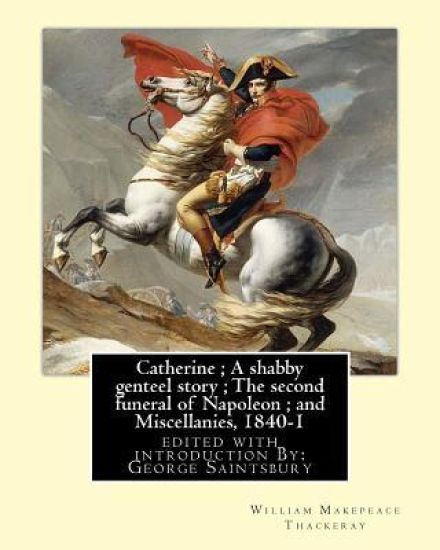
Catherine; A shabby genteel story; The second funeral of Napoleon; and Miscellanies, 1840-1: By: William Makepeace Thackeray, edited with introduction
George Saintsbury; William Makepeace Thackeray
Createspace Independent Publishing Platform
2016
nidottu
William Makepeace Thackeray ( 18 July 1811 - 24 December 1863) was an English novelist of the 19th century. He is famous for his satirical works, particularly Vanity Fair, a panoramic portrait of English society. Thackeray, an only child, was born in Calcutta, British India, where his father, Richmond Thackeray (1 September 1781 - 13 September 1815), was secretary to the Board of Revenue in the British East India Company. His mother, Anne Becher (1792-1864), was the second daughter of Harriet Becher and John Harman Becher, who was also a secretary (writer) for the East India Company. Richmond died in 1815, which caused Anne to send her son to England in 1816, while she remained in British India. The ship on which he travelled made a short stopover at St. Helena, where the imprisoned Napoleon was pointed out to him. Once in England he was educated at schools in Southampton and Chiswick, and then at Charterhouse School, where he became a close friend of John Leech. Thackeray disliked Charterhouse, and parodied it in his fiction as "Slaughterhouse". Nevertheless, Thackeray was honoured in the Charterhouse Chapel with a monument after his death. Illness in his last year there, during which he reportedly grew to his full height of six foot three, postponed his matriculation at Trinity College, Cambridge, until February 1829. Never too keen on academic studies, Thackeray left Cambridge in 1830, but some of his earliest published writing appeared in two university periodicals, The Snob and The Gownsman. Thackeray then travelled for some time on the continent, visiting Paris and Weimar, where he met Goethe. He returned to England and began to study law at the Middle Temple, but soon gave that up. On reaching the age of 21 he came into his inheritance from his father, but he squandered much of it on gambling and on funding two unsuccessful newspapers, The National Standard and The Constitutional, for which he had hoped to write. He also lost a good part of his fortune in the collapse of two Indian banks. Forced to consider a profession to support himself, he turned first to art, which he studied in Paris, but did not pursue it, except in later years as the illustrator of some of his own novels and other writings. Thackeray's years of semi-idleness ended after he married, on 20 August 1836, Isabella Gethin Shawe (1816-1893), second daughter of Isabella Creagh Shawe and Matthew Shawe, a colonel who had died after distinguished service, primarily in India. The Thackerays had three children, all girls: Anne Isabella (1837-1919), Jane (who died at eight months old) and Harriet Marian (1840-1875), who married Sir Leslie Stephen, editor, biographer and philosopher. Thackeray now began "writing for his life", as he put it, turning to journalism in an effort to support his young family. He primarily worked for Fraser's Magazine, a sharp-witted and sharp-tongued conservative publication for which he produced art criticism, short fictional sketches, and two longer fictional works, Catherine and The Luck of Barry Lyndon. Between 1837 and 1840 he also reviewed books for The Times. 4] He was also a regular contributor to The Morning Chronicle and The Foreign Quarterly Review. Later, through his connection to the illustrator John Leech, he began writing for the newly created magazine Punch, in which he published The Snob Papers, later collected as The Book of Snobs. This work popularised the modern meaning of the word "snob". Thackeray was a regular contributor to Punch between 1843 and 1854. George Edward Bateman Saintsbury ( 23 October 1845 - 28 January 1933), was an English writer, literary historian, scholar, critic and wine connoisseur.
Miscellanies; Volume 1
Henry Fielding; George Saintsbury; Herbert Railton
Creative Media Partners, LLC
2016
sidottu