Kirjojen hintavertailu – 12 876 364 kirjaa ja 26 kauppaa

Kirjailija

George Siedel

Kirjat ja teokset yhdessä paikassa: 9 kirjaa, julkaisuja vuosilta 2010–2024, suosituimpiin kuuluu Michigan Ross School of Business. Vertaile teosten hintoja ja tarkista saatavuus suomalaisista kirjakaupoista.

9 kirjaa

Kirjojen julkaisuvuodet: 2010–2024.

Michigan Ross School of Business

Michigan Ross School of Business

George Siedel

Van Rye Publishing, LLC
2024
pokkari
ABOUT THE BOOKHow did a new business school with twenty-two students in 1924 evolve into a world-class leader in management education a century later? Who were the school's legendary faculty members who revolutionized the accounting profession, influenced public policy decisions by US presidents, created the vocabulary that shapes business strategy, and more? What role does the school's location within a world-renowned university and a popular college town play in the school's success? These and other questions are answered as Professor George Siedel presents the history and stories that reveal the commitment of the University of Michigan Ross School of Business to building a better world through business. This book is a must-read for prospective and current U of M and Ross students, alumni, and faculty; business executives and entrepreneurs; university and business school leaders; and members of the Ann Arbor community. PRAISE FOR THE BOOK"Fascinating history, engaging stories, excellent writing by a great professor " -B. Joseph White, President Emeritus, University of Illinois and Dean Emeritus, University of Michigan"A necessary read not just for those interested in the history of Michigan Ross but also for those seeking to develop an understanding of how great institutions are built." -Gautam Ahuja, Eleanora and George Landew Professor of Management, Cornell University"I hope that others will find inspiration here to aim high in their work and, so doing, fill the pages of another book like this in 50 or 100 years." -Jim Walsh, Gerald and Esther Carey Professor of Business Administration, University of Michigan, and Past President, Academy of Management"With meticulous research and gifted storytelling, Siedel evokes the majesty of Michigan Ross and distills the ingredients of its success." -Leigh Anenson, Professor, University of Maryland and Past-President, Academy of Legal Studies in Business"An amazing contribution both to Ross and to the University; I stayed up most of the night reading the book and could not put it down." -William Hall, Chicago-based entrepreneur and former Professor, University of Michigan"George Siedel details the century-long history of this remarkable, magnificent institution with grace, fidelity and, yes, even love." -Tim Fort, Eveleigh Professor of Business Ethics, Indiana University"Siedel masterfully chronicles Ross's founding and evolution while explaining how its faculty, administrators, and alumni have fulfilled the school's enduring mission of building a better world through business." -Tom Highley, Managing Partner, Cordis Capital Partners"Reading this book has been a tremendous educational journey for me." -Brian Wu, Robert G. Rodkey Professor of Business Administration, University of Michigan"A delightful book honoring the school's 100th anniversary." -Frank Wilhelme, former Assistant Dean of Development and Alumni Relations, Michigan Ross School of Business"What a tour de force " -Dennis Severance, Accenture Professor of Computer and Information Systems Emeritus, University of MichiganABOUT THE AUTHORGEORGE J. SIEDEL is the Williamson Family Professor Emeritus of Business Administration and the Thurnau Professor Emeritus of Business Law at the University of Michigan. Professor Siedel was a Visiting Professor at Harvard University and Stanford University, a Visiting Scholar at Berkeley, and a Visiting Fellow at Cambridge University. As a Fulbright Scholar, he held a Distinguished Chair in the Humanities and Social Sciences. Professor Siedel has received many research and teaching awards and is the author of the best-selling books Negotiating for Success: Essential Strategy and Skills and The Three-Pillar Model for Business Decisions: Strategy, Law, and Ethics.
Proactive Law for Managers

Proactive Law for Managers

George Siedel; Helena Haapio

TAYLOR FRANCIS LTD
2024
nidottu
Savvy managers no longer look at contracts and the law reactively but use them proactively to reduce their costs, minimize their risks, secure key talent, collaborate to innovate, protect intellectual property, and create value for their customers that is superior to that offered by competitors. To achieve competitive advantage in this way managers need a plan. Proactive Law for Managers provides this plan; The Manager's Legal PlanTM. George Siedel and Helena Haapio first discuss the traditional, reactive approach used by many managers when confronted with the law, then contrast it with a proactive approach that enables the law and managers' legal capabilities to be used to prevent problems, promote successful business, and achieve competitive advantage. Proactive Law for Managers shows how to use contracts and the law to create new value and innovate in often neglected areas - and implement ideas in a profitable manner.
Seven Essentials for Business Success

Seven Essentials for Business Success

George Siedel

Taylor Francis Ltd
2021
nidottu
Successful leaders are great teachers, and successful teachers serve as models of leadership. This book enables both leaders and teachers to understand and use the best practices developed by award-winning professors, each of whom teaches one of the seven areas that are essential for business success. These professors candidly discuss their successes and failures in the classroom, the mentors who inspired them, how they developed their teaching methods, and their rigorous preparation for class. Through descriptions of the professors in action, readers will gain an insider’s perspective on their teaching skills, and witness how they teach the seven essentials for success in a variety of settings—MBA, Executive MBA, and executive education courses. The chapters also describe the daily lives (professional and personal) of the professors, and the impact they have beyond the classroom in improving organizations and society. If you are a leader or teacher—or if you are interested in the content of a business school education—this book provides an insider’s perspective on the best practices used by legendary professors when teaching the seven essentials that represent the core body of knowledge for business success.
Seven Essentials for Business Success

Seven Essentials for Business Success

George Siedel

Taylor Francis Ltd
2021
sidottu
Successful leaders are great teachers, and successful teachers serve as models of leadership. This book enables both leaders and teachers to understand and use the best practices developed by award-winning professors, each of whom teaches one of the seven areas that are essential for business success. These professors candidly discuss their successes and failures in the classroom, the mentors who inspired them, how they developed their teaching methods, and their rigorous preparation for class. Through descriptions of the professors in action, readers will gain an insider’s perspective on their teaching skills, and witness how they teach the seven essentials for success in a variety of settings—MBA, Executive MBA, and executive education courses. The chapters also describe the daily lives (professional and personal) of the professors, and the impact they have beyond the classroom in improving organizations and society. If you are a leader or teacher—or if you are interested in the content of a business school education—this book provides an insider’s perspective on the best practices used by legendary professors when teaching the seven essentials that represent the core body of knowledge for business success.
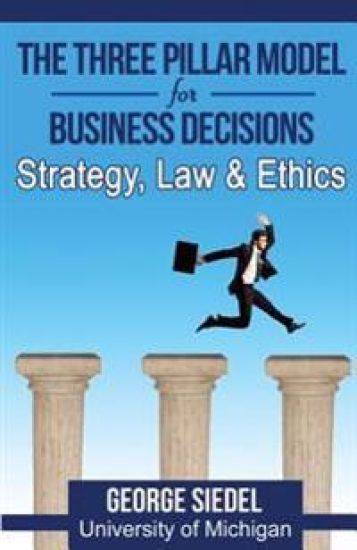
The Three Pillar Model for Business Decisions

The Three Pillar Model for Business Decisions

George Siedel

Van Rye Publishing, LLC
2016
pokkari
Your friend decides to order a pizza. President Obama decides to authorize the mission that leads to the death of Osama bin Laden. You decide that your business should launch a new product. What do these decisions have in common? They all require using the Three Pillar model of decision making. Our personal, leadership, and business decisions are based on a Law Pillar, a Strategy Pillar, and an Ethics Pillar. The Three Pillar model originated in a leadership course that every Harvard MBA student takes before graduation. The Harvard course is based on three lenses of decision making: economics, law, and ethics. The Three Pillar model expands these lenses by replacing "economics" with "strategy." With this change, the model becomes a powerful tool for personal and leadership decisions, as well as for business decisions. This book takes you through four steps that enable you to use the Three Pillar model for business decisions: Step One: Become a legally savvy leader. This does not require memorization of legal rules. Instead, you should understand how the law works in practice. Various surveys have identified the key legal areas that every business leader should understand: product liability, employment law, government regulation, intellectual property, contracts, and dispute resolution. This book provides briefings on each area and shows how they impact your key stakeholders: customers, employees, government, and investors. Step Two: Become an effective risk manager. After your briefings on the law, you are now ready to focus on the Law Pillar. The Law Pillar emphasizes risk management. This book explains how to manage the legal risks that constitute the main threat to your business success. For example, the chapter on product liability will describe how to make strategic new product decisions, how to isolate product risks by creating subsidiaries, and how to design new products to minimize the risk of being sued for selling a defective product. Step Three: Align the Strategy Pillar with the Law Pillar to create value. Many leaders think that there is an inherent tension between the Strategy Pillar, with its value creation orientation, and the Law Pillar, with its risk management orientation. This book explains how you can overcome this tension and align the two pillars by focusing on the interests of each of your stakeholders. For example, by focusing on customer interests, a process designed to prevent product liability can be transformed into a powerful product development tool. Step Four: Develop an ethical organization. Understanding the Ethics Pillar of decision making enables you to play a leadership role in developing compliance and values standards for your organization. This role requires that you "walk the talk" by using a principled process for making ethical decisions. By combining the Ethics Pillar with the Law Pillar and the Strategy Pillar, you can become a responsible corporate citizen while at the same time creating value for your shareholders and other stakeholders. Once you master the Three Pillar model for business decisions, you can easily apply the model to personal decisions and to leadership in any organization.
Négocier, la clé du succès

Négocier, la clé du succès

George Siedel

Van Rye Publishing, LLC
2015
pokkari
Nous n gocions tous au quotidien. Nous n gocions avec nos conjoints, nos enfants, nos parents et nos amis. Nous n gocions lorsque nous louons un appartement, achetons une voiture, faisons l'acquisition d'une maison ou encore postulons un emploi. Votre capacit n gocier pourrait bien tre le facteur le plus important dans l'avancement de votre carri re. La n gociation est aussi la cl de la r ussite en affaires. Aucune organisation ne peut survivre sans contrats rentables. D'un point de vue strat gique, les soci t s cherchent cr er de la valeur et repr senter un avantage comp titif. Mais le succ s de ces strat gies commerciales de haut vol d pend des contrats pass s avec les fournisseurs, les clients et autres parties prenantes. La capacit passer des contrats - la facult de n gocier et de conclure des contrats r ussis - est la fonction la plus importante de toute organisation. Avec ce livre, je souhaite vous aider atteindre le succ s dans vos n gociations personnelles et dans vos transactions d'affaires. Cet ouvrage est unique deux gards. D'abord, il ne traite pas uniquement des concepts de n gociation, mais vous fournit galement des actions pratiques entreprendre dans vos n gociations futures. Il comprend une liste de v rification pour planifier vos n gociations. Le livre inclut aussi (1) un outil que vous pouvez utiliser pour valuer votre style de n gociation; (2) des exemples d' arbres de d cision, qui sont utiles pour calculer vos solutions alternatives dans le cas de n gociations infructueuses; (3) une strat gie en trois parties visant augmenter votre pouvoir au cours des n gociations; (4) un plan pratique pour analyser vos n gociations, en fonction de votre prix de r serve, de votre objectif tendu, de votre cible vraisemblable et de votre zone d'accord possible; (5) des consignes claires sur les normes thiques appliquer aux n gociations; (6) des facteurs prendre en compte lorsque vous d cidez si vous devez passer par un interm diaire pour n gocier; (7) des outils psychologiques employer en n gociation - et les pi ges viter lorsque c'est l'autre partie qui les utilise; (8) des l ments cl s du droit des contrats qui interviennent au cours des n gociations; et (9) une liste de facteurs utiliser lorsque vous valuez votre performance de n gociateur. Par ailleurs, le livre est unique par son approche holistique du processus de n gociation. D'autres livres se concentrent exclusivement sur la n gociation ou le droit des contrats. De plus, les ouvrages sur la n gociation ont tendance cibler ce qui se produit autour de la table des n gociations, sans traiter de la conclusion de l'entente. Ces livres partent du principe erron que l'on d termine le succ s en valuant la n gociation plut t que la mise en oeuvre de l'accord. De m me, les ouvrages sur le droit des contrats tendent se concentrer sur les exigences l gales n cessaires pour qu'un contrat soit valide, ne donnant ainsi que peu de place au processus de n gociation qui pr c de le contrat et l'ex cution qui suit. Dans le monde r el, le processus contractuel n'est pas divis en phases distinctes. Ce qui se passe au cours d'une n gociation a un impact profond sur le contrat et la mise en oeuvre qui suit. Le contenu juridique du contrat doit refl ter les r alit s de ce qui a lieu la table de n gociation, ainsi que la r alisation qui s'ensuit. Ce livre, contrairement aux autres, traite de l'int gralit du processus de n gociation par ordre chronologique, en commen ant par votre d cision de n gocier et en continuant jusqu' l' valuation de votre performance en tant que n gociateur.
Negociar, ruta hacia el éxito

Negociar, ruta hacia el éxito

George Siedel

Van Rye Publishing, LLC
2015
pokkari
Todos negociamos de manera diaria. Negociamos con nuestras esposas, hijos, padres y amigos. Negociamos cuando alquilamos un departamento, compramos un coche o aplicamos a un puesto de trabajo. Tu habilidad para negociar deber a ser el factor m s importante en tu carrera. La negociaci n adem s es clave para el xito de los negocios. Ninguna organizaci n puede sobrevivir sin contratos que generen ganancias. A un nivel estrat gico, los negocios est n estrechamente vinculados con la creaci n de valor y la consiguiente consecuci n de ventajas competitivas. Pero el xito de las estrategias comerciales de alto vuelo depender de los contratos celebrados con proveedores, clientes y socios comerciales. La capacidad de contrataci n, esto es la habilidad de negociar y lograr contratos exitosos, es la funci n m s importante de toda organizaci n. Este libro ha sido concebido para ayudarte a alcanzar resultados exitosos en tus negociaciones personales y en tus transacciones comerciales. Es nico desde dos perspectivas: por un lado, no s lo cubre conceptos de negociaci n, sino que tambi n proporciona acciones pr cticas a seguir en futuras negociaciones, incluyendo una lista de chequeo para la planificaci n de la negociaci n y un ejemplo pr ctico de esa lista de chequeo completa. Tambi n incorpora: (1) una herramienta de evaluaci n de tu estilo personal; (2) ejemplos de " rboles de decisi n", tiles para calcular tus alternativas en caso de frustraci n de la negociaci n; (3) una estrategia de tres etapas para incrementar tu poder durante la negociaci n: (4) un plan pr ctico para analizar tus negociaciones en consideraci n a distintas variables, entre ellas tu precio de reserva y zona de probable acuerdo, entre otros; (5) lineamientos claros en est ndares ticos aplicables a la negociaci n; (6) factores a considerar al decidir si deber as negociar a trav s de un agente; (7) herramientas psicol gicas que puedes utilizar, y modos para eludirlas si las plantea la otra parte; (8) elementos esenciales del Derecho Contractual; y (9) una lista de chequeo de factores a utilizar cuando evaluas tu desempe o como negociador. En segundo t rmino, el libro es nico en cuando propone un enfoque global y general para todo el proceso de la negociaci n. Otras obras se focalizan sea en la negociaci n, o bien en el Derecho Contractual, concentr ndose en este ltimo caso, en cuestiones y requisitos espec ficos desde el punto de vista legal para que un contrato sea v lido, sin considerar otros aspectos. En el mundo en que vivimos, el proceso de contrataci n no puede ser desmenuzado en fases o compartimentos estancos. Lo que ocurre durante una negociaci n tiene un impacto profundo en el contrato y en el desempe o consiguiente. El contenido legal del contrato deber a reflejar lo que sucedi en el marco de la negociaci n. Este libro, a diferencia de otros, cubre ntegramente el proceso de negociaci n en orden cronol gico, comenzando con tu decisi n de negociar, continuando con la evaluaci n de tu propio desempe o como negociador.
Negotiating for Success

Negotiating for Success

George Siedel

Van Rye Publishing, LLC
2014
pokkari
We all negotiate on a daily basis. We negotiate with our spouses, children, parents, and friends. We negotiate when we rent an apartment, buy a car, purchase a house, and apply for a job. Your ability to negotiate might even be the most important factor in your career advancement. Negotiation is also the key to business success. No organization can survive without contracts that produce profits. At a strategic level, businesses are concerned with value creation and achieving competitive advantage. But the success of high-level business strategies depends on contracts made with suppliers, customers, and other stakeholders. Contracting capability-the ability to negotiate and perform successful contracts-is the most important function in any organization. This book is designed to help you achieve success in your personal negotiations and in your business transactions. The book is unique in two ways. First, the book not only covers negotiation concepts, but also provides practical actions you can take in future negotiations. This includes a Negotiation Planning Checklist and a completed example of the checklist for your use in future negotiations. The book also includes (1) a tool you can use to assess your negotiation style; (2) examples of "decision trees," which are useful in calculating your alternatives if your negotiation is unsuccessful; (3) a three-part strategy for increasing your power during negotiations; (4) a practical plan for analyzing your negotiations based on your reservation price, stretch goal, most-likely target, and zone of potential agreement; (5) clear guidelines on ethical standards that apply to negotiations; (6) factors to consider when deciding whether you should negotiate through an agent; (7) psychological tools you can use in negotiations-and traps to avoid when the other side uses them; (8) key elements of contract law that arise during negotiations; and (9) a checklist of factors to use when you evaluate your performance as a negotiator. Second, the book is unique in its holistic approach to the negotiation process. Other books often focus narrowly either on negotiation or on contract law. Furthermore, the books on negotiation tend to focus on what happens at the bargaining table without addressing the performance of an agreement. These books make the mistaken assumption that success is determined by evaluating the negotiation rather than evaluating performance of the agreement. Similarly, the books on contract law tend to focus on the legal requirements for a contract to be valid, thus giving short shrift to the negotiation process that precedes the contract and to the performance that follows. In the real world, the contracting process is not divided into independent phases. What happens during a negotiation has a profound impact on the contract and on the performance that follows. The contract's legal content should reflect the realities of what happened at the bargaining table and the performance that is to follow. This book, in contrast to others, covers the entire negotiation process in chronological order beginning with your decision to negotiate and continuing through the evaluation of your performance as a negotiator. A business executive in one of the negotiation seminars the author teaches as a University of Michigan professor summarized negotiation as follows: "Life is negotiation " No one ever stated it better. As a mother with young children and as a company leader, the executive realized that negotiations are pervasive in our personal and business lives. With its emphasis on practical action, and with its chronological, holistic approach, this book provides a roadmap you can use when navigating through your life as a negotiator.
Proactive Law for Managers

Proactive Law for Managers

George Siedel; Helena Haapio

Ashgate Publishing Limited
2010
sidottu
Savvy managers no longer look at contracts and the law reactively but use them proactively to reduce their costs, minimize their risks, secure key talent, collaborate to innovate, protect intellectual property, and create value for their customers that is superior to that offered by competitors. To achieve competitive advantage in this way managers need a plan. Proactive Law for Managers provides this plan; The Manager's Legal PlanTM. George Siedel and Helena Haapio first discuss the traditional, reactive approach used by many managers when confronted with the law, then contrast it with a proactive approach that enables the law and managers' legal capabilities to be used to prevent problems, promote successful business, and achieve competitive advantage. Proactive Law for Managers shows how to use contracts and the law to create new value and innovate in often neglected areas - and implement ideas in a profitable manner.