
Kirjojen hintavertailu – 12 859 827 kirjaa ja 27 kauppaa

Kirjailija

George Yancy

Kirjat ja teokset yhdessä paikassa: 23 kirjaa, julkaisuja vuosilta 2005–2026, suosituimpiin kuuluu Until Our Lungs Give Out. Vertaile teosten hintoja ja tarkista saatavuus suomalaisista kirjakaupoista.

23 kirjaa

Kirjojen julkaisuvuodet: 2005–2026.

The Center Must Not Hold

The Center Must Not Hold

George Yancy

Lexington Books
2011
nidottu
The Center Must Not Hold: White Women Philosophers on the Whiteness of Philosophy functions as a textual site where white women philosophers engage boldly in critical acts of exploring ways of naming and disrupting whiteness in terms of how it has defined the conceptual field of philosophy. Within this text, white women philosophers critique the field of philosophy for its complicity with whiteness as a structure of power, as normative, and as hegemonic. In this way, the authority of whiteness to define what is philosophically worthy is seen as reinforcing forms of philosophical narcissism and hegemony. Challenging the whiteness of philosophy in terms of its hubristic tendencies, white women philosophers within this text assert their alliance with people of color who have been both marginalized within the field of philosophy and have had their philosophical and intellectual concerns and traditions dismissed as particularistic. Aware that feminist praxis does not necessarily lead to anti-racist praxis, the white women philosophers within this text refuse to telescope as a site of critical inquiry one site of hegemony (sexism) over another (racism). As such, the white women philosophers within this text are conscious of the ways in which they are implicated in perpetuating whiteness as a site of power within the domain of philosophy. Framed within a philosophical space that values the multiplicity of philosophical voices, and driven by a feminist framework that valorizes de-centering locations of hegemony, interdisciplinary dialogue, and transformative praxis, The Center Must Not Hold refuses to allow the white center of philosophy to masquerade as universal and given. The text de-centers various epistemic and value orders that are predicated upon maintaining the center of philosophy as white. The white women philosophers who contribute to this text explore ethics, epistemology, aesthetics, taste, the nature of a dilemma, questions of the secularity of philosophy, perception, discipline-based values around how to listen and argue, the crucial role that social location plays in the continued ignorance about the reality of oppression and privilege as these relate to the subtle forms of white valorization and maintenance, and more. Those interested in critical race theory and critical whiteness studies will appreciate how the contributors have linked these areas of critical inquiry within the often abstract domain of philosophy.
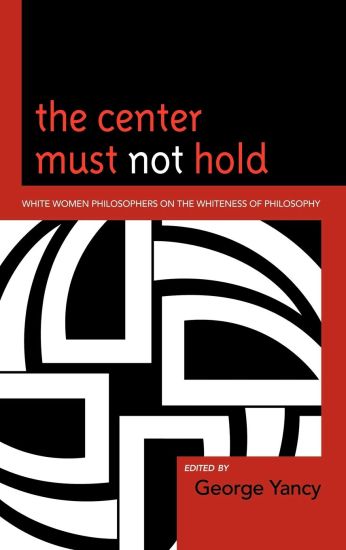
The Center Must Not Hold

The Center Must Not Hold

George Yancy

Lexington Books
2010
sidottu
The Center Must Not Hold: White Women Philosophers on the Whiteness of Philosophy functions as a textual site where white women philosophers engage boldly in critical acts of exploring ways of naming and disrupting whiteness in terms of how it has defined the conceptual field of philosophy. Within this text, white women philosophers critique the field of philosophy for its complicity with whiteness as a structure of power, as normative, and as hegemonic. In this way, the authority of whiteness to define what is philosophically worthy is seen as reinforcing forms of philosophical narcissism and hegemony. Challenging the whiteness of philosophy in terms of its hubristic tendencies, white women philosophers within this text assert their alliance with people of color who have been both marginalized within the field of philosophy and have had their philosophical and intellectual concerns and traditions dismissed as particularistic. Aware that feminist praxis does not necessarily lead to anti-racist praxis, the white women philosophers within this text refuse to telescope as a site of critical inquiry one site of hegemony (sexism) over another (racism). As such, the white women philosophers within this text are conscious of the ways in which they are implicated in perpetuating whiteness as a site of power within the domain of philosophy. Framed within a philosophical space that values the multiplicity of philosophical voices, and driven by a feminist framework that valorizes de-centering locations of hegemony, interdisciplinary dialogue, and transformative praxis, The Center Must Not Hold refuses to allow the white center of philosophy to masquerade as universal and given. The text de-centers various epistemic and value orders that are predicated upon maintaining the center of philosophy as white. The white women philosophers who contribute to this text explore ethics, epistemology, aesthetics, taste, the nature of a dilemma, questions of the secularity of philosophy, perception, discipline-based
Narrative Identities

Narrative Identities

George Yancy; Susan Hadley

Jessica Kingsley Publishers
2005
sidottu
" I can imagine that convincing psychologists to put pen to paper to construct narratives of their own lives, revealing stories about significant influences in their personal and professional identities was no easy feat. Yancy and Hadley have done just this, and their edited book offers a fascinating way to gain greater insight into the theoretical ideas of key psychologists through their self-construction."- Psychologist`…There is much to be inspired by, to reflect upon, to learn from, and to understand from a thorough reading of this book.' - Nordic Journal of Music Therapy`A collection of papers in which psychologists from assorted theoretical orientations take part in an exercise to discover how they came to be the `particular epistemic agents they have become'. Narrative, social constructionist, feminist, postmodernist, poststructuralist, hermeneutic, existential, phenomenological, humanistic, critical, psychoanalytic, performative, social therapeutic - they are all here.'- Journal of Analytical Psychology`Thirteen leading psychologists offer personal reflections on their professional identities within the context of their larger social lives. Their conceptions of self hood are examined through the lens of the theoretical presuppositions used in their daily work. These include narrative, feminist, social constructionist, postmodernist, hermeneutic, critical, poststructuralist, humanistic, and psychoanalytical therapeutic approaches'. - Book News`What a fascinating and illuminating work! Yancy and Hadley have succeeded in stimulating a group of accomplished narratologists in psychology…to deliberate on the ways in which their life experiences are related to their scholarly explorations of narrative. The authors…grace us with illuminating and articulate insights into the close linkages between personal and intellectual development.'- Ken Gergen, Mustin Professor of Psychology, Swarthmore College, Pennsylvania, and Mary Gergen, Professor of Psychology & Women's Studies,Penn State University, Delaware`I found Yancy and Hadley's collection of intellectual autobiographies a rich source for understanding and insight into the lives and innovations of the psychologists who are leading the development of the new approaches in psychology.'- Donald E. Polkinghorne, PhD, Attallah Chair of Humanistic Psychology, University of Southern CaliforniaIn this thoughtful collection, thirteen eminent psychologists from diverse schools of thought - including social constructionism, narrative psychology, feminism, phenomenology and psychoanalysis - examine their professional identities in the context of their personal biographies. The contributors address challenging questions about identity in relation to personality development, language and socialisation. They demonstrate how their cultural and historical contexts influenced their theoretical approaches to the nature of `self' and how these ideas in turn shaped how they perceive their personal histories. This unique insight into the lives of highly influential psychologists is a valuable reference and compelling reading for psychologists reflecting on their professional practice, and for anyone investigating issues of selfhood and identity from a psychological or philosophical perspective.